Measure a numerical discrepancy as a fraction of its reference, compare proportional accuracy across price scales, and recognise the zero-reference limit.
Relative error
Relative error is the absolute difference between an approximation and a specified nonzero reference, divided by the magnitude of that reference. It tells a quant how large a pricing discrepancy is in proportion to the price being approximated.
For reference x=0 and approximation x^,
Erel=∣x∣∣x^−x∣.
The numerator is absolute error. Dividing quantities with the same units makes relative error dimensionless. Multiply the ratio by 100 to report it as a percentage. This convention discards direction: an underestimate and an equally distant overestimate have the same relative error. Use the signed difference x^−x alongside it when direction matters.
Two prices, two denominators
Consider two synthetic claims with stipulated model reference prices. A fast approximation undervalues both:
Claim
Reference
Approximation
Absolute error
Relative error
Higher-price claim
USD 100
USD 99.8
USD 0.2
0.2%
Low-price claim
USD 0.01
USD 0.0098
USD 0.0002
2%
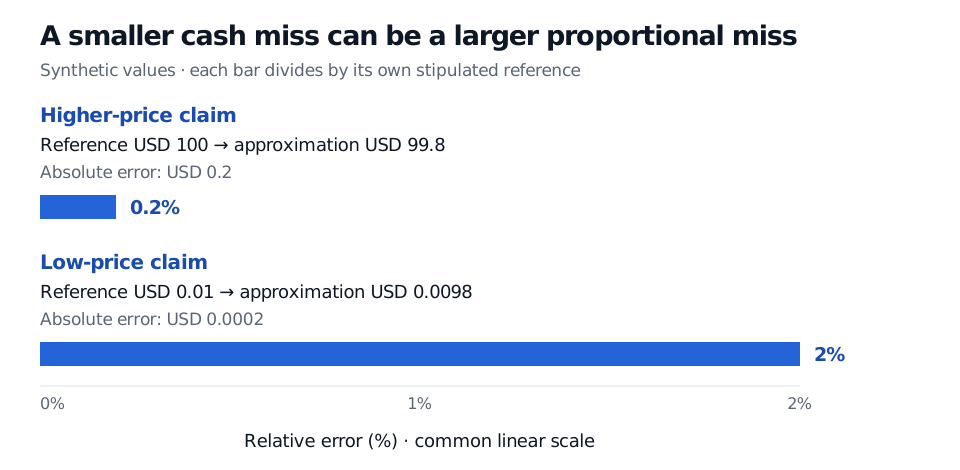
For the first claim, 0.2/100=0.002=0.2%. For the second, 0.0002/0.01=0.02=2%. The second cash discrepancy is 1,000 times smaller, yet its relative error is ten times larger. A convergence check concerned with proportional accuracy would rank it as worse.
Synthetic price comparisons: USD 100 versus 99.8 has absolute error USD 0.2 and relative error 0.2%; USD 0.01 versus 0.0098 has absolute error USD 0.0002 and relative error 2%.
Original synthetic example. Bars use a common percentage scale, while each percentage uses its own reference price as denominator.
That ranking is about proportional accuracy, not financial materiality. Position size, contract multiplier and the purpose of the calculation still determine whether the cash miss matters. A tiny option premium can carry a large percentage error while contributing little monetary error to a particular position. Report both measures when that distinction could change a decision.
Changing from dollars to cents cannot fix a relative error. The first comparison becomes 10,000 versus 9,980 cents: its absolute error is 20 cents and its relative error remains 0.2%. The second becomes 1 versus 0.98 cents, still 2%. Any common nonzero multiplicative unit conversion cancels between numerator and denominator.
The denominator is part of the claim
Use the reference magnitude, including for negative quantities such as a signed portfolio value. Substituting the approximation in the denominator produces a different statistic; name that convention if it is needed. Relative error is also asymmetric: swapping the reference and approximation generally changes the result.
At x=0, relative error is undefined, even if x^=0. An exact zero match has zero absolute error but would require the invalid ratio 0/0. Near zero, a small cash discrepancy can produce a very large relative error. For a value expected to cross zero, an absolute tolerance in meaningful units, or an explicitly defined scale for normalisation, can be more useful than a percentage criterion.
Finally, identify what the reference represents. The examples compare with stipulated model prices; they do not establish errors against an unknown true market value. Agreement with a numerical benchmark inherits that benchmark's limitations. Relative error alone supplies neither an uncertainty interval nor a guarantee of accuracy.
Input sensitivity and computational error are distinct questions. Numerical stability concerns the computation; conditioning concerns how the problem responds to input changes. SelfMadeQuant's Numerical Conditioning and Stability develops that distinction through hedge holdings and covariance calculations. The preview is public; the full lesson requires membership.