A value left unchanged by a function: why consistency, existence, uniqueness and convergence are separate questions in feedback models.
Fixed point
A fixed point of a functiong is an input x∗ that the function leaves unchanged:
g(x∗)=x∗.
In a financial model with feedback, this expresses consistency: the output implied by a proposed state equals that proposed state. It does not establish that such a state exists, that it is unique, or that repeatedly applying the model will find it.
A consistent value can repel an algorithm
Consider a synthetic, dimensionless feedback rule g(x)=10+0.8x, defined on the real line. The constant is an external contribution; the second term feeds back part of the current state. This is an arithmetic illustration, not an asset-pricing model or an estimated market relationship.
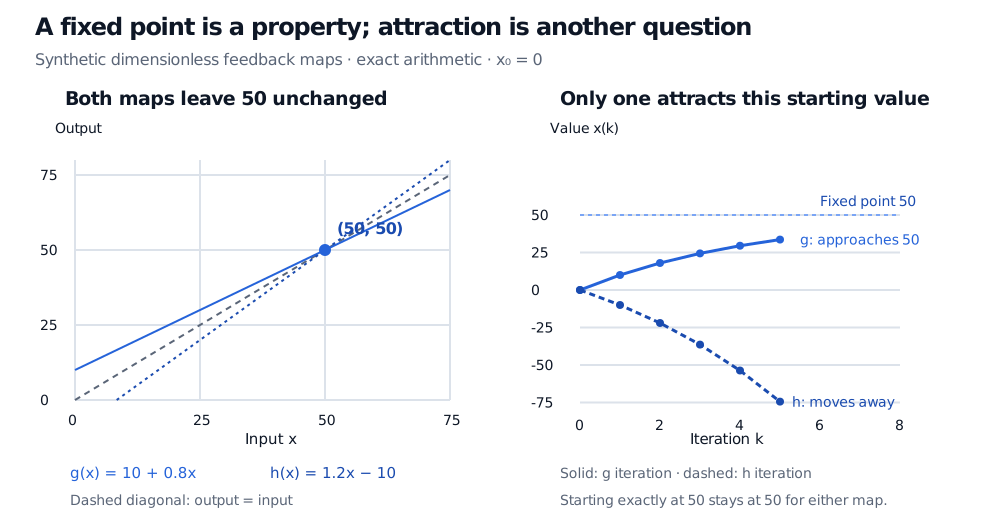
Each update retains 80% of the previous error. The iterates approach 50, although after four updates the distance is still 20.48.
Now change the rule to h(x)=1.2x−10. Its unique fixed point is also 50, but iteration from zero begins 0,−10,−22,…. Here
xk−50=−50(1.2)k,
so the distance grows. Starting exactly at 50 stays there for either rule. Having the right fixed point is therefore insufficient to make a useful solver.
Both synthetic maps intersect the diagonal at (50,50). From zero, g gives 0,10,18,24.4,29.52 and approaches 50; h gives 0,minus 10,minus 22 and moves away.
Original synthetic illustration. Left: equality of input and output identifies a fixed point. Right: iteration tests attraction; both maps have the same fixed point.
The domain and the guarantee
The domain is part of the problem. The map g(x)=x/2 has fixed point zero on the real line, but none on (0,∞). Positive iterates tend to zero without reaching a fixed point inside that domain. Other maps have no fixed points even on the real line, such as g(x)=x+1; the identity g(x)=x has every point fixed.
One sufficient guarantee is the contraction theorem. On a nonempty closed interval I, suppose g maps I into itself and, for some 0≤q<1,
∣g(x)−g(y)∣≤q∣x−y∣for all x,y∈I.
Then there is exactly one fixed point in I, and iteration from any point in I converges to it. The first example satisfies these conditions on [0,50] with q=0.8. These are sufficient conditions, not requirements every convergent method must satisfy.
Turning consistency into a root problem
The equation g(x)=x is equivalent to f(x)=g(x)−x=0, on the same domain. This opens the door to root-finding methods without committing to direct iteration of g. Different rearrangements of the same equation can produce very different convergence behavior, as the two affine rules demonstrate.
For the next computational step, Root-Finding and Numerical Integration develops bisection and Newton's method using bond yield as a root problem. The full lesson requires membership; a public preview is available. Before applying a solver to a financial feedback equation, specify its admissible domain, establish which solution is meaningful, and check the chosen method's convergence conditions.
Sources
T. A. Driscoll and R. J. Braun, Fundamentals of Numerical Computation, §4.2, Fixed-point iteration: fixed points, root reformulations and iterative behavior.
D. Bindel, Cornell CS 4220, Fixed point iteration and Newton, 27 March 2026: contraction assumptions, uniqueness and convergence.
J. Stewart, Single Variable Calculus: Early Transcendentals, 6th ed., Thomson Brooks/Cole, 2008, Chapter 2, Problems Plus, Problem 8; §4.2, Exercise 36: fixed-point definition, interval existence and uniqueness questions.