Understand a financial instrument as a contractual claim, distinguish debt, equity and derivatives, and separate contract terms from position size and current value.
Financial instrument
A financial instrument is a contractual arrangement that creates a financial asset for one party and a financial liability or equity for another. A bank loan, a bond, an ordinary share and an option all organise financial rights, but they organise them differently. For a quant, identifying those rights comes before choosing a pricing formula: the contract determines what can be received, what must be paid and when.
The term is broader than an exchange-traded security. A private loan can be a financial instrument even though it has no stock-exchange listing. Conversely, a valuable physical object is not a financial instrument merely because someone can sell it.
Start with the claim, not the ticker
Three common families answer different contractual questions:
Family
What does the holder have?
What must the analysis preserve?
Debt, such as a loan or bond
A claim to payments specified by the borrowing contract
Payment dates, interest terms, principal and what happens if the borrower fails to pay
Rights or obligations linked to an underlying price, rate or other reference
The payoff rule, exercise rights, settlement method and collateral terms where applicable
These are useful economic families rather than a complete accounting classification. A convertible bond, for example, combines debt payments with a conversion feature. The IFRS Foundation's IAS 32 overview explains why a compound instrument can require separate liability and equity components.
A derivative also need not promise a positive receipt. A forward can require its holder to pay, depending on how the underlying price moves. “Financial instrument” names the arrangement; “asset” or “liability” also depends on whose side is being considered.
One debt contract viewed from both sides
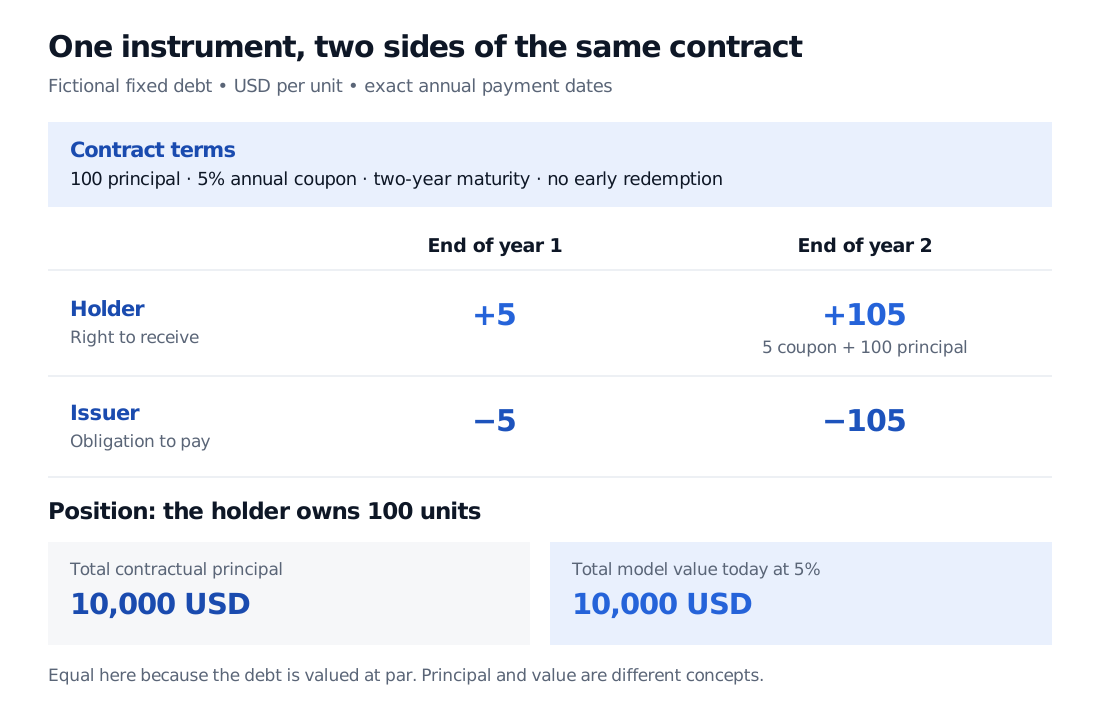
Consider a fictional, non-callable debt instrument denominated in USD. Each unit has 100 USD of face value, a 5% annual coupon, and exactly two years to maturity. Coupons are paid at the end of each year, and the principal is repaid with the final coupon. Assume all promised payments occur.
The holder has a right to receive 5 USD at year one and 105 USD at year two. The issuer has the corresponding obligations to pay those amounts. The final receipt contains a 5 USD coupon and the 100 USD principal; it is not a 105 USD coupon.
The same debt contract from both sides: the holder receives 5 USD after one year and 105 USD after two years; the issuer owes the matching payments. Owning 100 units gives 10,000 USD principal and, under the stated par assumptions, 10,000 USD model value.
Original synthetic example. The rows show future contractual cash flows, assuming full payment. The bottom panels distinguish total principal from today's model value; both happen to be 10,000 USD under the stated assumptions.
The promise is a feature of the instrument. The likelihood that the issuer fulfils it is a separate credit risk question. A contract can specify a fixed payment without making that payment certain.
Instrument, position and value are three different records
The instrument specifies the rights per unit. A position records who holds how many units. A valuation attaches a value at a date using market inputs and assumptions.
To isolate that distinction, discount the example's promised payments using a flat 5% annual effective rate. Use exact annual dates, no fees or taxes, and a simplified full-payment valuation:
V0=1.055+1.052105=100 USD per unit.
An independent way to check this result is to start with a 100 USD account earning 5% annually. After one year it holds 105 USD; withdraw the first 5 USD payment and 100 USD remains. After another year it again holds 105 USD, exactly enough for the final payment.
A holding of 100 units therefore has 10,000 USD contractual principal and 10,000 USD model value today. Those quantities coincide because this example is valued at par. If the discount rate rises while the promised payments stay the same, the model value falls; the contractual principal does not change. Principal is also not a general measure of potential loss across instruments. For derivatives, notional amount commonly scales payments and can differ greatly from current value.
The Time Value of Money primer develops the discount-factor step used here. Its public preview is open; the full lesson requires membership.
Formal definitions have a purpose and a boundary
The opening definition is a practical introduction. For IFRS accounting, IAS 32 uses a precise paired test: a contract gives one entity a financial asset and another entity a financial liability or equity instrument. HMRC's explanation of that definition includes loans and trade receivables/payables, illustrating why “financial instrument” is wider than the list of things quoted on an exchange.
An ordinary share is an asset to its investor and equity of its issuer; it is not automatically a debt obligation for that issuer. More complex contractual terms can change the accounting result. Regulatory and tax questions likewise require the definition in the applicable jurisdiction and rule, rather than assuming this economic grouping settles the classification.
For pricing work, first read the actual contract: parties, currency, payment or delivery rule, dates, contingencies and termination rights. A ticker is a label. Those terms specify the object being valued.
Frank J. Fabozzi and Francesco A. Fabozzi, Bond Markets, Analysis, and Strategies, 10th ed., MIT Press, 2021: Chapter 1, “Principal and Coupon Rate”; Chapter 2, “Present Value” and “Present Value of a Series of Future Values.” These sections support the debt cash-flow and discounting mechanics. The numerical contract above is original and fictional.