A discrete uniform distribution assigns the same probability to every value in a nonempty finite set. If a discrete random variable takes distinct values , its probability mass function is
The values need not be consecutive integers or equally spaced. Equal probabilities define uniformity here. A finite list of possible market scenarios does not make them equally likely; that requires a model assumption or a selection mechanism that delivers equal chances. Bertsekas and Tsitsiklis introduce this distinction through the discrete uniform probability law (§1.2).
Six audit buckets
A trading desk divides an order log into six labelled audit buckets and deliberately selects one bucket with probability each. Let be the selected bucket's index, from 1 to 6. This is a hypothetical randomised audit design, rather than a claim about how orders or returns naturally occur.
The event “select bucket 5 or 6” contains two of the six equally likely values:
More generally, if is the finite support and is a subset of it, then . This count-and-divide rule follows by adding for every selected value. It is the equal-chance assumption that makes counting sufficient.
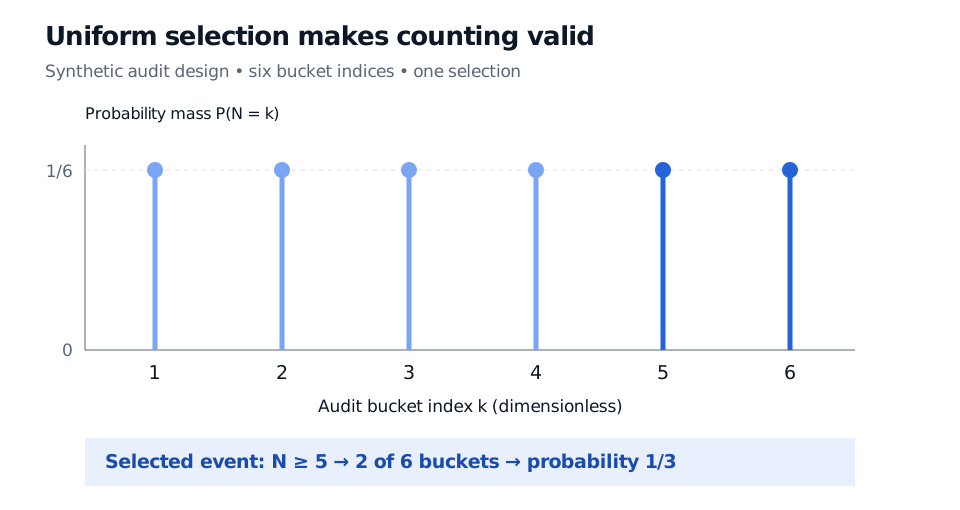
Original synthetic audit design: one bucket selected with equal probability. Filled points show probability masses, with the event highlighted.
Selecting buckets uniformly does not automatically select individual orders uniformly. If bucket sizes differ and one order is then picked uniformly within the selected bucket, an order in a smaller bucket has a larger overall selection probability. The unit being randomised matters.
Moments belong to the numerical values
For a uniform distribution on the consecutive integers , including both endpoints, the number of values is . Its expected value and variance are
For the audit index,
The mean is a weighted average; it need not be a possible outcome. No selection produces bucket 3.5. These moments describe the index, and the variance has squared-index units. They do not describe elapsed time, latency or P&L unless a numerical mapping to those quantities has been specified.
For arbitrary distinct support values, use their actual numbers:
The midpoint and consecutive-integer variance shortcuts require their stated support. They cannot be carried over to irregularly spaced values. MathWorks documents the special case with minimum 1 and maximum ; Siegrist treats general finite supports and equally spaced grids.
Transforming a uniform variable can also destroy uniformity. The indicator merges four bucket indices into zero and two into one, so and . Equal chances for the original values do not imply equal chances for grouped outcomes.
Discrete uniform versus continuous uniform
Here : an individual support point carries positive mass. Under a continuous uniform distribution, any single point has probability zero and interval probabilities depend on interval length. A flat PMF over six points and a flat density across an interval describe different probability laws.
For the counting foundations, continue with Counting and Combinatorics. For weighted averages and squared deviations, see Expectation, Mean, and Variance, including its uniform-integer example. Full lessons require membership; public previews show their scope.
Sources
- Dimitri P. Bertsekas and John N. Tsitsiklis, Introduction to Probability, 2nd edition, 2008, §1.2, “Discrete Uniform Probability Law,” and §2.4, Example 2.6.
- Kyle Siegrist, Random: Discrete Uniform Distributions — finite-set definition, moments and equally spaced supports.
- MathWorks: unidstat — Discrete uniform mean and variance — formulas for a uniform integer from 1 through the specified maximum.