A capitalisation rate, or cap rate, is a property's annual net operating income (NOI) divided by its purchase price or estimated market value. In commercial real estate, analysts use the ratio to compare how much property income each dollar of price buys. They also reverse the calculation to estimate a price from a representative year's income and a market cap rate. OCC, Commercial Real Estate Lending, Value Analysis and Appendix G
What goes into NOI?
Net operating income is the income generated by the property after operating expenses. Start with rent, tenant reimbursements and other property income, allowing for vacancy, rent concessions and collection losses as appropriate. Subtract expenses such as property taxes, insurance, management and routine maintenance. If the owner pays an expense and recovers it from a tenant, count both the bill and the recovery, or net them consistently. Under a triple-net lease, some costs may be paid directly by the tenant. The lease specifies who bears those costs. OCC handbook, Income-Generating Capacity of CRE and Appendix G, JBG SMITH Properties 2025 Form 10-K, Net Operating Income
The example below uses NOI before debt service, income taxes, depreciation, capital expenditure and replacement reserves. Property taxes are operating expenses under this convention. A different convention can deduct an allowance for recurring capital replacements when calculating the rate. Equity Residential, for example, deducts estimated management costs and in-unit replacement spending from its projected NOI for its acquisition cap rate. It generally starts with next-12-month income, but may use a later stabilised year for a property still filling vacancies. Equity Residential Q2 2026 supplement, Acquisition Capitalization Rate
From a sale price to a valuation
Suppose a fictional warehouse trades for USD 10 million and is expected to earn USD 600,000 of stabilised NOI over the next 12 months. Its forward entry cap rate is . If a similar warehouse has the same forward NOI and comparable sales support a 6% rate on that same income basis, direct capitalisation gives an estimated value of
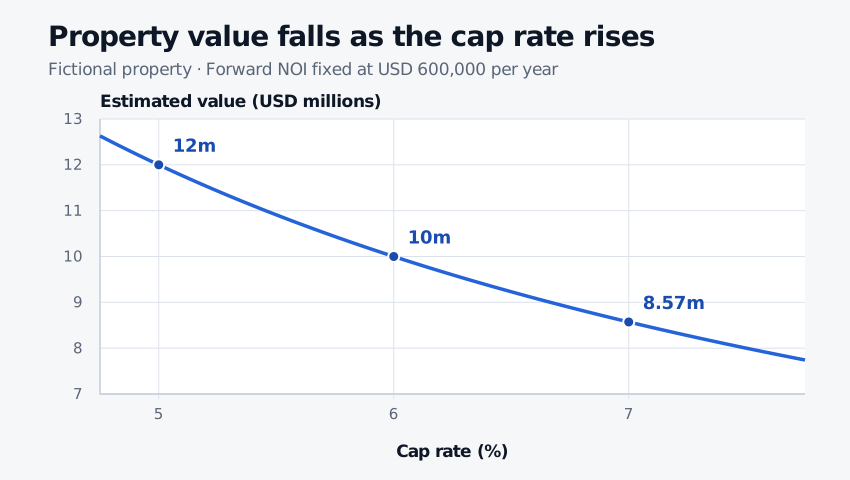
The same one-percentage-point move in either direction from 6% produces unequal changes in value because the cap rate is in the denominator.
Before borrowing a rate from a comparable sale, match the NOI period and accounting basis. Trailing rent and forward rent can differ after a renewal. One property's NOI can include a replacement allowance while another's excludes it. Then compare the economics of the leases, including expiry dates, tenant credit and unrecovered costs, as well as location, building condition and sale date. A cap rate from a fully occupied building can describe a stabilised valuation for a property in lease-up. An as-is valuation also needs to capture the time, missed rent and cost of reaching that occupancy. OCC handbook, Income-Generating Capacity of CRE and Value Analysis
A spread over a government bond yield can help put transaction cap rates in historical context. The Federal Reserve has tracked US purchase cap rates relative to the 10-year Treasury yield. The spread can widen just because the Treasury yield falls while property cap rates hold steady. Interpreting it also requires a view of rents, capital needs and the risk and liquidity of the properties changing hands. Federal Reserve, November 2019 Financial Stability Report, figure 1-13
The exit cap rate has its own job
In a discounted cash flow valuation with a sale at the end of year , the forward exit cap rate converts the following year's NOI into an estimated gross sale price at that date. Under this convention the terminal value before selling costs is
The buyer at exit acquires the income from year onward. The seller's year- cash flow stays in the explicit forecast. Deduct selling costs from the gross exit price, then use the discount rate to bring net sale proceeds and the holding-period cash flows back to today. The exit cap rate can differ from the entry cap rate because building condition, remaining lease terms and market pricing may differ by the sale date. OCC handbook, Value Analysis, Pacific Oak SOR (BVI) Holdings, Q2 2026 appraisal exhibit, Discounted Cash Flow Analysis
An investor's total return depends on income actually received and on how the property's value changes over the holding period. A levered cash-on-cash yield instead measures annual cash available to equity after items such as capital spending and debt service, relative to equity cash invested. Two buyers paying the same price for the same NOI can report the same entry cap rate and earn different cash-on-cash yields if their financing differs.
Sources
- Office of the Comptroller of the Currency, Commercial Real Estate Lending, version 2.0, pp. 42–44 and Appendix G.
- JBG SMITH Properties, 2025 Form 10-K, Net Operating Income.
- Equity Residential, Q2 2026 Earnings Release and Supplemental Financial Information, p. 29.
- Federal Reserve, November 2019 Financial Stability Report, Asset Valuation, figure 1-13.
- Pacific Oak SOR (BVI) Holdings, Q2 2026 appraisal exhibit, Income Capitalization Approach.