Commercial real estate (CRE) is property used for business or held to produce income, such as office buildings, shopping centres and logistics warehouses. In investment and lending, the category commonly includes multifamily rental properties even though their tenants use them as homes. The first underwriting question is where repayment or investment income comes from. A leased warehouse depends on rent collection. If a manufacturer owns and occupies the warehouse, its mortgage is usually serviced by the operating business. OCC Commercial Real Estate Lending handbook
What keeps the rent coming in?
An office forecast depends on employers’ demand for space and the cost of fitting out vacant suites. At a retail centre, an anchor’s departure can reduce foot traffic and trigger rent reductions under other tenants’ leases. An industrial warehouse competes on freight access and features such as loading docks. In multifamily, local household demand and frequent tenant turnover drive leasing and collections. The same current occupancy can therefore imply different cash flows across properties. OCC handbook, Appendix D
The rent roll and weighted average lease term (WALT) help locate renewal risk. The average can look comfortable even when a major tenant is about to leave. Check the expiry schedule by tenant and rent share, then model downtime, renewal rents, tenant improvements and leasing commissions. Also check who pays each bill. A triple-net lease typically shifts property taxes, insurance and maintenance to the tenant, but the lease determines what the owner can recover. OCC handbook, Appendix G, Realty Income 2025 Form 10-K, Business
From the rent roll to cash left for equity
Consider one year at a fictional warehouse. All figures are in thousands of US dollars. The owner collects 130 in base rent and 20 in tenant reimbursements. Of the 50 in operating expenses, 20 are the bills covered by those reimbursements. Showing the reimbursements on the income side means keeping the corresponding bills on the expense side. The result is the same if both are netted out. Kilroy Realty’s supplemental report illustrates the gross presentation and reconciles cash net operating income to its reported NOI. Kilroy Realty Q2 2026 Supplemental Report, pp. 9 and 45
Cash net operating income (NOI) is property operating receipts less operating costs under this example’s cash convention. The owner pays 60 in scheduled principal and interest and spends 10 on a capital replacement. Neither is included in the 50 of operating expenses.
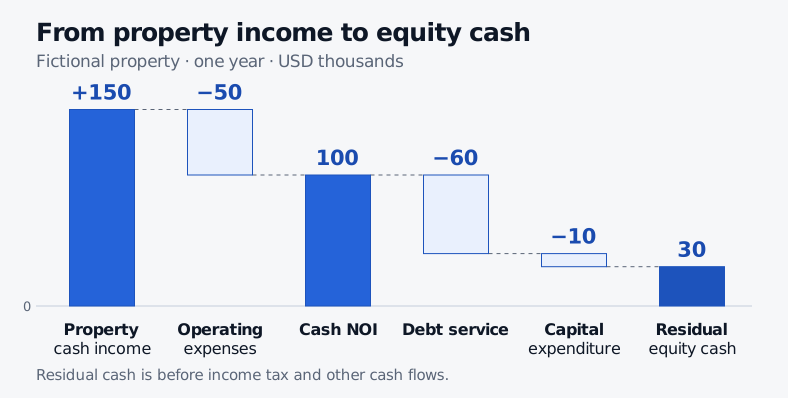
The annual cash NOI subtotal separates property operations from debt service and capital expenditure.
The 30 is cash left before income tax and other flows such as reserve funding. For valuation, direct capitalisation divides a representative annual NOI by an appropriate capitalisation rate. For credit, a simple NOI-based debt service coverage ratio (DSCR) here is times. A lender may use stabilised rents and vacancy assumptions or deduct a replacement reserve in its underwriting or covenant calculation. These definitions determine which income figure belongs in each ratio. OCC handbook, Income-Generating Capacity of CRE, Debt-Service Coverage Ratio and Value Analysis
A building, a share or a loan
Direct ownership gives the owner the property’s residual cash and exposure to its eventual sale price. Shares of a listed equity real estate investment trust (REIT) give investors a claim on the company, whose share price can change during trading even when its properties have not been sold or reappraised. A mortgage lender has a contractual claim to principal and interest, backed by collateral, and is exposed to default and recovery. A mortgage REIT can hold or originate those loans or invest in mortgage-backed securities. SEC Investor Bulletin on publicly traded REITs