Calculate WALT from a rent roll and identify which rents and tenants come up for renewal together.
Weighted average lease term and rent roll
Weighted average lease term (WALT) is the average time remaining on a property’s leases, weighted by each lease’s share of rent or leased area. In commercial real estate underwriting, it summarises when existing leases come up for renewal. The underlying rent roll, a dated schedule of tenants, space and lease terms, shows how much rent comes up for renewal at each date and which tenants account for it. OCC, Commercial Real Estate Lending, Appendix E
Two leases, three answers
A fictional property has two leases in force on the measurement date. Annual base rent is in thousands of US dollars. The table uses the effective date of the first available tenant break, when the tenant can end the lease early if the conditions are met.
Tenant
Annual base rent (USD thousands)
Leased area (m²)
Years to expiry
Years to first tenant break
A
60
400
5
3
B
40
600
2
None
For each included lease i, let ri be its annual base rent and ti its remaining term in years. Divide each lease’s rent by total included rent to get its weight. To contractual expiry, the calculation is
WALT=∑iri∑iriti=10060(5)+40(2)=3.8years.
Weight by area and the answer falls to 3.2 years. Tenant B has more of the space but contributes less of the rent. The area-weighted figure summarises when leased floor space comes up for renewal, while the rent-weighted figure summarises when the current base rent does.
Measure to the first available tenant break or expiry, whichever comes first, and rent-weighted WALT falls to 2.6 years. A’s input changes from five years to three. B still enters at two years. A break date gives the tenant an option to leave. Its notice deadline and any conditions matter for judging whether that option can still be exercised. AEW UK REIT defines its weighted average unexpired lease term (WAULT) using contracted rent and distinguishes the first-break and expiry conventions in its investor glossary. Its 2026 annual report defines the reported KPI on an expiry basis. AEW UK REIT investor glossary, 2026 annual report, p. 15
For a comparison across properties or issuers, line up the measurement dates, weights and lease populations. For a rent-weighted figure, check whether the rent basis is current annualised base rent or a measure that smooths incentives over the lease. Check whether the schedule covers only leases already in force or also signed leases awaiting commencement, and whether signed extensions already replace the old expiry dates. At portfolio level, check which properties are included and whether joint venture leases are weighted in full or by ownership share. A vacancy contributes no lease term to an in-place measure, so a building with substantial vacant space can still have a long WALT on its occupied space. Read vacancy alongside WALT.
When the average hides an expiry cliff
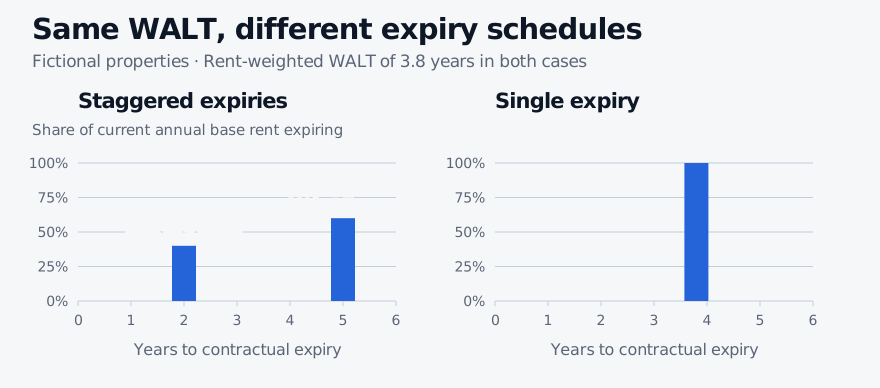
At 3.8 years, the two-tenant example has 40% of annual base rent expiring in two years and the rest in five. A second property could have the same WALT with all its leases expiring in exactly 3.8 years. The first property faces an earlier renewal negotiation. The second faces one date at which all its rent is up for renewal.
Two fictional expiry schedules with rent-weighted WALT of 3.8 years. One has 40% of annual base rent expiring in 2 years and 60% in 5 years. The other has 100% expiring in 3.8 years.
The same WALT can come from staggered expiries or a single date when every lease expires.
Bucket the rent roll by expiry year and group leases by tenant or common parent to see when several spaces or a large share of rent may need to be re-let. Then check actual collections, arrears, tenant financial strength and any guarantees against the rent shown on the schedule. Tenant B’s 40% rent share is the exposure at expiry. The cash outcome depends on renewal, downtime, replacement rent and re-leasing costs. Missed payments can reduce cash even before expiry. OCC, Commercial Real Estate Lending, Appendices D and E