The venture capital valuation method works backwards from a start-up’s forecast exit value and an investor’s target return to estimate today’s financing-round valuation and the stake the investor needs. It gives the founder and investor a price to discuss even when near-term cash flows are small or negative. The price depends on what the investor expects the stake to pay at exit. William A. Sahlman, The Structure and Governance of Venture-Capital Organizations, §7.7
Price the stake from the exit backwards
Start with the proceeds available to shareholders at the forecast exit. If a valuation multiple such as EV/revenue gives an enterprise value, bridge it to equity before dividing the proceeds among shareholders. Suppose a fictional sale values the operations at USD 110 million and the company has USD 10 million of net debt at exit. With no other adjustments, USD 100 million is available to equity. IPEV Valuation Guidelines, §2.4
An investor puts USD 2 million into the company today and targets 10× gross deal-level MOIC, or multiple on invested capital. That means collecting USD 20 million on the investment before fund fees and carried interest. Assume this is the only round, there are no interim payouts and all shares split the exit proceeds pro rata. The investor needs 20% of the USD 100 million equity pool. In USD millions, the implied equity valuations are
Post-money is the implied equity valuation immediately after the new shares are issued. Pre-money is the value assigned to the existing shares at the same round price. The USD 2 million goes into the company and is already included in the post-money figure.
The 10× target measures proceeds relative to the original cheque. With one payment at entry and one receipt after years, the corresponding annualised internal rate of return is . The same 10× means 58.49% a year over five years and 38.95% a year over seven. If the investor makes a follow-on investment or receives an interim distribution, use the dated cash flows to calculate the annual return.
What will the stake pay at exit?
A later round changes the share count. Suppose new investors buy 20% of the shares after a second round and the first investor buys no additional shares. The original holders now own 80% of the company, so the first investor's stake falls from 20% to 16%. At the same USD 100 million exit and with the same pro rata payouts, that investor collects USD 16 million, or 8×. With the entry terms fixed, the 16% stake needs a USD 125 million exit to reach 10×. A round can both dilute the stake and help the company reach a higher sale value. Treat those as separate inputs. IPEV Valuation Guidelines, §2.4
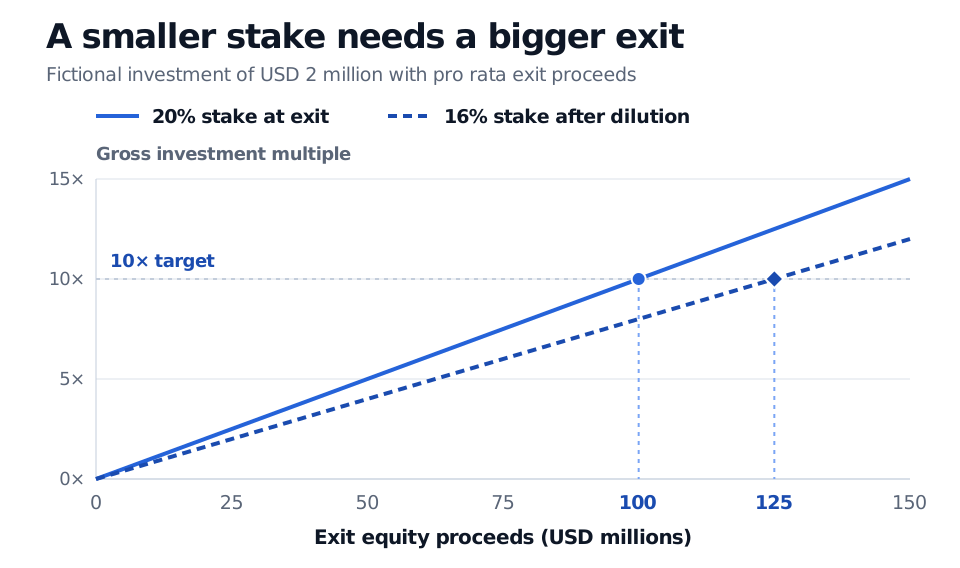
A later round can raise the exit value needed to meet the original investor’s target.
A preference changes who is paid first. Return to the single-round example. Suppose the investor holds preferred stock with a 1× non-participating liquidation preference and the option to convert into 20% of the common shares after conversion. At a USD 6 million equity exit, the preference pays USD 2 million before common holders receive the rest. Conversion pays only USD 1.2 million. The investor takes the preference and forgoes a share of the remaining proceeds. With multiple preferred series or participation rights, calculate the actual payout under the terms of each class. IPEV Valuation Guidelines, §§3.10 and 5.9
For the order of claims among debt, preferred and common shares, see the SelfMadeQuant finance primer. The preview is public and the full lesson requires membership. Equities
The round price depends on the scenario
A target return can reflect that the exit forecast assumes the company reaches its milestones. The business could run out of cash first, exit later, or sell on a lower revenue multiple. Ask what happens to the investor’s proceeds in each case, including a wind-down with nothing left for equity. If the analysis explicitly weights failure as a separate outcome, check whether the hurdle is already compensating for that same failure risk. Sahlman, §7.7
For fund reporting, fair value estimates the price market participants would pay for the specific investment in an orderly sale at the measurement date. In the December 2025 IPEV guidance, a recent financing can help calibrate that estimate when the price represents fair value. The valuer still needs to update the inputs for new evidence and consider differences in share-class rights. For methods that divide equity value across those classes, see OPM and PWERM equity allocation. IPEV Valuation Guidelines, §§1.1, 2.6 and 3.10
Sources
- William A. Sahlman (1990), The Structure and Governance of Venture-Capital Organizations, Journal of Financial Economics, §7.7, pp. 511–512.
- International Private Equity and Venture Capital Valuation Board, IPEV Valuation Guidelines, December 2025, §§1.1, 2.4, 2.6, 3.10 and 5.9. The edition applies to quarterly reporting periods beginning on or after 1 April 2026, with early adoption encouraged.