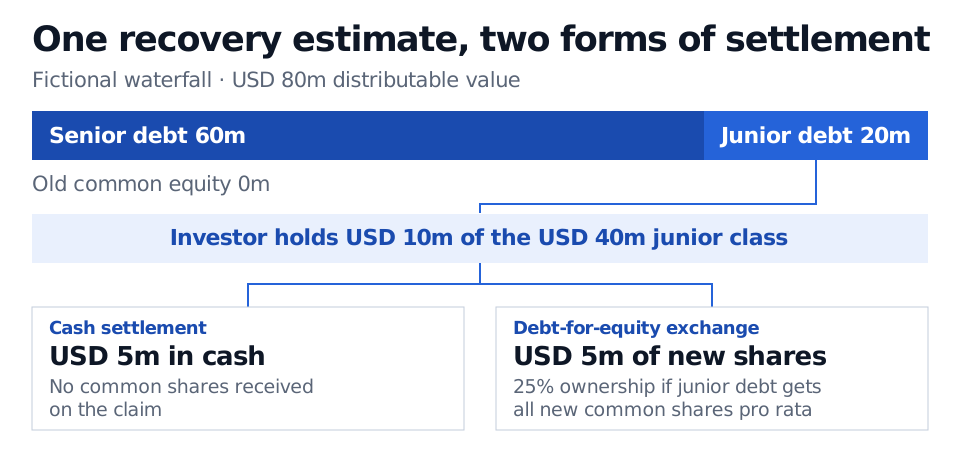
Find the partially covered debt class and trace how a purchased claim can become a stake in the reorganised company.
The Fulcrum Security and Loan-to-Own
The fulcrum security is the debt class where distributable value runs out in a restructuring waterfall. Loan-to-own is a distressed-debt strategy in which an investor acquires debt claims to seek an ownership stake through a restructuring. For the investor, the waterfall estimates the value available to the claim. The plan determines whether that value comes with a stake in the reorganised business. Michelle M. Harner, Activist Distressed Debtholders
Where the value runs out
A fictional company has USD 80 million of distributable value after costs and any obligations outside the example. Assume one pool, with USD 60 million of allowed senior debt first, USD 40 million of allowed junior debt second and old common equity last. Senior debt receives 60 million, junior debt receives the remaining 20 million and old equity receives zero. The junior class is the fulcrum, with a claim-based recovery rate of 20/40=50%.
At USD 50 million of distributable value, the senior class is partially covered and junior debt receives zero. At USD 110 million, both debt classes are fully covered and old equity receives USD 10 million under these assumptions. Real cases can involve separate collateral pools and different obligors. The same valuation can yield different recoveries if the claim amounts or priority change.
Buying the claim and receiving shares
Suppose an investor acquires USD 10 million of the allowed junior claims. With pro rata distributions, it receives one quarter of the class’s USD 20 million recovery, or USD 5 million at the assumed plan valuation. If the plan settles the junior claims in cash, the investor receives cash. If the plan gives the junior class all the new common shares pro rata in exchange for its claims, the investor receives 25% of those shares and participates in the residual value of the reorganised business. Issuing shares to other creditors or to new investors can shrink that ownership percentage.
Fictional USD 80 million waterfall allocates 60 million to senior debt, 20 million to junior debt and zero to old equity. A USD 10 million junior claim receives USD 5 million in cash or in new shares at plan valuation. The share outcome gives 25% ownership if all new common shares go to junior creditors pro rata.
Two fictional settlements give the same claim recovery at the assumed plan valuation. Only the share settlement gives the creditor a stake through the claim.
A revised plan can replace expected shares with cash or new debt. If the investor does receive shares, their market value can differ from the plan valuation. The investment return also depends on the claim purchase price, any cash paid to subscribe for additional shares and the time to distribution.
In a U.S. corporate Chapter 11 case, a court can confirm a plan over an impaired class that has not accepted it if the other applicable confirmation requirements are met and the plan is fair and equitable and avoids unfair discrimination with respect to each such class. For an impaired unsecured class that has not accepted the plan, the absolute priority rule bars junior holders from receiving or retaining property on account of their junior claims or interests unless every holder in the unsecured class receives or retains property worth the allowed amount of its claim as of the plan’s effective date. 11 U.S.C. § 1129(b)(1)–(2)
Office Properties Income Trust, 2026. The confirmed plan distributed new shares to several creditor groups when it took effect on 17 June, including holders of certain secured notes, unsecured notes and debtor-in-possession financing claims. Redwood’s funds received both exit notes and new shares on account of their secured notes and financing claims. Redwood’s separate right to designate trustees came from the amended bylaws and depended on its group’s beneficial ownership of common shares. Filed plan, effective-date filing, Redwood’s Schedule 13D, amended bylaws