Locate the marginal debt class in a restructuring waterfall, and distinguish partial claim recovery from a plan’s allocation of new equity.
Fulcrum security
A fulcrum security is the debt class at the boundary between claims covered by a distressed business's value and claims left out of the money. In a simple priority waterfall, it is the partially covered class: senior claims are satisfied, this class absorbs the remaining value, and junior claims receive nothing. Identifying it helps an analyst locate where a change in business valuation changes creditor recoveries—and which creditors may become shareholders in a restructuring.
The term describes an economic position in the capital structure, rather than a fixed instrument type. A secured loan, second-lien loan or unsecured bond can occupy that position. It is especially relevant to distressed debt investing, where the original promised payments may be replaced by cash, new debt, new equity or a combination.
Follow value until it runs out
Consider a fictional company with two allowed debt claims, each of USD 100 million, followed by old equity. Stipulate that the senior claim has first call on the same available value pool and that the unsecured class takes the remainder before old equity. Within each class, claims share proportionately. There are no other claims, accrued interest, guarantees or separate collateral pools in this model.
Let V be the value available for allocation to these two classes and old equity, in USD millions. It is already net of any other obligations and costs; it is not an unadjusted enterprise-value headline. Under the stipulated ranking,
Here S, U and E are allocated values, not necessarily immediate cash payments. For every nonnegative V, they sum to V.
Available value, USD m
Senior allocation
Unsecured allocation
Old equity residual
Economic boundary
80
80
0
0
Senior debt is partially covered
150
100
50
0
Unsecured debt is partially covered
220
100
100
20
Both debt classes are covered; equity receives the residual
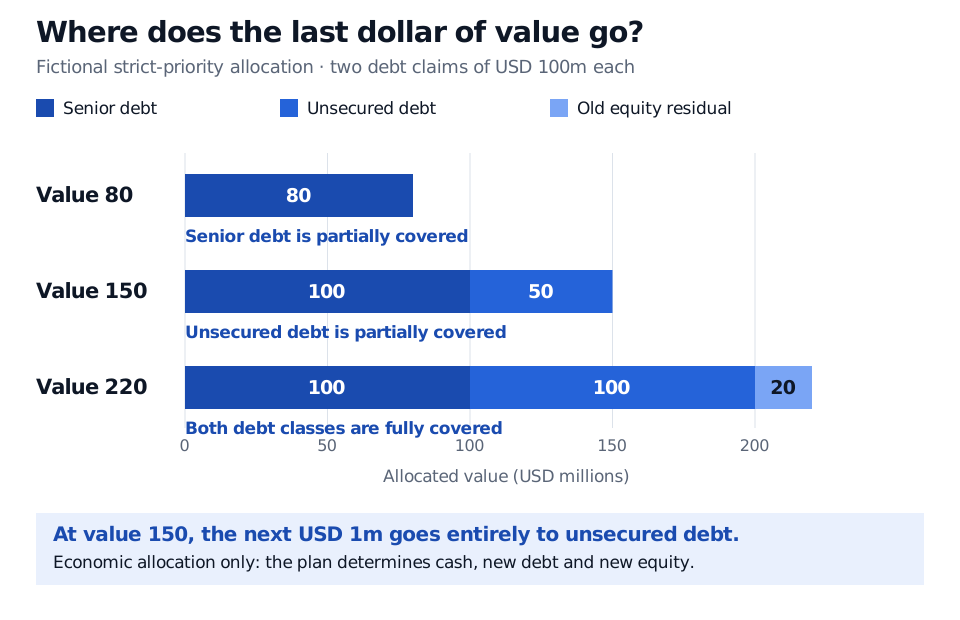
At V=150, the unsecured class is the fulcrum. Its recovery rate is 50/100=50% of its own claim. It does not own 50% of the company simply because half its claim is covered.
Within the interval 100<V<200, another USD 1 million of available value goes entirely to unsecured creditors; senior debt is already covered and old equity remains out of the money. Below 100, the marginal dollar goes to senior debt. Above 200, it goes to equity. At the exact boundaries of 100 and 200 there is no strictly partially covered debt class in this toy model; identify the adjacent ranges rather than forcing a unique label.
Fictional allocations in USD millions: value 80 gives senior debt 80; value 150 gives senior debt 100 and unsecured debt 50; value 220 gives each debt class 100 and old equity 20. At value 150, the next million goes to unsecured debt.
Original fictional waterfall: the marginal recipient changes as available value crosses cumulative claims of USD 100m and USD 200m. Allocated value does not specify the securities a plan distributes.
A valuation boundary is not an equity allocation
A familiar restructuring design leaves senior debt outstanding or replaces it with new debt, cancels junior claims, and exchanges the fulcrum debt for new equity. That possibility motivates loan-to-own positioning: acquiring debt with the intention of receiving ownership through a restructuring. Identifying a likely fulcrum class is an analytical step; acquiring a position, negotiating terms and obtaining control are separate steps.
The classic design is not compulsory. Diane Lourdes Dick's original Tactical Restructurings, pp. 16–18, discusses both the traditional debt-to-equity pattern and structures in which senior creditors receive equity while a junior fulcrum class receives cash or other property. The economic boundary can remain useful even when it does not identify the eventual shareholder class.
An actual ownership estimate therefore needs the proposed securities, their values, the new capital structure and any dilution from new-money investment or incentive awards. Holding a fraction of one debt class is not the same as holding that fraction of the reorganised company's shares or votes. Nor does being the fulcrum make a claim safe: a lower valuation can move the boundary above it, leaving it with no recovery.
Build the claim map before the waterfall
Enterprise value measures the operating business under a stated convention. Distributable value requires a bridge to the assets and claims involved: cash, non-operating assets, obligations outside the model, financing needs and restructuring costs must be accounted for consistently. Do not subtract a debt claim in that bridge and then subtract the same claim again in the waterfall. Book debt alone supplies neither this value bridge nor the eventual allowed claim amounts.
Next identify the obligor, collateral, guarantees, lien ranking and contractual subordination. Senior debt need not be secured debt, and a claim on one group entity need not reach assets held by another. Competing claims, disputed amounts and new financing can change the boundary.
Legal treatment also depends on jurisdiction and the proceeding. The US Courts' Chapter 11 overview, accessed 30 October 2026, describes claim classification, impaired creditors' voting and court confirmation. It also explains that a debtor may borrow new money with court approval. An economic waterfall does not replace that process or the negotiated plan.
For dated statutory illustrations, the official 2024 US Code edition links secured status to the relevant collateral interest in §506(a)(1), and describes conditional financing priorities and liens in §364(c)–(d). These explain why a single-pool senior-first toy model cannot resolve actual collateral or debtor-in-possession financing rights; they are dated background, not a complete statement of current reorganisation law.
For an application across different instruments, Capital Structure and Distressed Convertible Hedges examines recovery and ranking mismatches within an issuer's capital structure. The full lesson requires membership; its preview is public.
US Government Publishing Office, 2024 US Code edition, 11 USC §506(a)(1) and §364(c)–(d): dated statutory context for collateral-based secured status and financing priority.