Swing pricing adjusts an open-end mutual fund’s dealing price up or down from its unadjusted net asset value (NAV) per unit. An anti-dilution levy is a separate charge paid to the fund by specified transacting investors. Both tools help allocate the cost of investing new money or raising redemption cash, so existing investors bear less of the cost of other investors’ orders. Directive (EU) 2024/927, Annexes II and IV
Net flows determine the direction of a swing
Subscriptions and redemptions can offset each other. When redemptions exceed subscriptions, the fund may have to sell assets. An unswung NAV based on the fund’s asset marks and liabilities can differ from what the fund realises on those sales. Brokerage fees, the bid–ask spread and market impact can leave less value for each unit still outstanding after the sale. The same cost-allocation problem arises when the fund invests net subscription proceeds. EU UCITS technical standards, Articles 4 and 5
Under the EU UCITS specification, full swing can apply on any dealing date with nonzero net orders. Partial swing requires the net order imbalance to exceed a predefined activation threshold. The threshold governs when the adjustment applies. The swing factor, expressed as a percentage of NAV, governs the size of the change. Net subscriptions swing the price up, net redemptions swing it down, and a fund can use different factors at different thresholds. EU UCITS technical standards, Article 5
A UCITS using swing pricing publishes the swung NAV and uses that common price for both buyers and sellers dealing in the same units. On a down-swing day, redeemers receive less per unit and subscribers who happen to buy that day also pay less per unit. With a UCITS anti-dilution levy, the charge falls on the net-flow side. The levy is deducted from redeemers’ proceeds on a net-redemption day or charged to subscribers on a net-subscription day. EU UCITS technical standards, recital 10 and Article 7
One redemption, two ways to recover the cost
Suppose a fund starts with USD 10 million of net assets and 1 million units, for an unswung NAV of USD 10.00. Investors redeem 100,000 units, with no subscriptions. Assume the fund’s swing policy applies a downward factor of 50 basis points, or 0.50%. The resulting dealing price in USD per unit is
The fund pays USD 995,000 for the redeemed units, USD 5,000 less than at the unswung price. In a separate levy scenario, the dealing price stays at USD 10.00 and a USD 5,000 levy is deducted from the USD 1 million gross redemption amount. The same USD 995,000 leaves the fund.
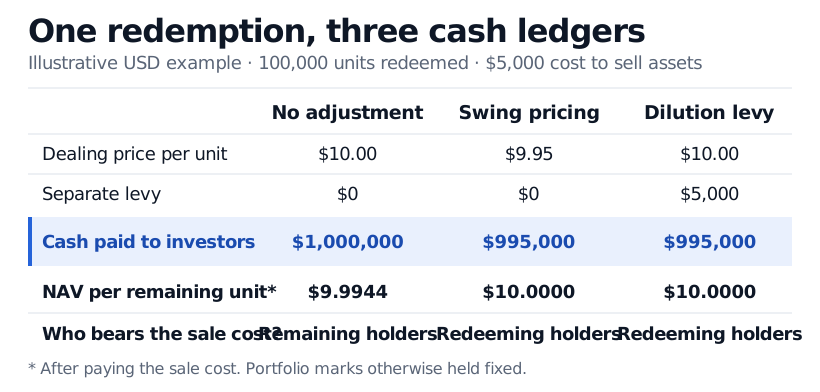
The two policies are separate cases. The illustration fixes the realised sale cost at USD 5,000 and holds other asset marks and liabilities constant.
The portfolio still costs money to trade. In this example the fund keeps just enough cash at settlement to absorb the assumed sale cost, leaving USD 9 million of net assets for the 900,000 remaining units. If the sale costs more than the adjustment recovers, the fund still bears the shortfall. A swing changes the dealing price without re-marking each asset. A change in a published swung NAV can therefore reflect the pricing adjustment as well as a change in the value of the portfolio. EU UCITS technical standards, recital 10 and Article 5
Which rules apply?
- EU. The delegated standards specify both tools for UCITS and open-ended alternative investment funds. They apply from 16 April 2026. Funds constituted before that date are deemed compliant with those standards until 16 April 2027, with provision for earlier opt-in on notification. UCITS standards · AIF standards
- UK. FCA COLL 6.3.8 permits an authorised fund manager to apply a dilution adjustment or charge a dilution levy in line with the prospectus, subject to separate limits for regulated money market funds. The FCA’s August 2026 package for UK UCITS and non-UCITS retail schemes takes effect on 1 February 2027, with some transitional provisions through 1 August 2027. FCA Handbook, COLL 6.3 · FCA Policy Statement PS26/17
- US. Rule 22c-1(a)(3) permits swing pricing for eligible registered open-end management investment companies with compliant policies and procedures. ETFs, money market funds and specified feeder funds are outside that permission. Rule 2a-7 has a separate mandatory liquidity fee for institutional prime and institutional tax-exempt money market funds, with its own net-redemption trigger and de minimis exception. 17 CFR § 270.22c-1 · 17 CFR § 270.2a-7
For a specific fund, the prospectus explains the dealing policy. For a cost review, compare the swing factor with the prices and fees the fund actually incurred when trading, especially in thin markets. The SelfMadeQuant Cost and Capacity Models lesson shows how to build that execution-cost estimate without counting the spread twice. The full lesson requires membership. FCA liquidity management review
Sources
- Directive (EU) 2024/927, Annexes II and IV, points 5 and 7 in each inserted annex
- Commission Delegated Regulation (EU) 2026/466, recitals 8, 10, 11 and 13 and Articles 4–5, 7 and 10–11
- Commission Delegated Regulation (EU) 2026/465, Articles 5, 7 and 10–11
- FCA Handbook, COLL 6.3.3 and 6.3.8
- FCA Policy Statement PS26/17, scope and commencement
- FCA Liquidity Management multi-firm review, Liquidity Management Tools
- 17 CFR § 270.22c-1(a)(3), swing pricing
- 17 CFR § 270.2a-7(c)(2), money market fund liquidity fees