A money market fund is a mutual fund that invests in liquid, short-term debt, cash and cash equivalents. Investors use it to earn income on cash they may need soon. The income tends to follow short-term rates because the fund regularly replaces maturing holdings at prevailing rates. A bank money market deposit account is a deposit eligible for FDIC insurance within applicable limits at an insured bank. The fund gives you investment shares, whose value can fall and which carry no FDIC deposit insurance. SEC investor bulletin, FDIC deposit insurance guide
From holdings to gross income
Suppose a fictional fund holds 97% in short-term instruments accruing at 5% per year and 3% in cash accruing at 3% per year. Treat both rates as simple annual accrual rates on the same basis. Holding weights and rates fixed gives a current gross annual accrual estimate of 4.94%.
The number describes income accrual before expenses and price changes. It says nothing about the fund’s dealing price, and it gives no forecast of what shareholders will earn over the next year. Even with the same allocation, reinvesting maturing assets at lower rates would lower the fund’s income.
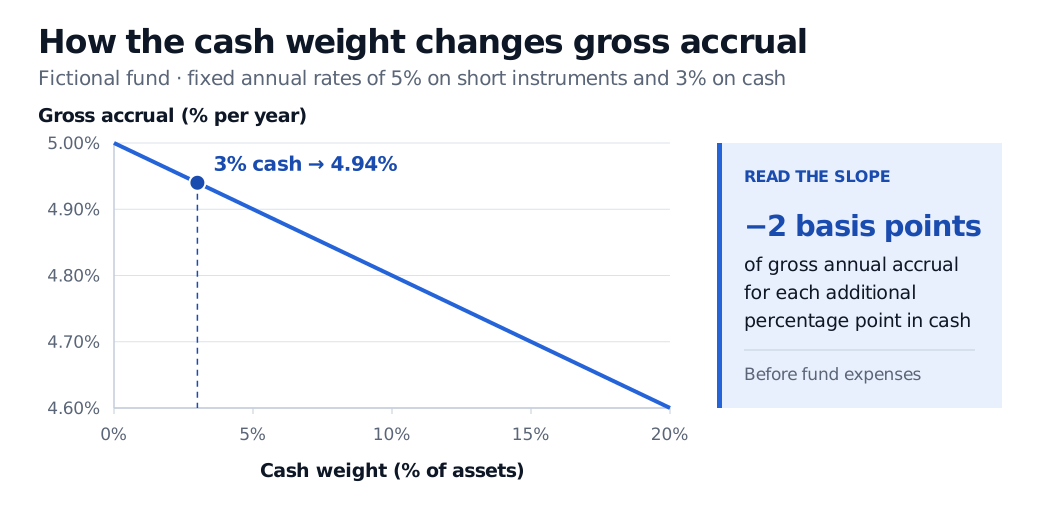
Fictional portfolio sensitivity at fixed rates, before expenses. Moving one percentage point of assets from short instruments to cash reduces gross annual accrual by two basis points.
The standard U.S. seven-day yield starts from the investment income earned in a hypothetical one-share account over the preceding seven calendar days. It accounts for applicable recurring fees, excludes capital gains and losses, and scales the resulting seven-day return by . Fund operating expenses, summarised by an expense ratio, already reduce a reported net yield. A single snapshot of holdings and gross accrual rates cannot establish that quote. SEC Form N-1A, Item 26(a)
The Money Markets lesson works through a Treasury bill whose bank-discount quote and return on cash invested use different denominators. The full lesson requires membership.
How a fund maintains a stable share price
U.S. government funds hold at least 99.5% of total assets in cash, government securities and qualifying fully collateralised repurchase agreements. Prime funds can hold short-term corporate and bank debt such as commercial paper. Tax-exempt funds typically hold municipal debt. Rule 2a-7 sets portfolio requirements for maturity, credit quality, diversification and liquidity. Qualifying securities can count toward liquidity requirements alongside cash. Rule 2a-7, paragraphs (a) and (d), SEC investor bulletin
Government and retail money market funds can use amortised cost, penny rounding or both, subject to the rule, to seek a stable dealing price, typically USD 1.00 per share. Retail funds are set up to limit beneficial owners to individuals. Amortised cost starts from the purchase cost of each security and recognises its premium or discount over time. Funds using it must also check their market-based net asset value (NAV) at least daily. If losses cause a USD 1.00 fund’s dealing price to fall below that level, it has broken the buck. Institutional prime and institutional tax-exempt funds transact at a floating NAV. Rule 2a-7, paragraphs (a), (c) and (g)
The June 2026 Fidelity Government Money Market Fund (SPAXX) prospectus illustrates the distinction. It discloses a USD 1.00 share-price objective and annual operating expenses alongside its policy of charging no fee on share redemptions. Its redemption price uses the next NAV calculated after a properly submitted order is received. Fidelity summary prospectus
Why heavy redemptions can cost money
If a fund has to sell holdings into a thin market to raise cash, remaining shareholders can bear the sale costs. A liquidity fee allocates costs to investors redeeming their shares. Under current U.S. rules, institutional prime and institutional tax-exempt funds generally must charge one when net redemptions for the day exceed 5% of net assets, or a lower threshold set by the board, subject to an exception for very small estimated costs. Non-government funds must also charge a discretionary fee if their board determines that doing so is in the fund’s best interest. Government funds may opt into that mechanism. Rule 2a-7, paragraph (c)(2)
The SEC removed Rule 2a-7’s temporary redemption gates tied to a liquidity threshold in October 2023. A separate rule still allows a fund to suspend redemptions for an orderly liquidation if the rule’s conditions are met. SEC 2023 reforms, Rule 22e-3