Commercial paper (CP) is short-term debt issued as a promissory note. Companies use it to raise cash for needs such as paying suppliers before customers pay their invoices. An investor in unsecured CP takes the issuer's credit risk. For the issuer, the funding question is how much cash will be available on the day the note comes due. Federal Reserve Board, About Commercial Paper
From issue price to repayment
Suppose a company issues a 30-day unsecured note with a face value of USD 1,000,000. An investor pays USD 990,000 at issue and receives USD 1,000,000 at maturity if the company pays as promised. In this discount issue, the USD 10,000 gain comes entirely from the difference between the two cash flows. The holding-period return before costs is
The denominator is the cash invested. This is the return over 30 days, conditional on repayment. The Money Markets lesson uses a Treasury bill to show how a bank-discount quote changes the denominator and annualises the discount. The full lesson is for members.
The note can come due before the cash arrives
Suppose the issuer has already spent the original proceeds, and its customer invoice is due on day 60. On day 30 the issuer can try to roll the paper by selling a new note and using its proceeds to help repay the old one. Raising USD 990,000 on the new note still leaves USD 10,000 to find. If investors decline to buy the new issue, the whole USD 1,000,000 must come from cash, a backup credit line or another source.
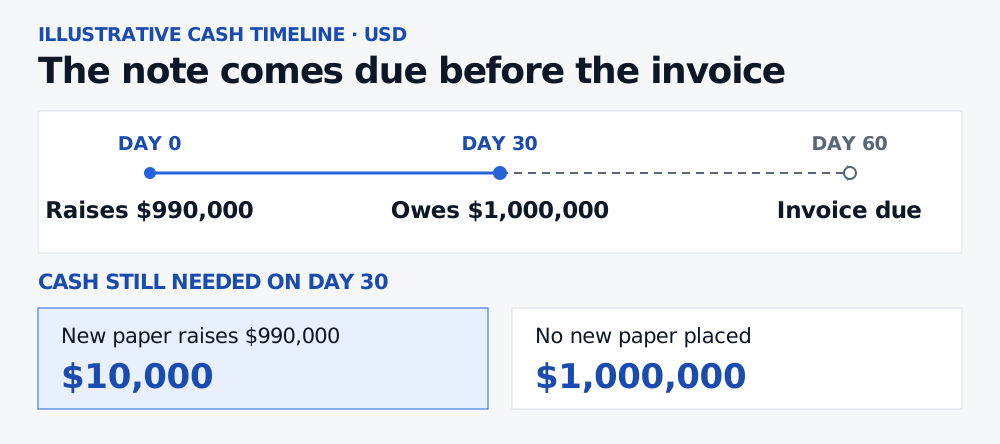
Cash still needed on day 30 after any new issuance and before using cash reserves or drawing on a backup line.
That is rollover risk. The customer could pay on time and the issuer could still run short on day 30. The cash forecast therefore needs to line up note maturities with collections and funding available on those dates.
Asset-backed commercial paper (ABCP) is typically issued by a conduit against a pool of assets such as trade or credit-card receivables. The investor's exposure depends on the pool and on any contractual liquidity or credit support. A liquidity line can supply cash when collections lag or new paper fails to sell, subject to its terms. Credit enhancement can absorb specified losses. The conduit can still face rollover risk when its paper matures before the underlying assets pay. Federal Reserve Board, Report to the Congress on Risk Retention
Reading the U.S. data
The Federal Reserve's commercial paper release covers maturities of up to 270 days. Its rate series estimate new-issue rates for selected market segments and maturities from qualifying trades. A series gives a market reference for that segment, while the proceeds a particular issuer can raise depend on the terms it can place. Federal Reserve Board, About Commercial Paper
The U.S. Securities Act exemption in section 3(a)(3) has its own conditions. It covers specified instruments that arise from current transactions or whose proceeds are used or intended for use in them, with an original maturity of no more than nine months excluding days of grace. Renewals must meet the same maturity limit. 15 U.S.C. § 77c(a)(3)