A UCITS is an undertaking for collective investment in transferable securities. Under the EU framework, it pools capital raised from the public, invests in transferable securities or other specified liquid financial assets on a risk-spreading basis, and provides for investors to redeem units from the fund’s assets, directly or indirectly. For a portfolio manager, that means clearing two separate checks before trading. The instrument has to be eligible, and the resulting exposure has to fit the applicable concentration limits. UCITS Directive, Articles 1 and 49–52
A UCITS can take the form of a contractual common fund, a unit trust or an investment company. Its home Member State authorises the fund. The marketing passport lets it offer units in another Member State after the required notification. A UCITS can also be an exchange-traded fund. Article 1 treats action by a UCITS to keep its exchange price close to net asset value as equivalent to redemption. Where an umbrella has several sub-funds, Article 49 applies the investment-policy rules separately to each one. UCITS Directive, Articles 1, 5, 49 and 91–93
What can the fund buy?
Article 50 sets out routes for securities and money market instruments on qualifying markets, certain recent issues, qualifying fund units and bank deposits, eligible derivatives and certain money market instruments traded away from regulated markets. The route determines what the manager needs to establish. For a transferable security, the Eligible Assets Directive includes criteria such as reliable valuation, negotiability, consistency with the fund’s investment policy and enough liquidity to meet redemption obligations. For an OTC derivative, Article 50 also tests the underlying, the counterparty, daily valuation and the fund’s ability to close the position at fair value. UCITS Directive, Article 50 · Eligible Assets Directive, Article 2
Article 50(2)(a) allows up to 10% of assets in transferable securities and money market instruments outside its paragraph 1 categories. An instrument in that allowance still has to qualify as one of those types. UCITS Directive, Article 50(2)
How much can the fund hold?
Article 52 starts with a 5% limit for transferable securities and money market instruments from one issuer. A Member State can raise it to as much as 10%. Where it does, the full weights of issuers above 5% count towards a combined 40% limit for those holdings. A weight of exactly 5% stays outside that basket. The article also contains group aggregation rules and separate tests for deposits, derivative counterparties and combined exposure to one body. Specific public-sector securities, covered bonds and qualifying index replication can follow different limits. UCITS Directive, Articles 52–54
Suppose a fictional sub-fund has a net asset value of €100 million and zero liabilities, so its assets are also €100 million. It holds €8 million of eligible listed shares from issuer A.
Assume the home Member State uses the 10% issuer limit, the fund’s mandate permits the shares, and all holdings are ordinary eligible equities of unrelated issuers. With five holdings of 8% each and twelve of 5% each, the basket is exactly 40%. If the manager funds a new 6% holding in issuer F by cutting each 5% holding to 4.5%, the basket rises to 46%. The fund crosses that limit with issuer A still at 8%. With only A’s weight, the manager would still need the instrument’s eligibility assessment and the rest of the fund’s exposures to reach a conclusion. UCITS Directive, Article 52(1)–(2)
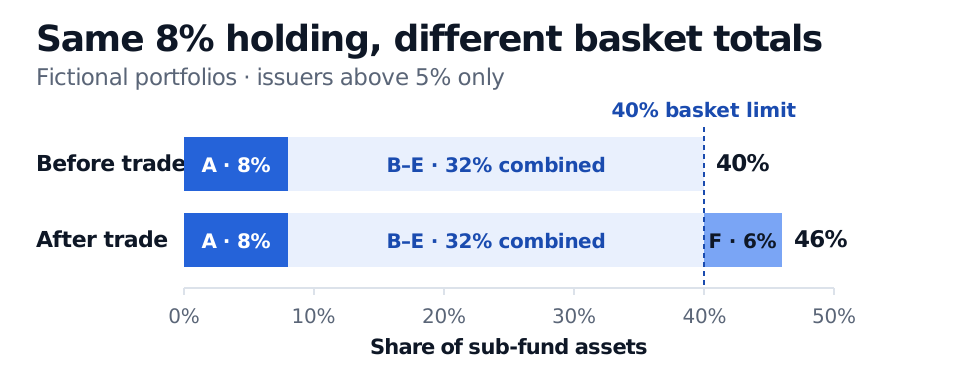
The new holding adds its full 6% to the basket. The smaller holdings used to fund it stay outside the basket.
Which version of the rules applies?
Start with the sub-fund’s home-state rules and prospectus. The current EU text reflects AIFMD II’s liquidity-management amendments, which Member States were required to apply from 16 April 2026, with the new UCITS supervisory reporting provisions due from 16 April 2027. A separate amendment, Directive (EU) 2024/2994, changed the scope of Article 52’s derivative counterparty limits to transactions without clearing through an authorised or recognised central counterparty. Its national transposition deadline was 25 June 2026. Directive (EU) 2024/927, Articles 2–3 · Directive (EU) 2024/2994, Articles 1 and 4
The European Securities and Markets Authority (ESMA) issued technical advice on possible revisions to eligible-asset rules in June 2025. The advice is part of the review process. Directive 2007/16/EC remains in force. ESMA technical advice, executive summary · Eligible Assets Directive
Sources
- Directive 2009/65/EC, consolidated 16 April 2026
- Commission Directive 2007/16/EC, Eligible Assets Directive
- Directive (EU) 2024/927, AIFMD II and UCITS amendments
- Directive (EU) 2024/2994, derivative counterparty risk amendments
- ESMA technical advice on the review of the UCITS Eligible Assets Directive