Shareholder yield combines dividends with net buybacks, sometimes adding debt paydown. Reconcile issuance, denominator dates and why the ratio is not an investor return.
Shareholder yield
Shareholder yield measures a company's distributions and financing flows relative to its equity market value, combining dividends with net share repurchases and, in some definitions, debt paydown. It lets a quant compare companies that return capital through different channels: a low dividend yield can coexist with substantial buybacks. The first research decision is to specify which definition the signal uses.
Two conventions are common. An equity-only measure adds dividends and net buybacks; the same cash-flow construction is called net payout yield in academic research. A broader measure also adds net debt paydown. The distinction changes both the number and its economic meaning. Boudoukh, Michaely, Richardson and Roberts (2007), Section I.A define net payout after subtracting equity issuance; Cambria's investment case, page 1 illustrates the debt-inclusive version.
The issuance that a gross buyback number hides
Use cash flows from the same completed twelve-month period, in one currency, for the same common-equity issuer. Let D be cash dividends paid, B executed repurchase expenditure and I cash proceeds from share issuance. Let Mt be market capitalisation at the stated measurement date, after that period's reports have become available. The cash-based equity-only convention here is
yequity,t=MtD+B−I=MtD+MtB−I.
The second term is net buyback yield. A share buyback sends cash to selling shareholders; issuance brings cash back into the company from investors. Adding gross repurchases without subtracting issuance can therefore overstate net distributions to equity holders.
Consider this fictional issuer, with all amounts in USD millions:
Item
Amount
Contribution using market cap of 1,000
Cash dividends paid
20
+2 percentage points
Executed repurchases
50
+5 percentage points
Cash proceeds from issuance
30
−3 percentage points
Net equity distribution
40
4% equity-only shareholder yield
Optional net debt paydown
10
+1 percentage point
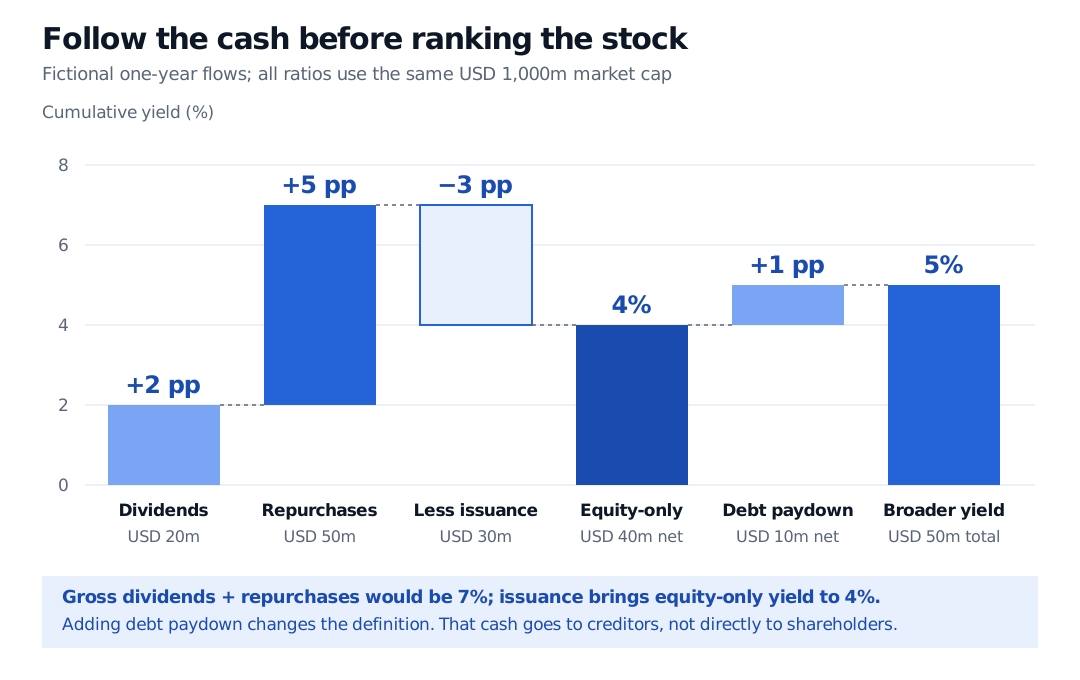
Net buybacks are 50−30=20, so net buyback yield is 2%. Add the 2% dividend component and equity-only shareholder yield is 4%. Dividends plus gross repurchases give 70/1,000=7%, a different measure that ignores the new equity financing.
Fictional annual cash flows divided by USD 1,000 million market capitalisation: dividends add 2 percentage points, repurchases add 5, issuance subtracts 3, giving 4% equity-only shareholder yield. Net debt paydown adds 1 percentage point for a broader yield of 5%.
Original fictional cash-flow bridge. All components share one twelve-month window and one market-cap denominator. Debt paydown changes the definition and pays creditors rather than delivering cash directly to shareholders.
Why adding debt changes the question
For a declared cash-flow convention, let Q be debt repayments less new borrowing during the same period. Then
ybroader,t=MtD+B−I+Q.
With net debt paydown of 10, the example becomes 50/1,000=5%. A negative Q would reduce this measure because the company raised more debt than it repaid.
This broader score recognises deleveraging alongside equity distributions. But the debt repayment itself goes to creditors. It is not a dividend-equivalent cash receipt for every shareholder. A company can also finance buybacks by borrowing: an equity-only yield records the equity payout without, by itself, revealing the resulting increase in leverage.
Do not infer cash debt paydown from a balance-sheet change without reconciliation. Acquisitions, exchange-rate changes and other non-cash adjustments can change reported debt; a change in debt net of cash also reflects cash-balance movements. Providers can define the debt component and its denominator differently. State the methodology rather than adding a debt number simply because it is available.
A yield quote needs a measurement policy
Three choices deserve explicit treatment in a data specification.
Window and valuation date. The numerator may cover a fiscal year or trailing twelve months; a forward estimate is a separate input. Our example uses completed cash flows and a single, dated market-cap denominator. If the same net equity distribution of 40 is divided by market cap of 800, yield rises from 4% to 5% without any increase in distributions. This price dependence makes shareholder yield useful as a valuation characteristic, but high yield can also reflect deteriorating expectations.
Cash flows versus share counts. This article's B−I is a cash-flow quantity. An adjusted change in shares outstanding is a different proxy: shares are issued and repurchased at different prices, and stock awards or acquisition shares may not produce matching cash proceeds. MSCI's 2021 yield-strategy research, for example, describes a share-count-based buyback yield in its footnote. Do not splice such a yield into a cash-flow series as though the methods were identical. Employee equity compensation can dilute continuing holders even when a cash-only issuance field is small.
Execution and availability. A repurchase authorisation is permission to buy, not evidence of executed expenditure. Use completed purchases for a historical cash-based measure. For a backtest, retain the dates when the underlying reports became available; a fiscal year-end label does not make its eventual accounts observable at that year-end. Using later information creates look-ahead bias.
Net yield can be negative. Keeping dividends of 20 and repurchases of 50 but raising issuance to 80 gives −10/1,000=−1%. That says the issuer raised more equity cash than it distributed in this convention; it is not a negative dividend.
What the percentage does not promise
Shareholder yield is a payout-and-valuation characteristic, not a bond coupon, a contractual distribution rate or an investor's realised total return. A continuing shareholder receives the declared dividend but receives buyback cash only by selling shares. Changes in ownership per share, future business cash flows and the trading price matter for the investment outcome. Buying back expensive shares need not create value, and past distributions need not continue.
In systematic research, the characteristic can rank companies or complement a value factor. A ranking is not evidence of a future premium: test the precisely specified signal using available-at-the-time data, consistent issuer coverage and realistic trading costs. The 4% in this example is an accounting ratio under stated conventions, not an expected or guaranteed 4% return.
For the next step from a payout yield to a valuation model, sections 1–2 of Equity Valuation: Dividend Discount and DCF Models explain the cash-flow principle, constant growth and the distinction between yield and required return. The preview is public; the full lesson requires membership.
Cambria, Shareholder Yield ETF Investment Case, page 1 — an explicit debt-inclusive convention and netting of repurchases against issuance. This supplies a definition example, not an endorsement of the fund or its performance claims.