The Securities Financing Transactions Regulation (SFTR) is the EU regulation that makes securities financing transactions (SFTs) and the reuse of financial instruments received as collateral more transparent. It covers repos, securities lending and borrowing, commodities lending and borrowing, buy-sell backs and sell-buy backs, and margin lending as defined in Article 3. The data lets supervisors see who is financing whom, on what terms and against which collateral. For an analyst measuring repo activity, several reports can describe one financing contract. Regulation (EU) 2015/2365, Articles 1, 3 and 4
Who reports the repo
Article 4 requires counterparties in scope to report a conclusion, modification or termination to a registered or recognised trade repository by the following working day. EU-established counterparties are in scope for their SFTs, including those concluded through overseas branches. A third-country counterparty comes within this scope for an SFT concluded through its EU branch. An SFT with a member of the European System of Central Banks (ESCB) is exempt from Article 4 reporting. SFTR Article 4 · SFTR Article 2
A counterparty can delegate submission. Article 4 also assigns responsibility for both reports to the financial counterparty when the non-financial counterparty falls within the statutory size test. One firm can therefore file both sides of a single trade. SFTR Article 4(2)–(3)
One repo, two reporting sides
Assume two EU banks each report their own side of an in-scope, uncleared, fixed-term repo. Bank A receives euro cash and provides bond X. Bank B lends the cash and takes the bond. The bond is allocated to this repo, and the banks agree a unique trade identifier (UTI), shown as R1 in the example. Each report identifies its own bank and the other bank by their legal entity identifiers. Bank A reports as the collateral provider and Bank B as the collateral taker. Both use R1. Implementing Regulation 2019/363, Articles 2–4 and Annex I
The new-trade reports carry the principal and currency, repo rate, start and maturity dates, and known collateral details. For bond X those include the bond's international securities identification number (ISIN), nominal amount, market value and any applicable haircut. The two reports enter the repository with different maturity dates even though the banks' trade confirmation agrees on Day 7. Delegated Regulation 2019/356, Annex, Tables 1–2
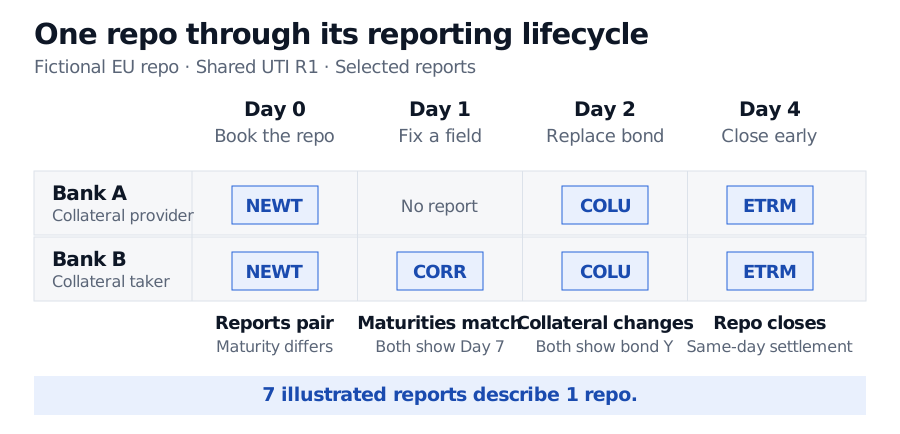
Read across either bank's row to follow its reports. Read down each day to see what the repository receives from both sides.
Pairing identifies the two sides. Reconciliation compares their data. In this example both
NEWT reports pass validation. The repository can pair them using the shared UTI and the banks' reversed reporting and other-counterparty identifiers. If the reports go to different repositories, the repositories can find each other using those fields and the master agreement type. They compare the latest specified loan and collateral fields under the applicable tolerances. Maturity requires an exact match, so Day 7 and Day 8 produce a break even though the reports pair. On Day 1, Bank B sends CORR with the agreed Day 7 maturity and the original date to which the correction applies. Delegated Regulation 2019/358, Articles 1–2 and Annex I · ESMA SFTR Guidelines, §4.9 and Table 5On Day 2, both banks report the end-of-day collateral after bond Y replaces bond X.
COLU updates the collateral under R1. An effective change to the actual repo terms, such as an agreed re-rate, would use MODI under R1. On Day 4, the banks agree to close early and settle that day, so both report ETRM. If they agreed to close on a future day, they would use MODI to amend the maturity date. A fixed-term repo that settles at its scheduled maturity expires without an ETRM report. A separately agreed replacement repo would begin with NEWT under its own UTI. Implementing Regulation 2019/363, Article 5 and Annex I · ESMA SFTR Guidelines, §§4.8–4.10In the illustrated history, seven reports describe one repo. For an outstanding balance, first reconstruct each side's state from the action types, then account for the two reports of the same contract. Before the early close, the latest collateral is bond Y. After the close, the repo is out of the outstanding balance. A correction to the UTI itself is a special case. ESMA calls for cancelling the erroneous record and reporting the existing contract again as
NEWT under the correct UTI. ESMA SFTR Guidelines, §4.16, paragraph 153Reuse and other reporting regimes
Reporting that collateral is contractually available for reuse is separate from reporting actual reuse. Article 15 sets conditions on the right to reuse collateral. The receiving party must inform the provider in writing of the risks and consequences. The provider must give prior express consent, evidenced in writing or by a legally equivalent means, to a security collateral arrangement that grants a right of use, or expressly agree to title transfer. Exercising the right must follow the agreed terms and generally involves transferring the instruments from the provider's account. SFTR Article 15 · ESMA SFTR Guidelines, §§5.4.5.3 and 5.6.1
EMIR and MiFIR transaction reporting serve different purposes. EMIR Article 9 covers derivative contracts. MiFIR Article 26 covers qualifying executions, and its RTS 22 excludes SFTs as a class, with an exception for SFTs with an ESCB member. Such a trade is exempt from SFTR Article 4 and can be reportable under MiFIR if the other Article 26 conditions are met. EMIR Article 9 · RTS 22, Article 2(5)
Sources
- Regulation (EU) 2015/2365, 9 January 2024 consolidation
- ESMA, SFTR Article 4
- Delegated Regulation (EU) 2019/356, reportable details
- Implementing Regulation (EU) 2019/363, report formats and frequency
- Delegated Regulation (EU) 2019/358, repository validation and reconciliation
- ESMA, Guidelines on reporting under SFTR
- ESMA, SFTR reporting standards and guidance
- ESMA, EMIR Article 9
- Delegated Regulation (EU) 2017/590, MiFIR reporting technical standard (RTS 22)