EMIR and MiFIR transaction reporting refers to two EU reporting duties that can apply to the same trade. Article 9 of the European Market Infrastructure Regulation (EMIR) gives supervisors data on derivatives contracts and their lifecycle. Article 26 of the Markets in Financial Instruments Regulation (MiFIR) gives competent authorities execution data for surveillance, including market abuse monitoring. A trading desk may need both the venue fill and the clearing record to account for one futures purchase. EMIR Article 9 · ESMA on MiFIR transaction data and its uses
A futures purchase that triggers both duties
A fictional EU investment firm buys four listed index futures in one fill on an EU regulated market, for its own account. The firm is a direct clearing member and a central counterparty (CCP) clears the trade that day. Assume the cleared derivative is reported at trade level and is initially kept outside position-level reporting.
EMIR follows the cleared contract. The firm and the CCP each ensure their side of the resulting contract is reported to a registered or recognised trade repository. Their reports share the CCP-generated unique trade identifier (UTI) for that contract. Under the same-day clearing rule for this venue trade, the reports describe the contracts that result from clearing. Article 9 generally requires reporting by the following working day after conclusion, modification or termination. Its scope includes listed derivatives as well as OTC derivatives. EMIR Article 9 · EMIR reporting guidelines, §§ 3.18 and 5.2.1.2 · EU reporting standards, Article 7
MiFIR follows the execution. The firm executed a transaction by dealing on its own account in an instrument admitted to trading on a venue. Its Article 26 report goes to the relevant competent authority as quickly as possible and by the close of the following working day at the latest. The report includes the execution time, price, quantity, instrument ISIN and trading venue transaction identification code (TVTIC). A contract arising solely from clearing falls outside the RTS 22 definition of a transaction, so the firm's cleared contract creates no extra MiFIR report in this example. Article 26 has its own instrument scope, which also reaches some off-venue executions. MiFIR Article 26(1)–(3) · RTS 22, Articles 2–3 and Annex I
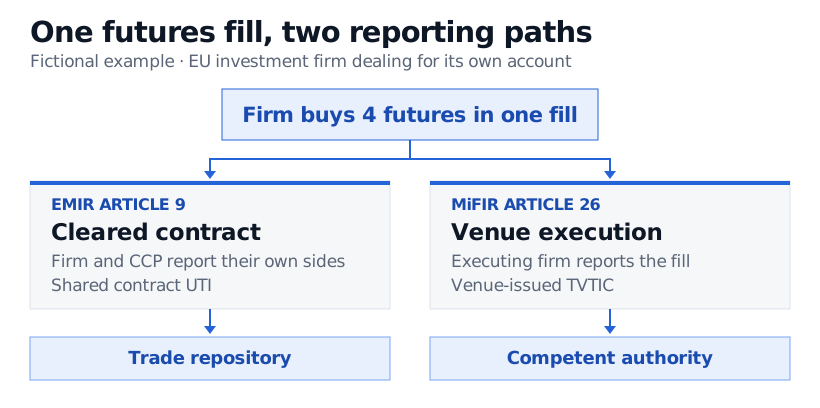
The clearing record and the venue fill supply different keys for tracing the same trading activity.
Check each reporting path
Match the MiFIR report to the venue fill and the EMIR report to the cleared contract in the clearing records. The TVTIC identifies a venue execution and the UTI identifies a derivative between counterparties. Keep the mapping from fill to cleared contract in the firm's records. Check acceptance on each path. The repository can accept the cleared contract while the competent authority rejects the transaction report for a missing instrument ISIN. In that case, check the fill against the instrument reference data and correct the MiFIR submission. EMIR reporting guidelines, § 3.18 · RTS 22, Article 15 and Annex I
EMIR permits delegation. Under MiFIR, the firm can report directly, use an approved reporting mechanism (ARM), or use the venue through which it traded when that venue reports on its behalf. A repository approved as an ARM can also satisfy Article 26 where the data meet MiFIR requirements and the repository transmits them to the competent authority on time. The obligations and data checks remain distinct even when one provider handles both. EMIR Article 9(1e)–(1f) · MiFIR Article 26(7)
SFTR reporting follows a different contract lifecycle, including repos and securities loans. Its worked case shows how two reports can pair under one UTI while a reported maturity date still fails reconciliation.
Which rules apply
The EMIR REFIT reporting standards have applied since 29 April 2024. As checked on 8 November 2026, ESMA's MiFIR transition note still points to the 9 January 2024 consolidated Article 26 and existing RTS 22 until revised RTS 22 starts applying. ESMA's July 2026 proposal for an integrated “report once” system calls for legislative changes and phased implementation. ESMA's EMIR reporting timeline · ESMA's Article 26 transition note · ESMA's July 2026 simplification recommendations