A trade repository collects and maintains regulatory reports on derivatives contracts. It gives supervisors a view of positions and links between counterparties across firms. For an analyst, the first question is what a row represents. Two rows may describe opposite sides of one swap, and several rows may describe the same side at different points in the contract's life. EMIR Article 2 · ESMA's EMIR reporting overview
The 2008 crisis exposed how hard it was to see the network of obligations in over-the-counter markets. In 2009 the G20 committed to reporting OTC derivatives to repositories as part of a wider reform agenda. Execution establishes the terms, a central counterparty steps between parties on trades it accepts for clearing, and the repository keeps the regulatory record. FSB on OTC derivatives reform
Two reports, one outstanding swap
Suppose two EU banks submit opposite-side reports for one fictional uncleared swap. Both have an EMIR reporting obligation. At the snapshot, each report shows the same unique transaction identifier (UTI), abbreviated A01, and the same notional amount of USD 100 million. Bank A's report names Bank B as its counterparty, and Bank B's names Bank A. A sum over report rows gives USD 200 million. For market-wide outstanding notional, the single swap contributes USD 100 million.
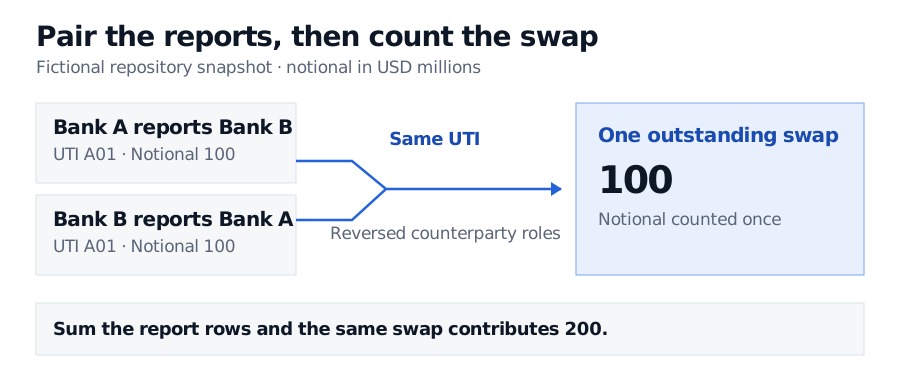
Each report preserves one bank's view. The paired view counts the contract once for a market-wide notional total.
EU repositories pair eligible reports using the UTI and the counterparty identifiers. They then compare specified fields within the applicable tolerances, including across repositories if the sides report to different ones. A valid submission can still be unpaired or have a mismatch. If the paired reports disagree on notional, investigate the discrepancy before choosing a value for the total. A single side can be legitimate when the other party is outside the EMIR reporting obligation. When both sides are in scope, an unpaired report calls for checking timing, submission status and identifiers. EU reconciliation rules, Articles 1 and 3
To estimate outstanding notional at a cutoff, reconstruct the state from the reports and their events before counting contracts. A correction can change the recorded terms of the same contract. An effective termination removes it from the outstanding total. Clearing can create new contracts with new identifiers. When clearing replaces a previously reported bilateral contract, keep the links to the original contract to trace the trade's history. ESMA's reporting guidelines, §§ 3.6 and 6.1
The UTI and the reporting role
EU EMIR. Under the Article 9 framework and the REFIT technical standards applicable since 29 April 2024, reports for the same derivative use a common UTI. Who generates it depends on the trade. For example, a CCP generally generates the UTI for its contract with a clearing member. At transaction level, the UTI identifies the contract. A legal entity identifier identifies an entity. The entity generating the UTI, the party legally responsible for reporting and the entity that sends the report can differ. For example, a financial counterparty generally reports both sides of its OTC derivative with a non-financial counterparty below the clearing threshold, subject to the conditions in Article 9. ESMA's REFIT timeline · EMIR Article 9 · EU reporting standards, Article 7 and the Annex
US CFTC Part 45. For an in-scope, uncleared off-facility swap with exactly one swap dealer, the dealer is the reporting counterparty. It ordinarily generates the UTI and sends creation and continuation data to a swap data repository (SDR). When execution takes place on or under the rules of a swap execution facility or designated contract market, that venue ordinarily generates the UTI and reports creation data. The UTI follows the same swap through its lifecycle. For open swaps, the reporting counterparty verifies SDR data against its own books. 17 CFR Part 45, §§ 45.3–45.5, 45.8 and 45.14
What the totals tell you
Outstanding notional measures the scale of contracts. Estimating counterparty credit exposure starts with market values and the applicable netting and collateral arrangements. Potential future exposure also depends on how those values could change over the horizon being measured. BIS on derivatives statistics · Basel Committee guidelines on exposure measurement
Under EMIR, designated authorities can access the contract details needed for their mandates. Repositories publish aggregate positions by derivative class for the public. EMIR Article 81
The Finance Primer's Market Participants lesson follows the distinct jobs from execution through custody. The page offers a public preview and members can read the full lesson.