A safe-asset shortage occurs when demand to hold assets expected to retain value in a crisis is strong relative to the supply of claims that can serve that purpose. Investors bid up those assets. For fixed promised cash flows, a higher price means a lower yield. For a bond analyst, that means the spread over a safe benchmark can reflect the value investors attach to the benchmark itself. Caballero, Farhi and Gourinchas (2017)
Safe for whom, and when?
A short-dated government bond from a credible issuer can be a dependable source of nominal cash for an investor with a near-term liability in the same currency. An investor who needs cash in another currency faces exchange-rate risk. Someone who must sell a long-dated bond tomorrow faces interest-rate risk even if full repayment is expected. Safety depends on the shock, the holder’s obligations and the horizon. It can also change abruptly. During the global financial crisis, some mortgage-backed claims lost their perceived safe status just as demand for protection rose. Caballero, Farhi and Gourinchas (2017), Table 1 and accompanying discussion
An asset can be valuable because it is easy to sell or because counterparties accept it as collateral. Those services matter separately from the reliability of the promised payments. In a repurchase agreement that calls for a specific Treasury issue, the cash lender may accept a lower rate than on general collateral to get that bond. That is repo specialness, a measure of scarcity for a particular issue. D’Amico, Fan and Kitsul (2014)
The SelfMadeQuant lesson on repo and the funding leg of fixed income compares general collateral and specific-issue repo. Its preview is public and the full lesson requires membership.
What a yield gap can tell you
Consider two fictional bonds in the same currency with matched duration. Bond A yields 4.30% and Bond B yields 3.80%, both on an annual effective basis. Assume the same default and recovery risk, option terms, tax treatment and other pricing factors. Bond B is easier to trade and more useful as collateral. Those are the only differences investors price in the example.
Under those assumptions, the 50 basis points are Bond B’s relative convenience yield, the yield investors give up for the additional services. In market data the same gap could also reflect differences in credit, options or taxes. To study the Treasury convenience yield, Krishnamurthy and Vissing-Jorgensen examined how several spreads varied with Treasury supply, controlled for default risk and used comparisons intended to separate liquidity from safety. Their evidence concerns the historical U.S. Treasury market. Krishnamurthy and Vissing-Jorgensen (2012), Sections I and III
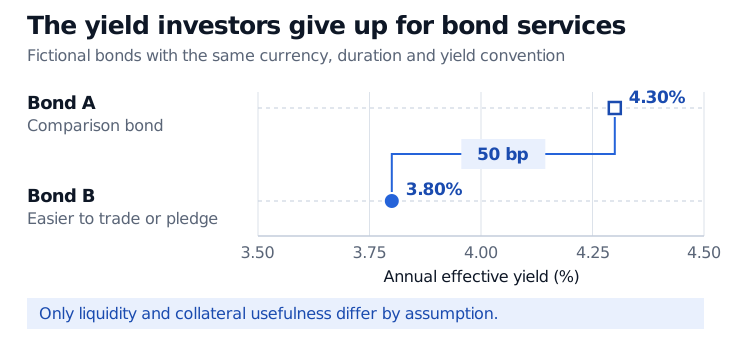
The chart shows the difference in quoted bond yields. Its interpretation as a convenience yield depends on the assumptions above.
When scarcity is global
Excess demand at the old price can clear through a higher price. The word shortage describes that pressure relative to supply, even after the market has adjusted. Caballero, Farhi and Gourinchas argued in 2017 that global demand for safe claims had grown faster than supply from a small group of credible issuers. In their account, cross-border purchases put downward pressure on safe rates. Bernanke’s earlier global saving glut hypothesis concerns a broader imbalance between desired saving and investment at historically normal real rates. Low yields can also reflect lower expected short rates or a lower term premium, so establishing a global shortage requires evidence about demand and the supply of credible substitutes across markets. Caballero, Farhi and Gourinchas (2017), Bernanke (2005), Bernanke (2006)
Sources
- Caballero, Farhi and Gourinchas (2017), The Safe Assets Shortage Conundrum.
- Krishnamurthy and Vissing-Jorgensen (2012), The Aggregate Demand for Treasury Debt.
- D’Amico, Fan and Kitsul (2014), The Scarcity Value of Treasury Collateral.
- Bernanke (2005), The Global Saving Glut and the U.S. Current Account Deficit.
- Bernanke (2006), Reflections on the Yield Curve and Monetary Policy.