Differentiate a ratio while allowing both numerator and denominator to change. A fixed-debt balance sheet shows why falling asset value can increase leverage.
Quotient rule
The quotient rule differentiates a ratio when its numerator and denominator depend on the same input. If q(x)=f(x)/g(x), with both functions differentiable at the point and g(x)=0, then
q′(x)=[g(x)]2f′(x)g(x)−f(x)g′(x).
The first term captures the numerator's contribution; the second subtracts the denominator's contribution. Dividing their derivatives, f′(x)/g′(x), generally gives the wrong answer. OpenStax's differentiation rules state the same formula and its nonzero-denominator condition.
This matters whenever a financial measure divides one changing quantity by another. A ratio can move in the opposite direction to its numerator.
Why a price fall can increase leverage
Consider a deliberately simple balance sheet: a fixed holding of one asset unit worth S USD and fixed debt of USD 60. Ignore interest, costs, margin calls and rebalancing. Equity is asset value less debt, E(S)=S−60. Define asset-to-equity leverage as
L(S)=S−60S,S>60.
The positive-equity restriction is part of this example. This is an accounting sensitivity model, with no assumption that a broker would permit or maintain the holding at every price.
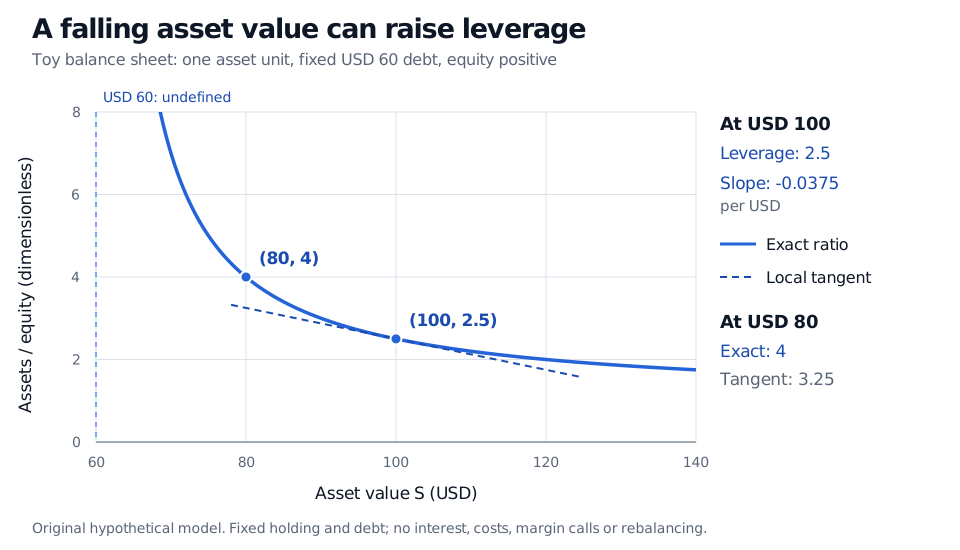
At S=100, assets are USD 100, equity is USD 40 and leverage is 100/40=2.5. If the asset falls to USD 80, equity falls to USD 20 and leverage rises to 80/20=4. The denominator shrinks proportionally faster than the numerator.
Both functions vary with S: f(S)=S and g(S)=S−60, so f′(S)=g′(S)=1. Applying the quotient rule gives
L′(S)=(S−60)21⋅(S−60)−S⋅1=−(S−60)260.
The derivative is negative throughout the chosen domain. A higher asset value reduces this leverage measure; a lower asset value increases it. Treating equity as constant would keep only 1/(S−60) and predict the wrong direction. Dividing the two derivatives would give 1, also wrong.
At USD 100,
L′(100)=−40260=−0.0375per USD.
The ratio and its derivative have different units. Leverage is dimensionless because USD divides USD. Its derivative has units of leverage change per USD change in asset value. A USD 1 increase therefore gives the local estimate
L(101)≈L(100)+L′(100)(1)=2.4625.
Exact revaluation gives 101/41≈2.463415. The derivative is a local slope, rather than an exact rule for a finite move.
Toy asset-to-equity leverage with fixed USD 60 debt. The curve passes through asset value USD 100 and leverage 2.5, and USD 80 and leverage 4. The tangent at USD 100 has slope minus 0.0375 per USD and predicts 3.25 at USD 80. At USD 60 the ratio is undefined.
Original hypothetical balance sheet with a fixed one-unit holding and USD 60 debt. The dashed tangent at USD 100 illustrates local sensitivity; it understates leverage after a USD 20 fall.
For that larger fall, the tangent predicts 2.5+(−0.0375)(−20)=3.25, while the exact ratio is 4. At USD 80 the slope itself is −60/202=−0.15 per USD: sensitivity has increased in magnitude. Recomputing the ratio matters when the denominator becomes small.
Where the minus sign comes from
The rule follows from the product rule. Write qg=f wherever g=0, then differentiate:
q′g+qg′=f′.
Solving for q′ and substituting q=f/g gives
q′=gf′−qg′=g2f′g−fg′.
The subtraction removes the part of the numerator's change already explained by the changing denominator. Keeping the order f′g−fg′ avoids reversing the sign.
If g is a nonzero constant, its derivative vanishes and the formula reduces to q′=f′/g. If f is constant, the first term vanishes and q′=−fg′/g2. The chain rule is still needed when either component contains a composition; it supplies f′ or g′ before the quotient rule combines them.
A small denominator is also a domain warning
In the leverage example, L(S)=1+60/(S−60). As S approaches 60 from above, equity approaches zero and the ratio grows without bound. At exactly USD 60, leverage is undefined, not zero. Below USD 60 the algebraic expression exists, but negative equity falls outside the positive-equity leverage interpretation used here. A negative result should not be presented as low leverage or low risk.
Algebraic simplification can hide an excluded point too. The rational function(x2−1)/(x−1) equals x+1 only for x=1. Its derivative is 1 on that domain. Cancelling the factor does not give the original function a value or derivative at x=1; filling the hole defines an extension.
James Stewart, Single Variable Calculus: Early Transcendentals, 6th edition, Thomson Brooks/Cole (2008), §3.2, pp. 185–187 — quotient-rule derivation and applications to rational functions.