State-owned enterprise (SOE) debt is borrowing by a company that a government owns or controls. Quasi-sovereign debt is a market label for debt of a legally separate issuer whose credit is closely tied to a government. Many SOE bonds fall into that category. For a credit analyst, the government can affect the issuer’s cash flows, the likelihood of a rescue and the legal source of repayment. Each matters in a different way. In its 2022 EMBI Global guide, for example, J.P. Morgan classified issuers in eligible countries as quasi-sovereign if they were wholly owned or fully guaranteed by the national government. J.P. Morgan Index Product Guide
The utility is short of cash
Imagine a national government owns an electricity utility. It appoints the board and tells the utility to keep tariffs low. The utility’s revenues and refinancing capacity determine whether it can service its own debt. The state can keep the grid operating through an equity injection or by transferring essential operations to another company. Only some interventions put cash in the issuer’s hands in time to pay bondholders. That is the difference between keeping an essential service running and keeping a particular bond current. IMF Government Finance Statistics Manual, chapter 2
Expected support is an assessment of whether the state is willing and able to step in when the issuer needs cash. An explicit sovereign guarantee gives the designated creditor or trustee a legal claim against the sovereign for payments covered by its terms. For a particular bond, the offering documents, governing guarantee and any amendments establish the guarantor, eligible bond series, principal and interest coverage, caps or expiry, and the trigger and process for making a claim. A guarantee covering only scheduled principal, for example, leaves a missed coupon outside its scope. From the state's perspective, a guarantee creates an explicit contingent liability. Discretionary intervention is an implicit fiscal exposure. Either can become more costly when a shock strains both the utility and the government, so sovereign repayment capacity matters even when a guarantee is enforceable. World Bank fiscal risk matrix · World Bank framework for managing government guarantees
What a 60 bp spread tells you
On the same day, the fictional utility’s senior unsecured bond yields 4.8% and its government’s direct sovereign bond yields 4.2%. Both are in USD, have five years remaining, pay a 4.5% annual coupon and repay principal at maturity. Both lack embedded options. Their modified durations are close at 4.37 years for the utility and 4.41 years for the sovereign. Using annual effective yields to maturity, the simple credit spread over the sovereign is
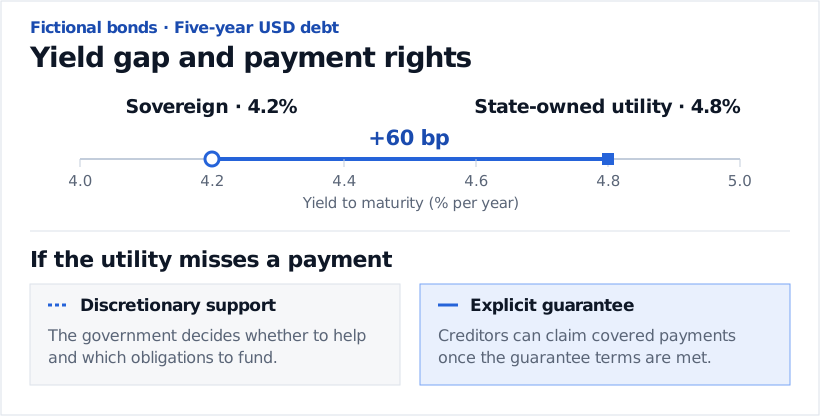
The upper panel shows the observed yield comparison in a fictional market. The lower panel compares two possible legal arrangements for the utility bond.
When interpreting that spread, check the corporate bond’s payment priority and any embedded options against those of the instruments used for comparison. A less actively traded utility bond can carry a liquidity premium even if investors expect strong support. The sovereign benchmark itself can carry default and restructuring risk. Estimating a default probability from this relative yield would require assumptions about both issuers, recoveries, liquidity and risk premia. Establishing a guarantee requires reading the governing documents. Federal Reserve Bank of Richmond study on bond liquidity and yield spreads