A sovereign payment default occurs when a government fails to pay principal or interest under the terms of its debt. A sovereign debt restructuring changes those terms, often through a bond exchange, to reduce or defer payments. For an analyst valuing a distressed government bond, recovery depends on which claim the deal covers and what payments the replacement instrument promises, including their timing. IMF, Sovereign Debt
From a missed payment to a settled exchange
A payment is missed when it goes unpaid on its due date. If the bond indenture gives that payment a grace period, the missed payment becomes a contractual event of default only if it remains unpaid when that period expires and the applicable conditions are met. An exchange can be pre-emptive if it is completed before a unilateral payment default, or post-default if it follows one. The contract and governing law determine remedies such as acceleration, which makes principal due early. IMF, Sovereign Debt · Asonuma and Trebesch, Section 2.1
Sovereigns have no general bankruptcy procedure that brings all creditors into one proceeding. Courts may still hear individual claims, and enforcement depends on jurisdiction and which assets creditors can reach. A restructuring therefore usually proceeds through several steps that can overlap. IMF, 2025 stocktake
- Identify which debts the deal covers. The government reconciles what it owes and defines the perimeter, the claims eligible for treatment. Domestic bonds, international bonds, commercial loans and official bilateral debt can be covered by different deals or fall outside a particular exchange. Where an IMF programme is involved, its debt sustainability analysis helps estimate how much relief is needed. Global Sovereign Debt Roundtable playbook
- Negotiate and solicit participation. The sovereign can propose a lower principal, smaller coupons, longer maturities or a combination. An agreement in principle with a creditor committee can precede a formal exchange offer. Where collective action clauses apply and their requirements are met, a qualifying vote can bind dissenting holders of the affected bonds. Global Sovereign Debt Roundtable playbook · IMF, 2025 stocktake
- Settle the exchange. Once the offer conditions are met, the sovereign delivers the new instruments or other consideration and retires the old bonds surrendered in the exchange. A holdout whose claim is outside the exchange and any binding amendment may pursue a separate settlement or seek enforcement. Global Sovereign Debt Roundtable playbook · IMF, 2025 stocktake
What does a 30% principal cut buy?
Take a fictional exchange of 100 in old face value for 70 in new face value, in the same currency. The exchange settles on an old-bond coupon date immediately after that coupon is paid. Take settlement as time zero. There is no accrued interest, arrears or additional consideration at settlement. Both bonds pay their next coupon one year later and return all principal at maturity.
| Terms per 100 of old face value | Old bond | New bond |
|---|---|---|
| Principal | 100 | 70 |
| Annual coupon rate | 8% | 4% |
| Annual coupon payment | 8.00 | 2.80 |
| Years to maturity from settlement | 2 | 4 |
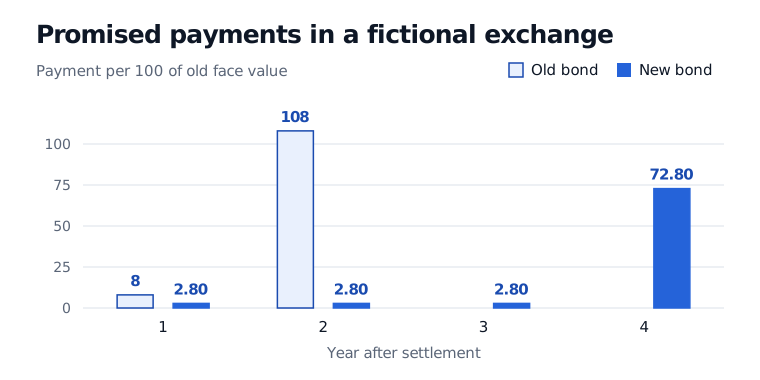
The old principal was due in year 2. The exchange pushes the smaller principal payment to year 4 and reduces each annual coupon.
Discount both payment schedules to settlement at the same illustrative 10% effective annual rate. Their present values are
| Measure | Calculation | Result |
|---|---|---|
| Face-value reduction | One minus new principal divided by old principal | 30.00% |
| Net present value (NPV) reduction | One minus new PV divided by old PV | 41.28% |
| Discounted loss relative to old face | One minus new PV divided by old principal | 43.31% |
All ratios use unrounded values. The last row has the denominator used in a market haircut calculation, where the new debt is typically valued at its exit yield, the yield at which the new bond starts trading. Here the 10% rate is an assumption. The old PV is a benchmark for the old contractual promises at that same rate. An investor's actual gain or loss also depends on what they paid for the old bond. IMF, 2025 stocktake, note 24 · Sturzenegger and Zettelmeyer, Section II
In a live deal, check how past-due interest is treated and include any cash paid at settlement or other consideration in the value of the new package. To estimate relief across the full debt perimeter, sum old and new present values for the claims being treated before taking the ratio. To assess near-term financing needs, compare the amounts due by year, including payments on debt outside the exchange. In this example the year-2 bill for the exchanged bond falls from 108 to 2.80. The new principal still comes due in year 4. Global Sovereign Debt Roundtable playbook
Sources
- International Monetary Fund, A Stocktaking of the Current International Architecture for Resolving Sovereign Debt Involving Private Sector Creditors (2025), Sections I, III and IV. Policy paper
- Global Sovereign Debt Roundtable, Sovereign Debt Restructuring: A Playbook for Country Authorities (April 2026). Playbook
- Leonardo Martinez, Francisco Roch, Francisco Roldán and Jeromin Zettelmeyer, Sovereign Debt (2022), Section 5. IMF working paper
- Tamon Asonuma and Christoph Trebesch, Sovereign Debt Restructurings: Preemptive or Post-Default (2015 working paper), Section 2.1. Author working paper
- Federico Sturzenegger and Jeromin Zettelmeyer, Haircuts: Estimating Investor Losses in Sovereign Debt Restructurings, 1998–2005 (2005 working paper), Section II. IMF working paper