An IMF-supported program is a set of policies a member country undertakes with support from the International Monetary Fund to address an economic problem. In a lending arrangement, conditionality is the set of agreed policy actions, measurable criteria and reviews used to assess progress and govern access to financing. For an analyst, the distinction matters when a foreign-currency payment is due. The amount approved for the program, the amount available to draw and the amount actually drawn answer three different questions. IMF, Conditionality.
Follow the money through a Stand-by Arrangement
The IMF's Stand-by Arrangement (SBA) provides short-term support for a balance-of-payments problem, such as a shortage of foreign currency to meet external payments. The IMF Executive Board approves a total amount and sets terms for access. A portion can be available immediately, with later installments, or tranches, phased in subject to reviews and applicable conditions. A member can also treat an SBA as precautionary and leave available funds undrawn. IMF, SBA factsheet.
In October 2025, IMF staff and the Armenian authorities reached a staff-level agreement on policies for a new precautionary SBA, subject to Board approval. The December approval notice separately listed the total access and the portion immediately available. It made the rest subject to scheduled reviews. IMF, staff-level agreement, IMF, Armenia SBA approval.
Suppose the Board approves 300 units for a fictional SBA. The first 100 units are immediately available and the country draws all 100. Under this schedule, the remaining units become available only after the Board completes the review and the applicable performance criteria are met or waived. At that point, 200 units are available to draw and cumulative draws still total 100. If the review is delayed beyond a payment date, the pending tranche contributes zero cash by that date. Even after the review, the cash flow occurs when the country draws.
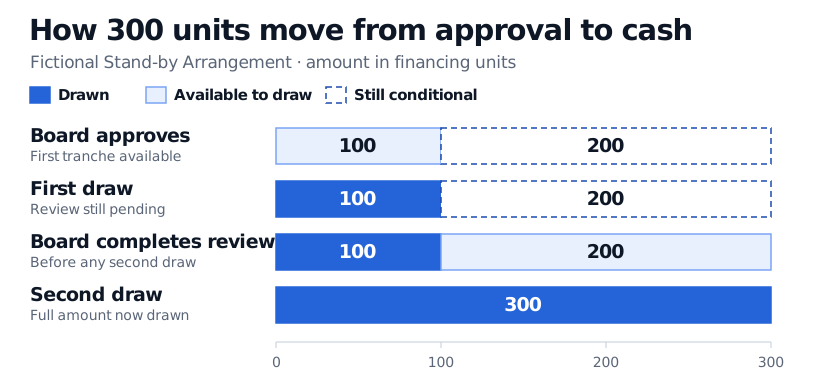
Completion of the review makes the second tranche available. Cumulative cash received rises only at a draw.
What the Board reviews
The authorities' letter of intent and policy memorandum describe the commitments. The technical memorandum sets out how criteria are measured. The label on each commitment tells you how a miss is handled. IMF, operational guidance on program design.
| Commitment | Role in the arrangement |
|---|---|
| Prior action | A step the authorities must take before the Board approves the arrangement, completes a review or grants a waiver, such as adopting a specified budget measure. |
| Quantitative performance criterion (QPC) | A measurable condition for drawing, such as a floor on net international reserves. A miss requires a waiver for access to proceed. |
| Indicative target | A numerical tracker for assessing progress. A miss is considered in the review. |
| Structural benchmark | A marker of progress on a critical reform, such as publishing a report on government arrears. A miss is considered in the review. |
At a scheduled review the Board assesses the program as a whole and can adjust it as conditions change. It can waive a missed QPC if it judges the program can still be implemented successfully, for example when the miss was minor or temporary or the authorities have taken corrective action. Missed indicative targets and structural benchmarks enter that overall assessment without a formal waiver. IMF, Conditionality.
In September 2026 the Board reaffirmed the 2002 Guidelines on Conditionality and supported a phased rollout of reforms, including stronger follow-up on corrective actions when these justify waivers. It called for piloting a medium-term structural reform strategy. The rollout starts with guidance and tools, with selected reforms piloted before broader implementation. IMF, 2026 Board review.
Why a review matters for sovereign risk
For a sovereign debt model, put the expected draw on the cash-flow timeline beside reserves and payments coming due. Compare a draw before the payment with a delayed or unavailable tranche. A review can also revise the policy and growth outlook, so a completed review has no fixed effect on bond spreads. Near-term financing can ease a liquidity squeeze while debt sustainability still depends on future debt service and the capacity to pay. If the IMF assesses debt as unsustainable, lending requires steps to restore sustainability, which can include a restructuring. IMF, guidance on financing assurances and sovereign debt.
Sources
- IMF, Stand-by Arrangement factsheet, including conditionality and precautionary access.
- IMF, Conditionality factsheet, including condition types, reviews and waivers.
- IMF, staff-level agreement on Armenia's new Stand-by Arrangement, October 2025.
- IMF, approval of Armenia's Stand-by Arrangement, December 2025.
- IMF Executive Board, 2026 Review of Program Design and Conditionality, September 2026.
- IMF, Operational Guidance Note on Program Design and Conditionality, January 2024, paragraphs 49–50.
- IMF, Guidance Note on Financing Assurances and Sovereign Arrears Policies and the Fund's Role in Debt Restructurings, November 2024, paragraph 101.