A collective action clause (CAC) is a provision in a sovereign bond contract that lets a specified majority approve changes, such as reducing principal or extending maturity, that bind all holders of the affected bonds once the contractual requirements are met. A holdout creditor declines a restructuring deal, often in the hope of collecting more on the original claim. When valuing distressed bonds, the voting rules help determine which claims move to the new payment terms and which may still depend on a separate settlement or enforcement. ICMA model clauses
Seventy percent can fall short
Suppose a fictional single-series contract requires affirmative votes representing at least 75% of eligible outstanding principal to amend its payment terms. On the voting record date, USD 100 million in principal qualifies. Holders of 70 million vote yes, holders of 10 million vote against and holders of 20 million do not vote. The voting share is
so the amendment fails by 5 percentage points. Among the principal represented in votes cast, 70 out of 80 million backed the proposal (87.5%). Under this contract the full 100 million goes in the denominator, including eligible principal whose holders stayed out of the vote.
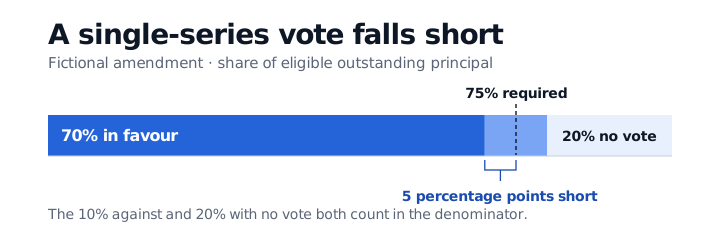
Fictional vote on one bond series. The dashed line marks the approval threshold on the same principal base as the vote.
In this example the denominator is the face amount still outstanding in the affected series on the record date, after contractual exclusions. The ICMA English-law model, for example, treats notes held by the issuer or specified issuer-controlled entities as outside the voting base. If the fictional proposal reached 75% and satisfied the remaining contract requirements, such as notice and applicable quorum or written-consent procedures, the effective amendment would bind the whole series, including holders who voted against or stayed out. Other series from the same issuer and loans outside the proposal would require their own arrangements. ICMA English-law model, clauses (a), (b) and (i) and aggregation procedures
How much can one series block?
The voting method determines where a holdout can assemble a blocking position. These thresholds illustrate amendments to payment terms under the May 2015 ICMA English-law model, where those terms are reserved matters.
| Method | Approval test in the model | Where a blocking position matters |
|---|---|---|
| Single series | At least 75% of outstanding principal in that series. | Within the series. |
| Two-limb aggregation | At least 66⅔% of outstanding principal across the affected series and more than 50% in each affected series. | Across the pool or within any one included series. |
| Single-limb aggregation | At least 75% of outstanding principal across the affected series, with a uniformly applicable proposal. | Across the pool. The vote can pass even with low support in one included series. |
For an exchange under the model’s single-limb procedure, uniformly applicable means offering holders of every included series the same terms for the same consideration or an identical menu. For any actual vote, use the governing bond documents. Even the May 2015 ICMA New York-law model requires more than 75% for its single-series and single-limb routes, so exactly 75% clears the English-law model's percentage test and falls short under the New York-law model. ICMA English-law clauses (b)–(e) and New York-law subsections (d)–(f)
Older bonds may permit only series-by-series voting, and some debt may fall outside the group eligible for aggregation. If a holdout keeps an original claim, litigation and enforcement can extend beyond an exchange of the other bonds. The IMF’s 2025 stocktake documents the holdout suit against Sri Lanka and notes how difficult it can be to enforce a judgment against a sovereign. To value the debt during a restructuring, track the approval outcome series by series before assigning new cash flows to the affected claims. IMF stocktake, paragraph 14 and Box 1