In the United States, a primary dealer is a bank or securities dealer that the Federal Reserve Bank of New York has designated as a trading counterparty for monetary policy operations. The New York Fed also expects these firms to bid in every Treasury auction. For a rates desk reading auction results, that standing expectation explains why dealers show up even when the amount they win varies from one sale to the next. New York Fed — Primary Dealers
What the dealer commits to bid
The New York Fed expects a primary dealer to bid for at least its pro-rata share of the amount offered, calculated by dividing the offering by the number of primary dealers at that auction. It assesses whether bids are reasonably competitive against rates in the when-issued market, where participants can trade a Treasury security before it is issued, taking volatility and other risks into account. This expectation governs the bid the dealer submits. Treasury's auction rules govern the award. Other eligible investors can also bid directly or through intermediaries. New York Fed — Primary Dealers · TreasuryDirect — How Auctions Work
How 100 million bid becomes 60 million awarded
After accepting eligible noncompetitive bids, Treasury fills competitive note bids from the lowest yield upward. The highest yield accepted is the stop-out yield. Bids at that yield can be partially filled if demand there exceeds the amount left. In a single-price auction, all successful bidders pay the price corresponding to the stop-out yield, including those who bid at lower yields. 31 CFR § 356.20 — Auction Awards
Suppose a dealer tenders USD 100 million in par for its own account across three competitive bids. In this fictional auction, Treasury stops at 4.01% and awards half the amount bid at that yield. The dealer wins USD 40 million below the stop and USD 20 million at the stop. Its bid above the stop wins nothing.
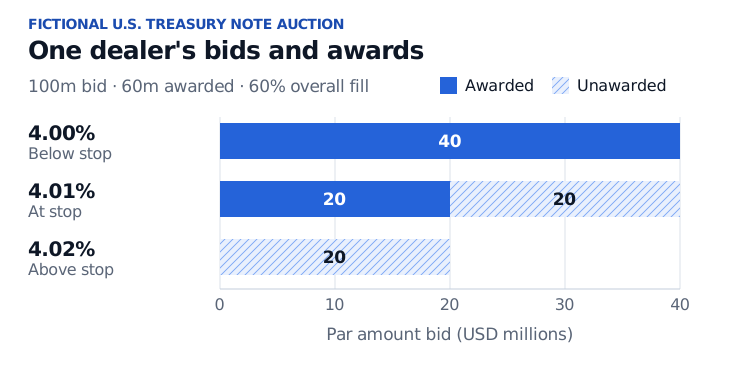
The 50% proration applies only to bids at the stop-out yield. The dealer's overall fill combines all three bids.
In Treasury's competitive auction results, the Primary Dealer category captures dealers bidding directly for their own accounts. A competitive customer bid submitted through a primary dealer belongs in Indirect Bidder. To calculate the dealers' share of competitive awards, divide the category's awards by total competitive awards. The 60% above instead uses one dealer's own bid size as its denominator. TreasuryDirect — FAQs about Auctions
Where the dealer trades after issuance
Market making means quoting prices to buy and sell. The New York Fed looks for a substantial two-way presence in government securities, especially Treasury cash and repo, and expects primary dealers to quote for its official account holders as needed. Separately, when the Fed's Trading Desk buys or sells outstanding Treasuries for monetary policy, a primary dealer can take the other side of that secondary-market trade. The New York Fed also conducts issuance auctions as Treasury's fiscal agent. A dealer buying new debt at auction is buying from Treasury in the primary market. New York Fed — Primary Dealers · New York Fed — Treasury Securities · New York Fed — Counterparty Policy