The midprice, or midquote, is the arithmetic average of a market's best bid and best ask for the same instrument at a stated time. It gives a quant a common reference for marking positions and comparing executions. It does not, by itself, identify a price at which the position can be bought or sold.
With best bid and best ask , the midpoint is
The subscript matters: this is a reference for a particular observation time. The quote scope matters too. A midpoint from one venue's order book can differ from a midpoint formed from a consolidated best bid and offer across venues. Identify which one a dataset or execution report uses.
The mark and the cash ledger
Consider a hypothetical stock quoted USD 99 bid / USD 101 ask at one venue. Both prices refer to the same instant and share class. Its midpoint is USD 100 per share; its bid-ask spread is USD 2 per share. Each quote is USD 1 away from the midpoint.
Now stipulate that a market buy for 100 shares fills entirely at the ask of USD 101. There is enough offered quantity, the quote does not change, and fees are zero.
| What is measured | Calculation | USD |
|---|---|---|
| Cash paid for the actual buy | 100 shares × 101 | 10,100 |
| Position marked at the midpoint | 100 shares × 100 | 10,000 |
| Buy's cost relative to that mark | 10,100 − 10,000 | 100 |
The USD 100 benchmark difference is the one-way half-spread cost under these assumptions. It is already present in the cash paid. Subtracting it again from a holdings-and-cash ledger would double count it. Explicit fees, if any, would be an additional cost.
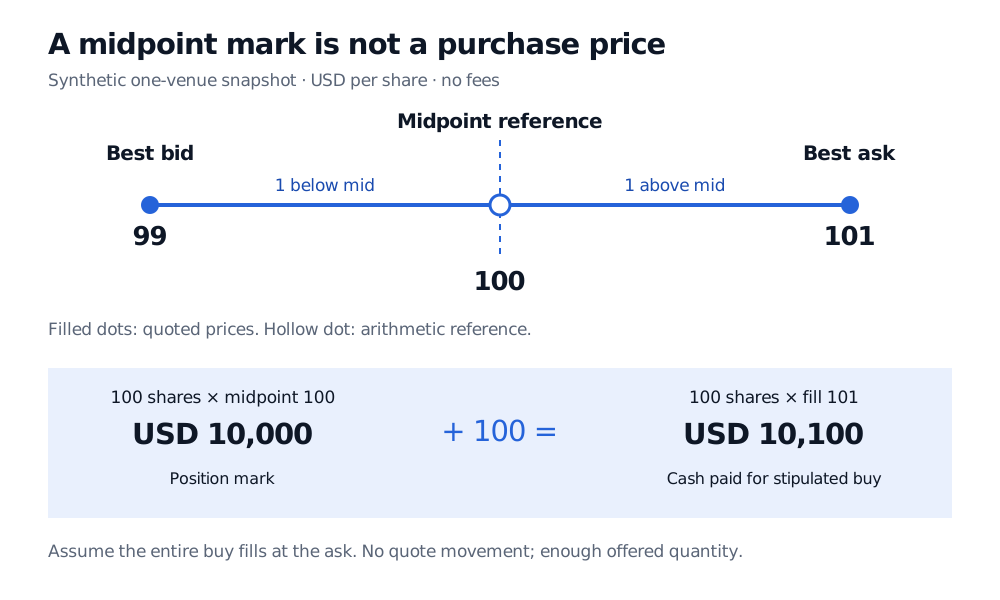
Original synthetic one-venue snapshot, USD per share. The entire 100-share buy is assumed to fill at the unchanged ask with enough quantity available and no fees. The midpoint is a reference, not an execution guarantee.
Marking the acquired shares at USD 10,000 does not mean that selling them would raise USD 10,000. An exit needs buyers, available size and an executable price. A larger trade may consume several price levels; even the displayed best quote can disappear before an order arrives. The membership lesson Order Books, which has a public preview, develops that depth calculation and its assumptions.
Three prices that answer different questions
The last trade records an execution that already happened. It can be old or lie on either side of the current midpoint. A new quote can move the midpoint without any trade; a trade at an unchanged bid or ask need not move the midpoint. A last-trade series and a midpoint series therefore need not tell the same short-horizon story.
The arithmetic midpoint uses the two prices with equal weight. It does not use the displayed quantities on either side, the queue, hidden liquidity or a prediction of the next price change. Changing quote sizes alone leaves this midpoint unchanged.
A microprice is a model-based reference that uses order-book information, often including imbalance, to estimate a near-term price. Its construction depends on the model; Sasha Stoikov's author repository provides one such estimator and links to the underlying research. It should not be relabelled as the plain midpoint, nor assumed to be an executable price. A directional signal around a midpoint still has to survive transaction costs and actual fills.
Midpoint execution is possible, but conditional
Some venues provide midpoint-pegged orders or matching mechanisms. For example, Nasdaq's midpoint-liquidity description explains orders priced with reference to the midpoint of the U.S. national best bid and offer (NBBO). Such an order can obtain a price inside the quoted spread if it executes. The mechanism still needs eligible opposing interest and is governed by its venue rules; merely computing a midpoint does not produce that interest.
For execution analysis, specify when the benchmark is observed. A decision-time midpoint, an order-receipt midpoint and a midpoint immediately before a fill can differ. The SEC's Rule 605 FAQs give a concrete U.S. reporting example in which several market-order statistics use the NBBO at order receipt. That reporting convention is not a universal clock for every research dataset.
When the arithmetic outlives the meaning
Before using a midpoint, retain its instrument, currency, quote units, venue scope, timestamp and trading state. Check that both sides are present and usable at the chosen time. Do not average a price per share with a price per contract, or silently combine stale and current observations.
- In a locked quote, bid equals ask, so the arithmetic midpoint equals both. That alone does not promise a fill for any requested size.
- In a crossed quote, bid exceeds ask. The average can still be calculated, but the crossed state requires investigation or an explicit dataset rule before treating it as an ordinary market benchmark.
- In a one-sided quote, one input is missing. There is no two-sided midpoint; replacing the missing side with zero invents a price.
An apparently smooth midpoint history can conceal thin depth, stale observations or a change in quote scope. In a backtest, keep the marking convention separate from the fill model. Positions, Trades, Fills and P&L shows how actual fills update cash and holdings before positions are marked; it has a public preview and requires membership for the full lesson.
Sources
- Narang, R. K. (2013), Inside the Black Box, 2nd ed., Wiley, Chapter 7, “Order Execution Algorithms,” p. 120: mid-market definition and execution benchmarking; Chapter 5, pp. 80–84: fees, timing and liquidity-related costs.
- Nasdaq, Midpoint Liquidity, pp. 1–2: venue-specific midpoint orders and routing.
- SEC, Frequently Asked Questions: Rule 605 of Regulation NMS, updated 1 April 2026, Q14 and Q16: midpoint-pegged examples and the order-receipt benchmark in specified U.S. execution statistics.
- Stoikov, S., The Microprice, author repository: an order-book-conditioned price estimator, with the accompanying paper and implementation.