“Eligible” matters: a screen’s last-price field may apply session, trade-condition and correction rules. Check the field definition before assuming that every incoming transaction updates it.
A trade at 98 and a quote at 99 / 101
The last trade is below the current bid. There is no contradiction: the transaction and the quote describe different moments. The quoted market can change through order additions, cancellations and amendments without another trade occurring.
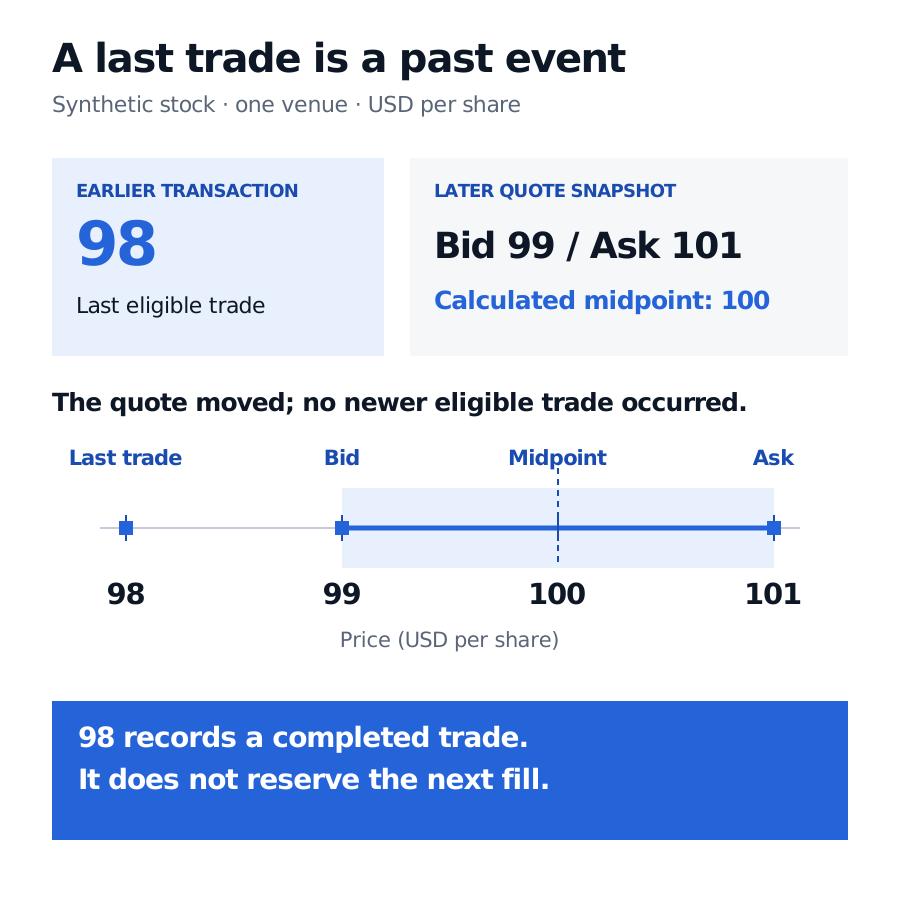
A last trade can also remain inside the current spread while being old. Its location relative to today’s quotes does not, by itself, establish freshness or data quality.
“Latest” needs a clock
Three times can describe different stages of the same transaction:
| Time | What it describes | Why it matters |
|---|---|---|
| Execution or event time | When the transaction occurred, according to the source’s defined clock and field semantics | Orders transactions in a reconstruction of market events |
| Reporting or dissemination time | When a report was submitted or distributed, as defined by that particular field | Helps identify delay between the transaction and its publication |
| Local receipt time | When the consuming system received the message | Establishes when that system could first use the information |
A feed need not provide all three, and submission time and dissemination time are themselves distinct events. Do not assume a field named “timestamp” means execution time, or compare clocks without checking their basis and synchronisation.
A late report may arrive after reports of trades that actually occurred later. Sorting solely by receipt time can therefore make an older transaction appear to be the newest event. Conversely, a historical file sorted by execution time can contain reports that a live strategy had not yet received. A backtest must respect information availability when constructing signals or decision benchmarks; it cannot bring a delayed report into an earlier decision.
Keep the price field’s purpose attached
| Field | Question it answers |
|---|---|
| Last traded price | Where did the latest qualifying recorded transaction occur? |
| Best bid and ask | What buying and selling interest does this quote snapshot show, within its stated scope? |
| Quote midpoint | What is the average of the paired bid and ask? |
| Valuation mark | What price has the valuation policy selected or estimated for the position? |
| Execution benchmark | What reference has been chosen to evaluate a trade? |
For research, retain the instrument and price units, venue or consolidation scope, session, trade identifier, relevant timestamps and sale-condition or correction flags. A direct venue feed and a consolidated data product can legitimately have different last-price observations.
Sources
- SEC Investor.gov — Understanding Order Types, updated 18 August 2026: last-price and quote observations do not guarantee a market order’s execution price.
- Nasdaq — TotalView-ITCH 5.0 specification, §§1.4.2 and 1.5.3: non-printable execution messages and broken trades; Data Types describes the feed’s timestamp representation.
- SEC Investor.gov — Closing Price: session and vendor conventions can distinguish a displayed last transaction from a closing-price field.
- Rishi K. Narang, Inside the Black Box: A Simple Guide to Quantitative and High-Frequency Trading, 2nd ed. (Wiley, 2013), Chapter 7, pp. 119–121: execution objectives, midpoint benchmarks and the distinction between observing a price and obtaining a fill.