A market order instructs a broker or trading venue to buy or sell a specified quantity at the best prices available for execution, without an investor-specified limit price. It prioritises prompt trading. For a quant strategy, the consequence is that the entry price must come from actual fills: multiplying the requested quantity by the price on the screen can understate the cash needed.
In a simple order book, a market buy takes available sell offers, while a market sell takes available bids. The price observed when the order was submitted is not reserved. Nor is the last traded price necessarily a price available for the next trade. These distinctions matter even when the market has barely moved, because the best quote may cover only part of the order.
Buying 70 shares does not mean buying them all at 101
Freeze a synthetic book at the instant an eligible market buy arrives during continuous trading. Sellers offer 50 shares at USD 101 and 100 shares at USD 102. The buyer requests 70 shares. Assume one eligible pool, whole shares, no fees, hidden liquidity, routing, competing messages or binding venue controls. Matching consumes the cheaper offer first.
| Execution price, USD per share | Shares bought | Cash paid, USD |
|---|---|---|
| 101 | 50 | 5,050 |
| 102 | 20 | 2,040 |
| Total | 70 | 7,090 |
The first offer supplies 50 shares; the next 20 come from the offer at 102. Afterward, 80 shares remain offered at 102. This is a book walk: a single incoming instruction produces fills at more than one price.
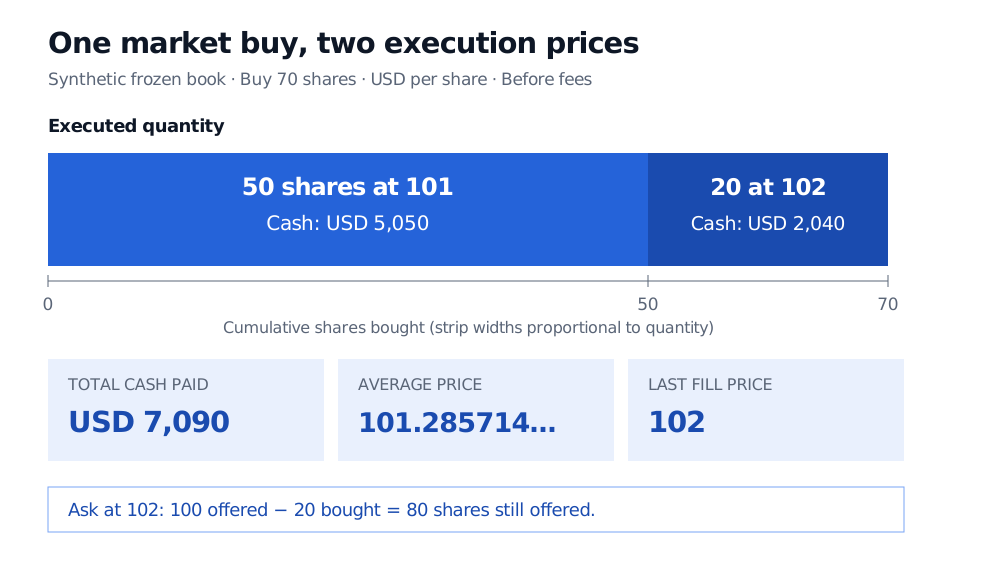
Original frozen-book illustration. Strip widths represent executed shares, not time. Prices are USD per share; cash amounts exclude fees. The unconsumed 80-share offer is separate from the buyer’s completed order.
The average execution price weights prices by the shares actually filled:
The marginal execution price, meaning the price of the last share bought in this stipulated sequence, is 102. It differs from the average. Neither number says where the security will trade next.
Pricing all 70 shares at the initial best ask would predict USD 7,070 of cash paid. The actual ledger requires USD 20 more, or exactly of a dollar per share on average. This is slippage measured against the initial ask. A comparison against a different reference, such as the midpoint, would also include the spread concession. Those price effects are already in the fills; deducting them again from this cash ledger would double-count them. Explicit fees would need their own cash entry. For the buyer, the cash change is −USD 7,090 and the inventory change is +70 shares.
The free public order-book simulator lets you compare market and limit orders, change order size, and switch between thin, normal and deep synthetic liquidity. No account is required. Its presets provide other books to explore; this article’s exact book is a separate illustration.
Urgency still needs an execution report
The frozen example completes because its eligible offers contain enough shares and nothing interrupts matching. A real market order does not promise unconditional completion. Liquidity can disappear before arrival, trading can halt, and the order may be ineligible for the requested session. Routing, exchange price protections and broker or venue rejection controls also affect what happens. Their precise operation depends on the product, venue and instructions; “market” does not override them.
For example, NYSE’s Pillar risk-control documentation describes configurable rejection of market orders. Its historical auction-collar explanation also illustrates how exchange price protections can leave market orders unexecuted. Those controls are different from a price limit chosen by the investor.
A limit order makes that choice explicit: a buy limit caps each purchase price, and a sell limit floors each sale price. In the same frozen book, a buy limit of 101 could buy 50 shares but could not pay 102 for the remaining 20. Handling of that remainder would depend on its other instructions. A marketable limit can therefore seek immediate trading while protecting price, at the cost of possible non-completion.
For a trading model, keep requested quantity, confirmed fills and outstanding quantity separate. Full execution in a frozen-book calculation is a result of its assumptions, not a property guaranteed by the order’s name. Market, Limit and Conditional Orders develops that bookkeeping through partial fills, acknowledgement and cancellation. Its preview is public; the full lesson requires membership.
Sources
- SEC, Understanding Order Types — Investor Bulletin, updated 18 August 2026 — market prices, multiple execution prices and limit-price protection.
- Investor.gov: Market Order and Trading Halts and Delays — order definition and interruptions to trading.
- NYSE, Pillar Risk Controls, version 4.82, 22 September 2026, §6.3 — configurable order restrictions; Trading Information — session distinctions. NYSE Auctions & Price Collars, 26 March 2020 — a historical example of unexecuted market orders under auction protections, rather than a statement of every current venue rule. Primary sources checked 2026-10-27.
- Rishi K. Narang, Inside the Black Box: A Simple Guide to Quantitative and High-Frequency Trading, 2nd edition, Wiley, 2013, Chapter 7, “Aggressive versus Passive,” pp. 120–122 — taking resting liquidity and walking multiple price levels.