A limit order authorises a trade only at a specified price or better: a buy limit sets the maximum purchase price, while a sell limit sets the minimum sale price. It lets a trading strategy refuse prices that would consume too much of its expected edge. The cost of that protection is uncertain execution: some, all or none of the requested quantity may trade.
For limit price , each execution price must satisfy
The direction matters. A seller wants a higher price, so its limit is a floor. A buyer wants a lower price, so its limit is a ceiling. These are execution-price conditions, as described in Investor.gov’s limit-order definition. They do not protect the position’s value after the trade, and fees must be accounted for separately.
A capped purchase can stop partway through the book
Consider an original synthetic instruction: buy 100 shares with a limit of USD 101 per share. The order book is frozen when the order arrives. Sellers offer 60 shares at 101, and the next offer is 102. Assume whole shares, one eligible pool, no hidden liquidity, no competing orders, no routing and no fees. The stipulated handling permits partial fills and leaves unfilled quantity resting at the limit.
The order buys the available 60 shares at 101, paying USD 6,060 before fees. It cannot continue to 102 because that exceeds the authorised price. The other 40 shares remain as a bid at 101.
| Ledger item after arrival | Result |
|---|---|
| Requested quantity | 100 shares |
| Executed quantity | 60 shares |
| Cash paid before fees | USD 6,060 |
| Unexecuted quantity still live | 40 shares |
| Resting bid price | USD 101 per share |
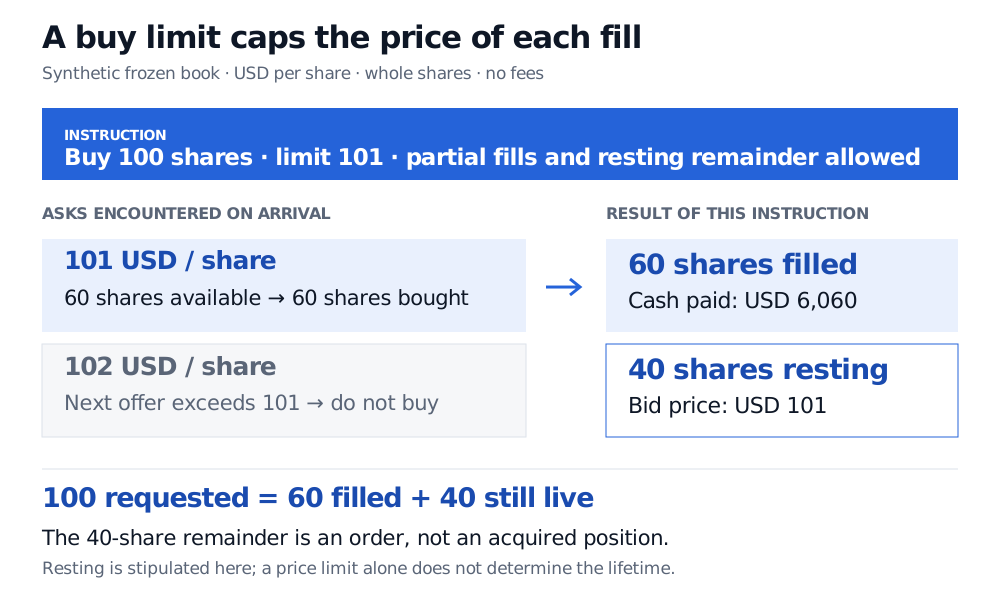
Original frozen, single-pool example. Prices are USD per share and quantities are whole shares. Partial fills and a resting remainder are stipulated; hidden liquidity, competing activity, routing and fees are excluded.
The quantity ledger is 100 requested = 60 filled + 40 still live. Only the executed shares have been bought; the live remainder can still create additional exposure later. No cash has been paid for those unexecuted 40 shares in this trade ledger.
The limit is also not a target average price. Each fill must respect it; cheaper fills do not authorise later purchases above the cap. Conversely, a limit does not require execution at exactly its stated price: a better eligible price is allowed. The SEC’s order-type bulletin explains the distinction between price protection and an execution guarantee.
“Limit” does not mean “wait”
The example’s order is marketable on arrival: its buy limit reaches the best available offer. It immediately takes liquidity for part of its quantity, then supplies liquidity through the resting bid. The same instruction can therefore have an aggressive first stage and a passive remainder.
A buy limit below the best ask cannot immediately match that ask in a simple continuous book. It may instead wait for eligible selling interest. Whether it then fills depends on later activity and the applicable allocation rules, including orders competing at the same price. Seeing a price trade at the limit does not establish that this particular order received a fill.
Waiting has an economic consequence beyond delay. A buy order may miss a rising market, or fill as the market falls and its signal weakens. That second possibility is part of adverse selection. Price protection does not make a passive execution automatically profitable.
Try the public order-book simulator, which requires no account: choose buy or sell, market or limit, a quantity and a limit price, then predict the fill. Its synthetic liquidity presets let you compare immediate executions with resting quantity. The worked book above is a separate illustration, rather than a preloaded simulator scenario.
Choose the remainder policy as well as the price
The 40-share resting bid follows the assumed policy, not the word “limit” alone. The price constraint and the order’s lifetime or completion condition answer different questions:
- A day order gives the unexecuted quantity a designated session deadline.
- An immediate-or-cancel order permits an immediate partial fill and cancels the rest. Applied to the same frozen pool and cap, it buys 60 and cancels 40.
- A fill-or-kill order requires immediate completion in full. With only 60 eligible shares for the 100-share request, it buys none and cancels all 100.
The last two distinctions follow Investor.gov’s IOC and FOK definitions. Available combinations, sessions and handling depend on the broker, product and venue.
For execution modelling, record the price condition, remainder policy and confirmed fills separately. A quote observed before arrival is not reserved liquidity, and an order submission is not proof of a position. Market, Limit and Conditional Orders develops these distinctions and follows orders through acknowledgement, partial fills and cancellation. Its preview is public; the full lesson requires membership.
Sources
- Investor.gov: Limit Orders — buy ceilings and sell floors.
- SEC, Understanding Order Types — Investor Bulletin, updated 18 August 2026 — execution uncertainty, price improvement and broker-specific instruction differences.
- Investor.gov: Immediate-Or-Cancel Order and Fill-Or-Kill Order — alternative immediate completion conditions. Primary sources checked 2026-10-26.
- Rishi K. Narang, Inside the Black Box: A Simple Guide to Quantitative and High-Frequency Trading, 2nd edition, Wiley, 2013, Chapter 7, “Aggressive versus Passive,” pp. 121–124, and “Other Order Types,” pp. 124–125 — limit aggressiveness, execution uncertainty, allocation and order modifiers.