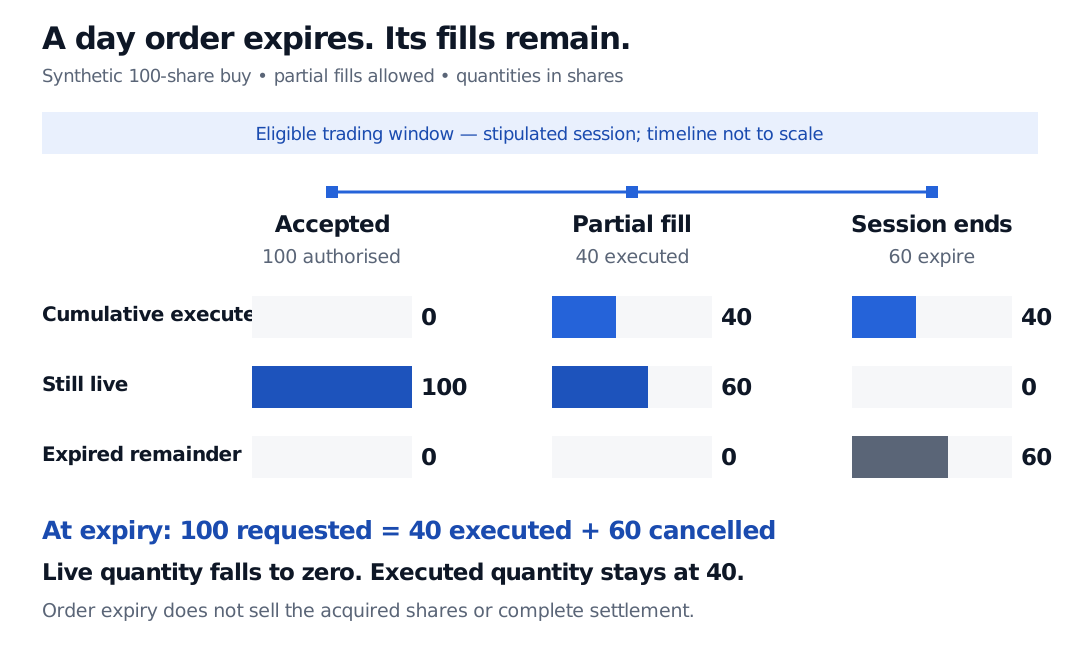
Follow a day order through a partial fill and session-end expiry, separating its unfilled remainder from executed shares and settlement.
Day order
A day order is a trading instruction whose unexecuted quantity expires at the end of its designated trading session. It limits how long an order can remain available for execution. For a systematic strategy, that boundary can prevent yesterday's trading intention from becoming an unintended fill after the signal has changed.
“Day” is a time-in-force instruction, rather than a price instruction. A limit order sets an acceptable execution price; attaching day validity sets the deadline. Neither condition promises that a buyer will find enough sellers. The order types and combinations actually available depend on the broker, product and destination.
The deadline acts on what is left
Consider a fictional buy limit order for 100 shares, with partial fills allowed. The order is accepted during its eligible session. A confirmed execution buys 40 shares; no further fills occur before the stipulated session end. The remaining 60 shares expire and are cancelled.
Confirmed state
Cumulative shares bought
Shares still live
Shares cancelled at expiry
Order accepted
0
100
0
After the partial fill
40
60
0
After session-end expiry
40
0
60
The completed ledger reconciles as 100 requested = 40 executed + 60 cancelled. There is no price or cash amount in this example: its purpose is to isolate the quantity and lifetime rules.
A synthetic 100-share buy has 100 shares live at acceptance, then 40 executed and 60 live, then 40 executed and 60 cancelled at session-end expiry.
Original synthetic share ledger. Partial fills are allowed; no subsequent executions, replacements or trade corrections occur. The session boundary is stipulated, and the timeline is not to scale.
Expiry does not reverse a fill. The buyer has acquired 40 shares through the executions. Ending the order's remaining lifetime does not submit a sell order for those shares. It also does not mean the trades have settled: settlement is the later completion of the trade's delivery and payment obligations under the applicable rules. “No open remainder” and “no position” describe different facts.
Which session does “day” mean?
Do not translate DAY into midnight on the trader's laptop, an automatic 24-hour duration, or a universal regular-session closing time. Check the trading calendar, time zone, eligible sessions and broker handling of submissions outside those sessions.
For U.S. stock investors, the SEC's order-type bulletin says unexecuted day orders generally cancel at the end of regular trading hours and do not carry into extended hours or the next trading day. That is a general description, with an explicit warning that brokers' similarly named instructions can differ.
A concrete broker example shows why the extra settings matter. Interactive Brokers' Classic TWS order-ticket guide describes DAY orders restricted to regular trading hours, outside-hours attributes, and queuing of qualifying after-hours DAY submissions for the next trading day. Read the current product and connection-specific terms before assigning the expiry event in an execution model.
A good-till-cancelled order has a different persistence policy, subject to the broker's cancellation and maximum-lifetime rules. An immediate-or-cancel order removes its unfilled remainder immediately under its specified execution conditions. DAY leaves room for execution during its eligible window; it does not require all-or-none completion.
Put the expiry in the order ledger
A backtest that carries the fictional 60-share remainder into the next session has changed the instruction. It may create fills that the day order could never receive. A backtest that deletes the 40 executed shares at expiry makes the opposite accounting error.
Record the designated session and expiry separately from the price condition. Update confirmed fills, then reconcile the terminal unfilled quantity with the broker's final order state. In live systems, reaching a local clock deadline is not a substitute for processing execution and cancellation reports: a delayed report can describe a fill that occurred while the order was still eligible.
The SelfMadeQuant lesson Market, Limit and Conditional Orders develops this distinction between authorised quantity, confirmed fills and cancellation state, including a cancellation-versus-fill race. Its preview is public; the full lesson requires membership.
Interactive Brokers, Classic TWS Order Ticket: DAY, trading-hour attributes and after-hours handling. Checked 26 October 2026.
Rishi K. Narang, Inside the Black Box: A Simple Guide to Quantitative and High-Frequency Trading, 2nd edition, Wiley, 2013, Chapter 7, “Other Order Types,” pp. 124–125: order modifiers and the importance of current market-specific rules.