A good-till-cancelled (GTC) order is a trading instruction that can carry its unfilled quantity beyond the current trading session, until completion, cancellation or an expiry imposed by the applicable broker rules. It lets a strategy leave an instruction working without re-entering it each day. The cost of that persistence is that an old trading decision may still create a new position after its original signal has faded.
GTC specifies time-in-force: the lifetime of the instruction. A limit order specifies the acceptable price. Combining them gives a price condition and a persistence policy; it does not guarantee execution. A day order, by comparison, ends at its designated session boundary.
What survives the first session?
Consider a fictional GTC limit order to buy 100 shares, with partial fills allowed. Stipulate that the broker carries the unfilled remainder beyond the first session and into later eligible sessions, unless it is cancelled or reaches the broker's policy expiry. This is an illustrative policy, not a rule for every broker.
During day 1, a confirmed partial fill buys 40 shares. The remaining 60 shares are still open after that session ends. The investor does not need to submit another 60-share buy to preserve this instruction. Doing so while the original remains executable would add another order.
| Event | Shares bought through confirmed fills | Unfilled shares still open | Shares cancelled |
|---|---|---|---|
| Acceptance | 0 | 100 | 0 |
| Day 1 partial fill | 40 | 60 | 0 |
| First session ends | 40 | 60 | 0 |
| Later cancellation confirmed, with no further fills | 40 | 0 | 60 |
The session boundary changes none of these quantities under the stipulated GTC policy. At the end of the illustrated path, 100 requested = 40 executed + 60 cancelled. Cancelling the remainder does not undo the 40 shares already bought or submit a sale of them.
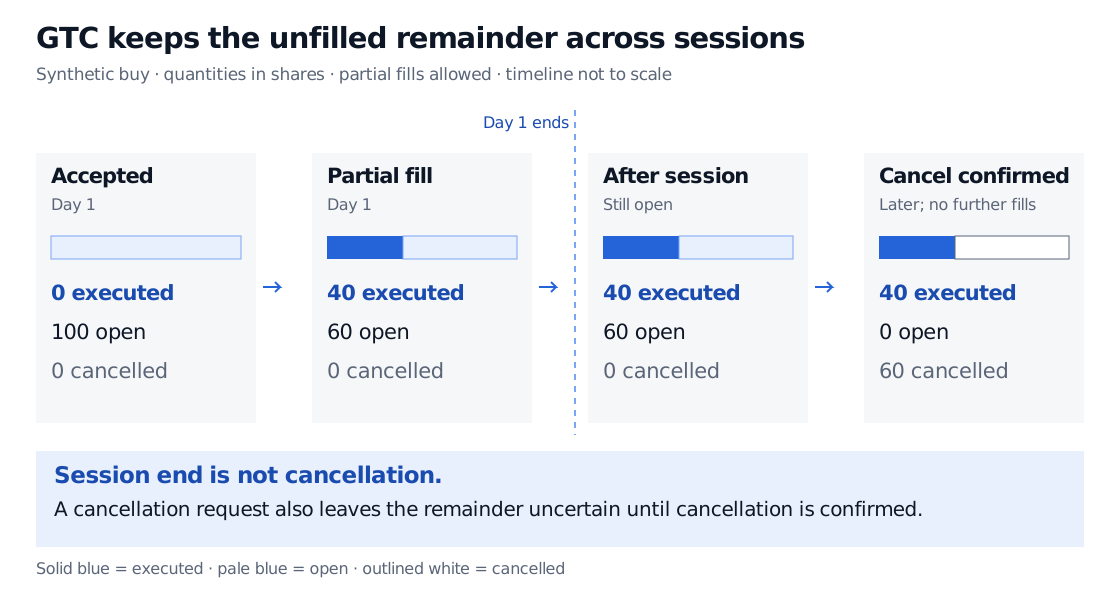
Original synthetic timeline, in shares. The broker policy is stipulated to carry the remainder across sessions; partial fills are allowed. The later cancellation is confirmed, with no intervening fills or trade corrections. Time is not to scale.
“Until cancelled” has conditions
The SEC's GTC definition explicitly notes that brokers typically impose a time limit, and that the limit differs between firms. GTC therefore does not mean perpetual authorisation. Nor does persistence by itself grant access to every trading session: order availability and eligible hours require their own checks.
Corporate actions are another reason to read the current terms. For example, Interactive Brokers' GTC documentation and disclosures list automatic-cancellation conditions involving specified corporate actions and an automatic expiry at the end of the following calendar quarter, with final-trading-day handling when necessary. Its disclosures also say ordinary dividends do not reduce these orders and warn that corporate-action cancellations may not occur in time. Those are broker-specific terms, not a universal GTC convention.
Before relying on a standing instruction, establish which order and product combinations support it, the maximum lifetime, eligible trading hours, and how dividends, splits and other corporate actions affect the price, quantity or validity. A backtest needs the same policy: carrying every GTC order forever can invent fills after the real instruction would have expired.
Cancel the authority, then reconcile the position
An order cancellation request is not evidence that the open quantity has stopped being executable. The SEC's online-investing guidance warns that an electronic cancellation receipt does not establish that the original trade was cancelled. A fill may already have occurred.
In the example, the last row requires confirmed cancellation and no additional fills. While cancellation is pending, keep the uncertain remainder in the exposure calculation. Reconcile the final execution reports and order status before deciding how much a replacement should buy.
For a systematic strategy, persistence should follow the useful lifetime of the decision. Review standing orders when a forecast changes, a risk limit binds or an instrument undergoes a corporate action. The SelfMadeQuant lesson Market, Limit and Conditional Orders develops these instruction choices and the cancellation-versus-fill race. Its preview is public; the full lesson requires membership.
Sources
- SEC Investor.gov, Good-Til-Cancelled Order: definition and broker-dependent maximum lifetimes.
- SEC Investor.gov, Understanding Order Types, updated 18 August 2026: time-in-force and differences between brokerage instructions.
- SEC Investor.gov, Online Investing: confirming cancellation and avoiding duplicate trades.
- Interactive Brokers, Order Types and Algos, “Good Til Canceled” and disclosures: current broker example of expiry and corporate-action handling. Checked 26 October 2026.
- Rishi K. Narang, Inside the Black Box: A Simple Guide to Quantitative and High-Frequency Trading, 2nd edition, Wiley, 2013, Chapter 7, “Other Order Types,” pp. 124–125: GTC modifiers and changing market-specific order rules.