A partial fill occurs when some, but less than all, of an order’s requested quantity has executed. The executed part is a trade; the unfilled part is still an instruction whose future depends on its terms and state. A quant strategy that records the entire request as a position will overstate its holdings and may understate the risk of sending a replacement.
The purchase is 40 shares, not 100
Consider a synthetic limit order to buy 100 shares at no more than USD 101 per share. At its arrival, only 40 eligible shares are offered at 101, with no other eligible liquidity at or below the limit. Assume whole shares, no fees and no competing messages during this matching step. The order permits partial execution, so those 40 shares trade.
| Ledger item | Result after this execution |
|---|---|
| Original requested quantity | 100 shares |
| Cumulative executed quantity | 40 shares |
| Quantity not yet executed | 60 shares |
| Purchase consideration | USD 4,040 |
| Inventory change | +40 shares |
| Cash consideration owed | USD 4,040 |
Completion is 40%. The average execution price is USD 101 per share, because purchase consideration is divided by the 40 shares actually bought. Dividing USD 4,040 by the 100-share request gives USD 40.40, which is not an execution price: it spreads a real purchase over shares never acquired.
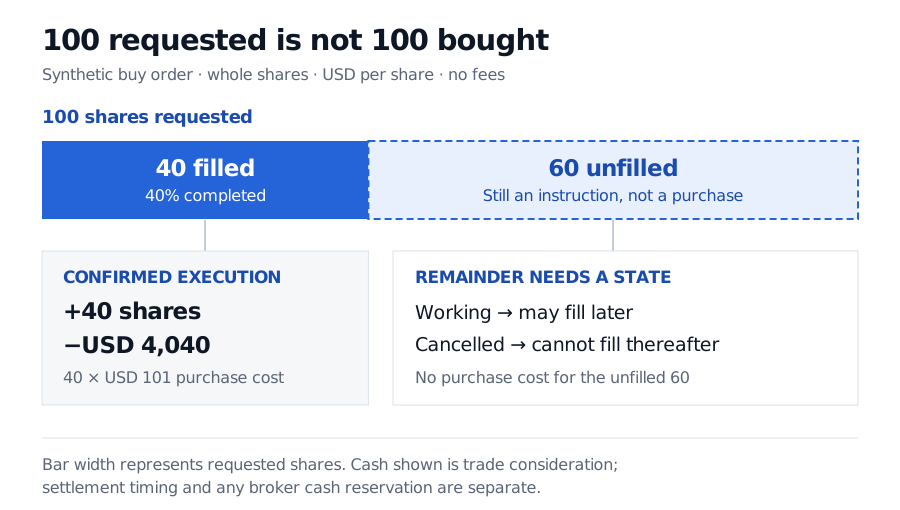
Original synthetic ledger. Width represents shares, not elapsed time. Prices are USD per share and fees are zero. Cash is trade consideration, separate from settlement timing or a broker’s buying-power reservation.
In a trade-date economic ledger, the buy has a −USD 4,040 cash consideration entry. This does not mean settled cash necessarily moves at the execution instant. Nor does it describe any cash or buying-power reservation a broker may retain for the outstanding order. The unfilled 60 shares create no purchase consideration until they execute.
What happens to the other 60?
A partial fill describes the execution outcome so far. It does not tell you whether the remainder is still executable.
- With an instruction that allows the remainder to rest, the 60 can remain working at the limit, subject to the order’s lifetime and applicable rules. They may execute later, possibly across several trades, or never execute.
- With immediate-or-cancel, the 40-share execution is retained and the unfilled 60 are cancelled.
- Had this instead been fill-or-kill, the stipulated 40-share availability would be insufficient: none of the 100 would trade and all 100 would be cancelled. That is a different completion condition, not a partial fill followed by reversal.
These are common instruction meanings described in the SEC’s order-type bulletin. Exact availability, lifetime, session and handling rules depend on the broker and venue. The Market, Limit and Conditional Orders lesson connects these dimensions; its preview is public and its full lesson requires membership.
A cancellation request does not release the quantity
Suppose the 60-share remainder is working and the strategy requests cancellation. Before cancellation completes, 20 more shares fill. The original order has now bought 60 shares, with 40 left to cancel. If a separately submitted 60-share replacement also fills, total acquisition becomes 120 shares, exceeding the original target by 20.
Cancelling the remainder does not undo earlier fills. Reconcile final cumulative execution and confirmed cancelled quantity before deciding how much replacement capacity exists. In this scenario, once the old order’s last 40 are confirmed cancelled and its executions reconciled, only 40 additional shares are needed to reach the original target. The SEC’s online-investing guidance warns that a cancellation receipt need not establish that cancellation succeeded.
For the operating controls behind that distinction, Live Execution Monitoring tracks both confirmed fills and quantities that could still execute. Its preview is public; the full lesson requires membership. A partial position and a working remainder belong in different fields, even when they came from the same order.
Sources
- SEC Investor.gov, Understanding Order Types — Investor Bulletin, updated 18 August 2026 — price limits, IOC, FOK and variation in broker instructions. Checked 2026-10-27.
- SEC Investor.gov, Online Investing, execution and cancellation sections — verify execution and successful cancellation before repeating a trade. Checked 2026-10-27.
- Rishi K. Narang, Inside the Black Box: A Simple Guide to Quantitative and High-Frequency Trading, 2nd edition, Wiley, 2013, Chapter 7, “Aggressive versus Passive,” pp. 120–122, and “Other Order Types,” p. 125 — execution in pieces, incomplete fills and completion conditions.