A bid price is a price at which a buyer expresses willingness to buy an asset for a specified quantity. The best bid is the highest qualifying buying price within the market scope being observed. For a seller seeking immediate execution, it is a starting point for estimating proceeds: the buyer’s bid is the price the seller may receive if a trade actually executes against it.
The ask price is the selling side of the quote. Their difference is the bid-ask spread. A bid is named for the party offering to buy, even when a screen shows it to someone considering a sale.
Price and quantity travel together
Consider a synthetic stock on one venue, quoted in USD per share. The displayed best bid is 99 for 50 shares. An incoming seller sells 30 shares against that bid. For this calculation, stipulate that all 30 shares execute at 99 before any other book update, and ignore fees and taxes.
The seller’s gross proceeds are
The buyer receives 30 shares and pays USD 2,970. Displayed buying interest at that price falls from 50 to 20 shares. Those 20 shares are the remaining bid size; the incoming seller’s 30-share order has filled completely.
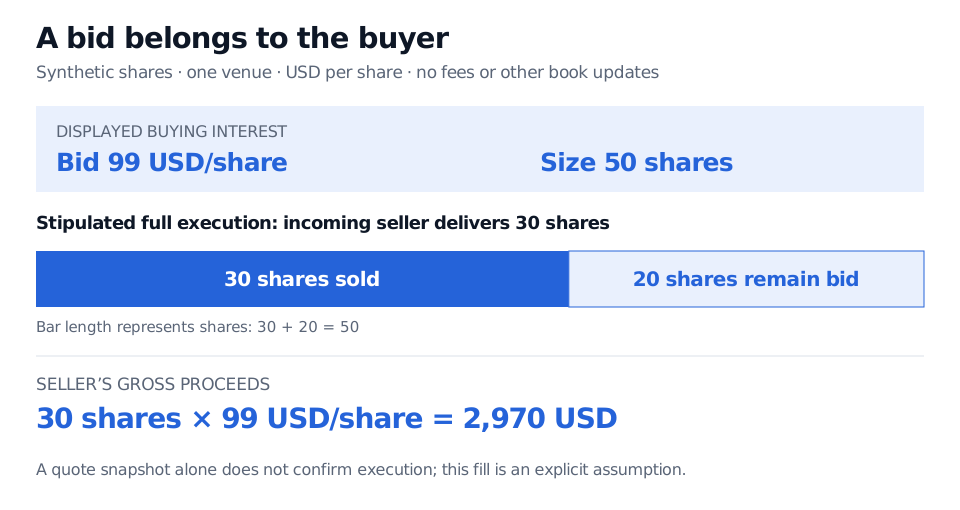
Original synthetic single-venue example. All 30 shares are stipulated to execute at the displayed bid, with no fees, cancellations, new orders or other fills. The remaining 20 shares are buying interest, not unsold shares from the incoming order.
The bid size describes interest available at that price in the displayed snapshot. It does not justify pricing an arbitrarily large sale at 99. A larger sale could reach lower bids in the order book, receive only a partial fill, or remain unfilled according to its instructions and the market state. A sell limit order can impose a minimum sale price; it cannot force a buyer to supply the desired quantity.
What exactly does the screen show?
| Field | Meaning | Consequence for a seller |
|---|---|---|
| Best bid | Highest qualifying buying price in a stated scope | A possible execution price for the available quantity |
| Last-traded price | Price of a completed transaction | Historical evidence, which may differ from current bids |
| Quote midpoint | Average of the paired best bid and ask | A reference value, with no assurance of an order there |
“Best” needs a boundary: one venue’s best bid and a consolidated best bid can differ. Record the instrument, venue or consolidation scope, quote currency, price units, size and timestamp. A price in USD per share produces USD proceeds; it does not directly give proceeds in the seller’s home currency. Other instruments can use different quotation bases, so the cash calculation must follow the relevant units.
A quote also needs an availability context. An indicative dealer quote is different from a firm quote under stated dealing terms; even a displayed order can change before an incoming order reaches it. Cancellations, competing trades and routing access can separate the observed bid from a confirmed fill. The SEC’s order-type bulletin explains why a market order’s execution price can differ from both the last trade and a real-time quote.
For a quant, copying each historical bid directly into a simulated sale overstates what the data establishes. Trades, Quotes and Market State develops the size and timing checks needed to reconstruct what a strategy actually observed. The public preview outlines the lesson; the full lesson requires membership.
Sources
- SEC Investor.gov — Bid Price/Ask Price: stock quote-side definitions and spread.
- SEC Investor.gov — Understanding Order Types, updated 18 August 2026: execution uncertainty, available liquidity and limit-price protection.
- Rishi K. Narang, Inside the Black Box: A Simple Guide to Quantitative and High-Frequency Trading, 2nd ed. (2013), Chapter 7, pp. 120–122: midpoint, aggressive and passive execution, and book depth.