The ask price, or offer price, is a price at which a seller is quoting a willingness to sell an instrument. The best ask is the lowest available selling quotation within the stated market scope. For a buyer seeking immediate execution, it is the selling side of the quote to examine—together with its size, timestamp and accessibility.
A screen may shorten “best ask” to “ask.” That does not make it a universal price for the instrument. A venue's best ask covers that venue; a consolidated best ask covers the venues included by that feed. In an order book, higher ask levels can offer additional quantity at higher prices.
Read the price and size together
Consider a hypothetical share traded on one venue. Its displayed best ask is USD 101 per share for 50 shares. An incoming buyer wants 30 shares. Stipulate that all 30 fill at that price: the displayed order is still there when the purchase reaches it, is accessible to the buyer, and no competing order consumes it. Ignore fees.
The cash paid is
The buyer receives 30 shares, and 20 of the original displayed shares remain at that level under these assumptions. The ask was a unit price, not the total cash required for the trade.
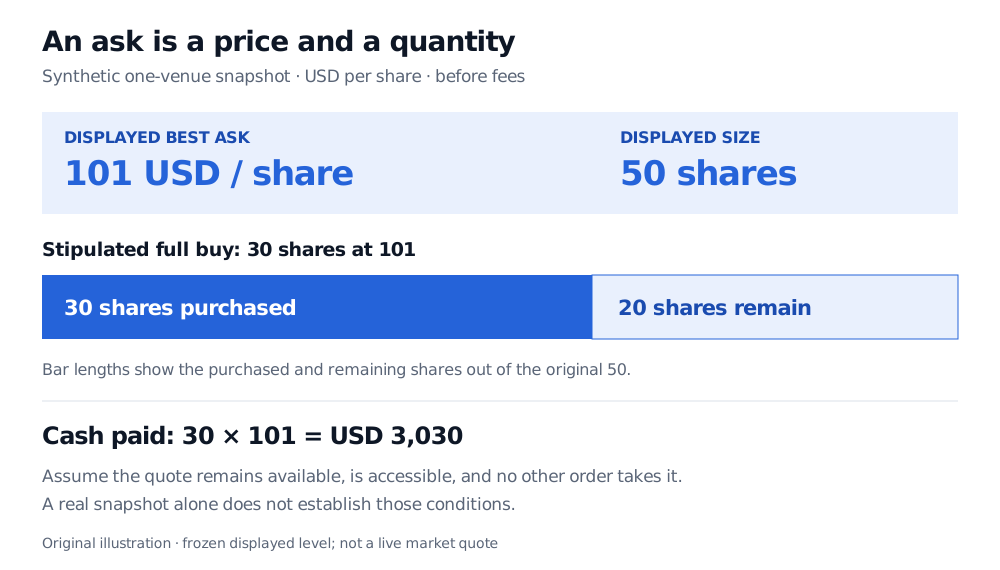
Original synthetic frozen-quote example. The full fill is stipulated: the quote stays accessible and unchanged, with no competing order or fees.
The same snapshot does not price a purchase larger than the displayed 50 shares. Such an order might consume more expensive offers, find additional undisplayed liquidity, or fail to complete under its instructions. To calculate its full cost, more information is needed. Even a smaller order can encounter a changed quote before it reaches the market. The SEC's explanation of trade execution emphasises both quote size and the time between submitting an order and its execution.
Three price fields, three meanings
The ask is a quotation. The last-traded price records a completed transaction, potentially from an earlier market state. It does not establish the price at which the next purchase can execute. Investor.gov's order guide makes this distinction explicitly.
It is a useful benchmark, but its arithmetic does not create an offer to sell there. In a two-sided quote with , the midpoint lies below the ask. The bid-ask spread is ; it separates the best quoted buying and selling prices. Nor is the ask what an investor should assume they will receive when selling immediately: that order faces the bid side.
This distinction matters in a backtest. Marking a position at the midpoint and assuming a purchase there are different operations. A simulated purchase needs an execution assumption supported by available market data.
From quotation to order instruction
A market order to buy prioritises execution without specifying a maximum purchase price. It may trade near the ask, but the observed ask is not a promised fill price. A buy limit order sets a maximum unit price. Setting that limit at the observed ask can make the order immediately executable against that offer if it remains available; it does not guarantee completion.
Finally, a quoted ask is not an all-in cost estimate. Commissions and applicable venue or broker charges can change the cash debited. A quote's currency, price basis, size units, market scope and timestamp all belong in an execution calculation.
The Order Books lesson develops this into a calculation across several displayed levels, including the difference between the last share's price and the average price of the purchase. A public preview is available; the full lesson requires membership.
Sources
- Investor.gov, “Bid Price/Ask Price”: the buying and selling sides of stock quotations and the spread.
- Investor.gov, “Types of Orders”: market orders, limit prices and the distinction from a last-traded price.
- SEC, “Trade Execution: What Every Investor Should Know” (2013): quoted quantities, routing delays and possible price improvement.
- Narang, R. K. (2013), Inside the Black Box, 2nd ed., Wiley, Chapter 7, “Aggressive versus Passive,” printed pp. 120–124: midpoint benchmarks, taking offers, order-book depth and the distinction between a past trade and a current quote.