Maintenance capex is capital spending intended to preserve an existing business’s operating capacity. Growth capex is capital spending intended to expand capacity or develop new operations. Both use cash when paid. The split lets an analyst separate what it costs to keep the business running at its current scale from what a free cash flow forecast must budget for expansion. IAS 7, paragraphs 50(c)–51, Cameco, 2025 MD&A, Capital spending
Start with the capacity you want to preserve
At a packaging plant, a qualifying like-for-like replacement of a worn machine can be maintenance capex. A second line that adds throughput can be growth capex. The distinction comes after deciding whether to capitalise or expense the cost. Under IAS 16, routine servicing such as lubrication and minor repairs is expensed as incurred. Those payments already reduce operating cash flow when paid. A replacement that meets the recognition criteria is capitalised, and the cash payment for the equipment is an investing outflow. IAS 16, paragraphs 7 and 12–14, IAS 7, paragraphs 14 and 16(a)
One project can do both jobs. If the new machine replaces worn capacity and also raises throughput, estimate what a replacement that preserved the old throughput would have cost. Use that as the maintenance baseline and attribute the incremental spending to growth if the project evidence supports that allocation. State the basis and use a range where the costs are hard to separate. Definitions matter even when management publishes a split. Cameco’s 2025 MD&A separates spending to keep facilities running from spending to replace capacity and hold production steady. Both serve the maintenance objective when the forecast baseline is current production. AmeriGas Partners, April 2014 response to SEC staff, comment 5, Cameco, 2025 MD&A, Capital spending
One year, two cash calculations
A fictional plant reports operating cash flow (CFO) of 100 and total cash capex of 60, in USD millions. An analyst estimates that 35 went to maintenance and 25 to growth. With spending shown as a positive outflow, the cash flow statement and the estimated split yield two calculations.
| Calculation | USD millions | What it measures |
|---|---|---|
| CFO less all cash capex | Cash left after the plant’s actual capital payments. | |
| CFO less estimated maintenance capex | Cash left in a hypothetical calculation that omits growth spending and holds CFO fixed. |
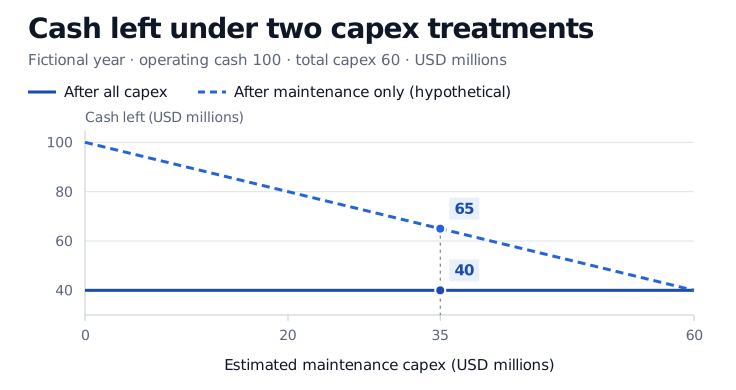
Moving spending between the two categories leaves total cash spent unchanged. The maintenance-only calculation moves with the estimated split.
Carry the spending into the forecast
Start with the cash paid for assets in the investing section. Check management’s discussion and the asset notes for project descriptions, and reconcile any allocation to cash capex for the same period and scope. IAS 7 encourages separate disclosure of cash flows that expand operating capacity and those needed to maintain it, so the filing may leave the split to estimate. Use asset age, replacement schedules and current equipment prices to inform a maintenance range. Depreciation spreads an asset’s depreciable amount over its useful life. Replacement spending can land in a single year and reflect different prices. IAS 7, paragraphs 16(a) and 50(c)–51, IAS 16, paragraphs 50–53 and 73–74
In a discounted cash flow model, pair expansion spending with the operating cash flows it is expected to enable. If a scenario drops an expansion project, revisit future sales and costs and account for any spending already committed. The year’s 40 reflects actual spending in the example, which can be lumpy. The hypothetical 65 depends on this year’s CFO and an estimated maintenance allocation. A forecast needs its own cash and replacement schedules. Damodaran, Valuation Project Questions, Forecasting capital spending and working capital