Skip to content

Give-up trade

A give-up trade separates execution by one broker from carrying by another. Follow acceptance, five-contract reconciliation and rule-specific rejection responsibilities.

A give-up trade is a trade executed through one broker and allocated to a different broker for clearing and carrying, subject to the required acceptance. It lets a client choose execution services separately from its clearing relationship. For a quant desk, the practical consequence is that an execution report and an accepted clearing allocation describe different stages of the same trade: treating both as new fills would overstate exposure. CME’s give-up definition describes an order executed by one clearing firm and given to another for clearing and processing.
The trade is the transaction being allocated. The give-up agreement is the contractual arrangement governing the parties’ relationship. Signing that arrangement does not establish that a particular allocation has been accepted.

Who does what?

In a simple exchange-traded futures example, the roles are:
ParticipantRole in this example
ClientAuthorises the purchase and identifies its intended clearing account.
Executing broker AObtains the market fill and sends the trade information for allocation.
Clearing broker BAccepts the allocation and carries the client’s position under the applicable arrangement.
Central counterparty (CCP)Faces its clearing members under its own rules; it is a separate institution from B.
Here A and B are stipulated to be different clearing-member firms. More elaborate arrangements can involve a separate clearing member supporting the executing broker. A client’s clearing broker should never be confused with the central counterparty: ICE Clear U.S. Rule 401 places the clearing corporation’s contractual obligations at the clearing-member level, rather than directly with the member’s customers or executing brokers.

Five contracts do not become ten

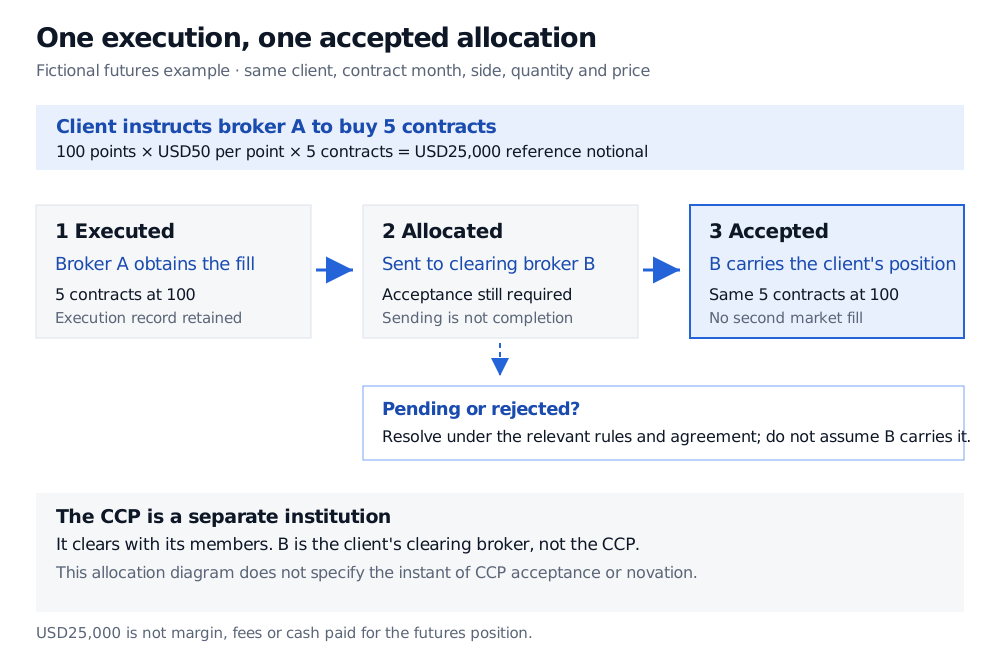
Suppose A buys five contracts for a client at 100 quoted points. This fictional contract has a multiplier of USD50 per point per contract. The client has an authorised account at B; B accepts the give-up under the applicable arrangement. Assume no other trades, corrections or offsets.
Reference notional per contract=100×50=USD 5,000,Total reference notional=5×5,000=USD 25,000.\begin{aligned} \text{Reference notional per contract} &= 100\times 50=\text{USD }5{,}000,\\ \text{Total reference notional} &=5\times 5{,}000=\text{USD }25{,}000. \end{aligned}
The accepted allocation is the same five contracts, at the same execution price, now carried at B for that client. It is not another five-contract market purchase. The USD25,000 figure is a notional amount, not cash paid to buy the futures position, margin, fees or profit.
Fictional five-contract futures purchase at 100 points and USD50 per point per contract: A executes, the allocation is sent to B, and B accepts the same five contracts. Reference notional remains USD25,000. Pending or rejected allocations require rule-specific resolution. The CCP is separate from the brokers.
Original fictional allocation flow. The stages describe one client purchase, not additional market trades. The diagram does not locate the legal instant of CCP acceptance or novation; margin and fees are excluded.

For reconciliation, keep the original fill and the allocation status connected. Check the contract and expiry, buy/sell side, quantity, execution price, client account and receiving firm. If execution and clearing records both show five contracts, identify their relationship before adding quantities. Conversely, a missing acceptance is an operational exception to resolve, not permission to remove the position from risk records.

Sending, accepting and rejecting are different events

Allocation instructions alone do not prove that B has taken responsibility. The relevant exchange and clearing rules, account authorisations and contracts determine acceptance, rejection and responsibility while an allocation is unresolved.

Two United States rule examples, checked on 31 October 2026, make the distinction concrete:
  • NYMEX Rule 984: A.3 limits clearing-member rejection to specified communicated trading-limit breaches or errors for which the executing broker is responsible. A.1 allows rejection after acceptance in those circumstances. B.1 requires the executing broker to establish customer authorisation, execute accurately, confirm execution and transmit it under exchange rules; B.3 requires initial clearing-account authorisation checks. Acceptance does not remove the parties’ duties of good faith, care and diligence. These are NYMEX provisions, not universal broker discretion. Current Chapter 9, Rule 984.
  • ICE Clear U.S. Rule 402(e): subject to exceptions in its rules or procedures, a matched trade not accepted by the designated clearing member is cleared to the member guaranteeing the executing exchange member or direct-access user, provided that guarantee remains in force. That fallback does not mean the intended receiving broker accepted it. Rules 401–402, in the July 29, 2024 edition currently linked from ICE’s regulation page.

There is no single booking or acceptance deadline implied by the term “give-up”. Use the applicable market’s current procedures and the actual arrangement. A pending or failed give-up needs a documented resolution; it should not be treated as either automatic acceptance by B or cancellation of the original execution.

Continue with execution versus clearing

Exchanges and OTC Markets explains why the venue agreeing a trade and the arrangement managing its obligations are separate choices. Its public preview introduces the distinction; the full lesson requires membership.

Sources

Last updated
  • give up trade
  • futures
  • trade allocation
  • clearing
  • post trade
← Back to the glossaryBack to top ↑