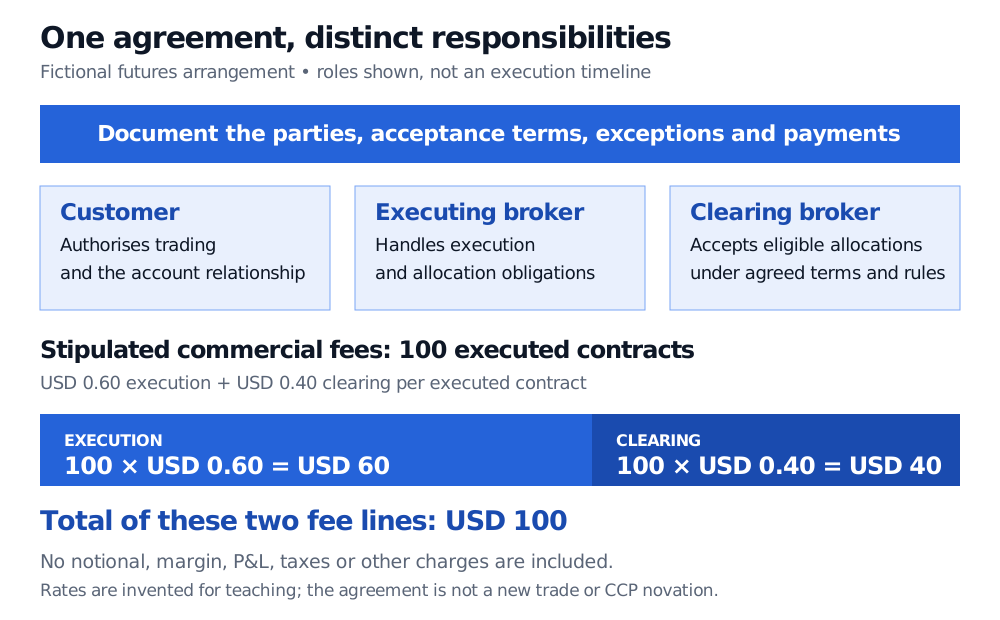
A give-up agreement allocates responsibilities when one broker executes and another clears. Read the parties, acceptance terms and fee schedule without confusing them with a trade or CCP novation.
Give-up agreement
A give-up agreement is the contract that allocates responsibilities when one broker executes a customer's derivatives trades and another broker is intended to accept them for clearing. It connects the execution relationship to the clearing relationship: who may act, what business is covered, how allocations are accepted or disputed, and how charges are paid. For a quant team, an execution price is therefore only part of the record needed to reconcile positions, costs and operational exposure.
The agreement governs the relationship. A give-up trade is a transaction processed within that relationship. Signing the document neither executes a market order nor, by itself, performs novation to a central counterparty.
Start with the legal entities, not the broker logos
In a simple arrangement, the customer, executing broker and clearing broker are distinct parties. A separate authorised trader or order-passing broker can add another role. The entity receiving an order may differ from the entity actually executing it; a group brand alone does not identify the responsible legal person.
FIA's Standard Give-Up Agreements library currently identifies its standard templates as the November 2017 versions, with customer, trader and order-passing-broker variants. Its 2017 explanatory presentation, especially slides 7–8, stresses matching the parties to the operational trade flow and identifying an agent's role. Those are historical template materials still referenced by the current library, not a newly issued 2026 contract.
A useful way to read the actual agreement and its schedules is to connect each provision to a concrete operating question:
Contract area
Operating question
Parties and scope
Which customer accounts, brokers, markets and products are covered?
Authority and limits
Who may send orders, and what authorisation or limits apply?
Allocations and exceptions
How are trades identified, accepted, rejected or corrected?
Charges and billing
Which rate schedule applies, on what quantity basis, and who invoices whom?
Responsibility and disputes
Who bears specified errors or losses, and how are disagreements handled?
Duration and governing terms
When does the arrangement apply, change or terminate?
This is a reading map, not a substitute set of clauses. FIA describes its templates as basic documents requiring attention to the applicable commercial and regulatory circumstances. A firm's negotiated agreement, amendments and schedules determine its contractual terms.
Acceptance is not guaranteed by the signature
An agreement must be read alongside the rules of the relevant exchange and clearing system. It does not create an unrestricted obligation to clear every order a customer might send.
For example, NYMEX Rule 984, in the current rulebook checked on 31 October 2026, sets minimum responsibilities for customer-trade clearance. It permits rejection on the specified grounds of communicated trading-limit breaches or an execution error for which the executing broker is responsible. It also allows rejection after acceptance on those grounds. Acceptance does not discharge the participants' duties of good faith, care and diligence. Before an initial order, the executing broker must confirm the customer's account and authority with the clearing member. These are NYMEX provisions, not universal terms for every give-up arrangement. NYMEX Rule 984, §§A–B.
A rejected allocation is consequently an exception to resolve, not evidence that the market execution has vanished. The applicable rules and contract determine the resulting obligations; the word “give-up” alone does not identify who ultimately bears a loss.
Risk-screening documentation is also distinct. FIA's March 2013procedural guidance, §§7–9, explains its separate clearing-broker-limit screening agreement and says that it does not amend the underlying give-up agreement. That historical guidance helps distinguish the documents; it is not a complete statement of today's regulatory requirements.
A fee schedule changes the cost ledger
Assume a fictional customer executes 100 futures contracts through Broker A, and Broker B accepts the allocations for clearing. Stipulate two commercial charges, each assessed once per executed contract for this execution:
Service
Fictional rate
Charge for 100 contracts
Execution
USD 0.60 per contract
USD 60
Clearing
USD 0.40 per contract
USD 40
Total of these two lines
USD 1.00 per contract
USD 100
The calculation is 100×(0.60+0.40)=100 USD. These are invented rates, not a broker quotation or a claim that all agreements separate fees this way. They exclude exchange and regulatory charges, taxes, any subsequent closing execution, traded notional, margin and trading profit or loss.
Agreement roles connect a customer, executing broker and clearing broker. In a fictional 100-contract execution, execution fees are 100 times USD 0.60, or USD 60; clearing fees are 100 times USD 0.40, or USD 40. The two fee lines total USD 100, excluding notional, margin and other charges.
Fictional commercial arrangement. The bars divide only the two stipulated service charges; they do not measure traded exposure or collateral. The role boxes describe contractual responsibilities, not a universal sequence of trade processing.
The commercial charge and its payment route are separate questions. FIA's 2017 presentation, slides 5 and 7, discusses both clearing-broker payment-agency language and electronic rate schedules. Thus an invoice passing through the clearing broker need not mean that broker performed the execution. A cost model should attach each fee to its service, agreed rate basis and payment obligation, rather than count every invoice as another trade.
For the broader distinction between venue choice and post-trade obligations, Exchanges and OTC Markets provides a public preview; the full lesson requires membership.