A geometric sequence multiplies by a fixed ratio. Distinguish growing payments from their sum and an invested balance, with explicit payment timing.
Geometric sequence
A geometric sequence is an ordered list in which each term is obtained by multiplying the previous term by the same fixed number, the common ratio. A contribution schedule that raises every annual payment by 10% is geometric: the payment amounts change by a constant factor, even though their dollar increases differ.
With first term a1 and common ratio r, the rule is
ak+1=rak,ak=a1rk−1,k=1,2,….
The explicit formula above uses r=0; the zero-ratio boundary is handled by the recursive rule below.
The exponent is k−1 because the first term needs no multiplication; reaching term four takes three multiplications. For nonzero terms, the ratio test is ak+1/ak=r. OpenStax, §11.3 gives the recursive and explicit descriptions.
A payment schedule that grows by 10%
Suppose a hypothetical savings plan schedules four payments at the ends of years 1, 2, 3 and 4. The first is USD 100, and each subsequent payment is 10% larger. Its payment rule, in USD, is
ak=100(1.10)k−1,k=1,2,3,4.
Payment date
Year 1 end
Year 2 end
Year 3 end
Year 4 end
Payment (USD)
100
110
121
133.10
Increase from previous payment (USD)
—
10
11
12.10
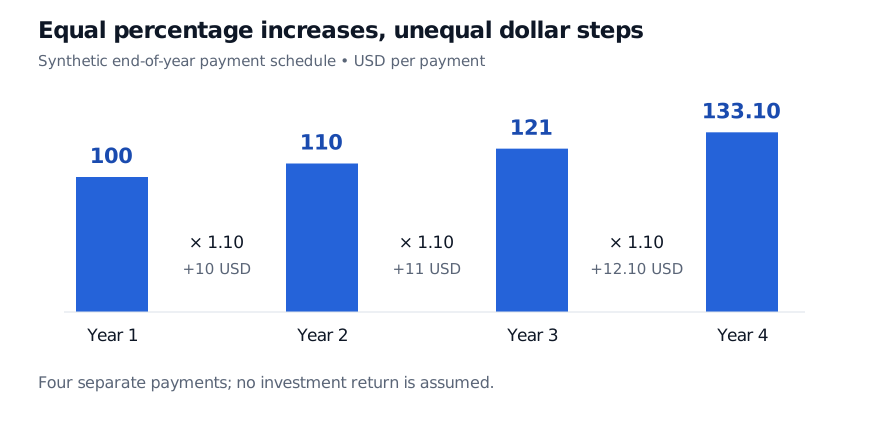
Four synthetic end-of-year payments of USD 100, 110, 121 and 133.10. Each is 1.10 times its predecessor; dollar increases are USD 10, 11 and 12.10.
Original synthetic schedule. Bars represent separate payments, with no investment return assumed. The multiplier stays fixed while the dollar step grows.
The growth factor is 1.10, whereas the growth rate is 0.10, or 10% per year. Multiplying by 0.10 would retain only one tenth of the previous payment. Adding USD 10 every year would instead give 100, 110, 120, 130: an arithmetic sequence with a fixed difference.
For positive amounts, a fixed ratio above one produces discrete exponential growth. This is an assumed payment policy, not a forecast that a traded asset will earn 10% every year.
The fourth payment is not the account balance
The sequence lists payments. Adding the four terms gives a finite geometric series: total contributions of USD 464.10. Neither the final payment of USD 133.10 nor the payment-growth rate determines the invested account balance.
For example, separately assume an empty initial account, a constant 5% annual effective investment return, and no fees or withdrawals. Immediately after the fourth end-of-year payment, the future value is
The first payment earns three years of returns; the fourth earns none at that valuation instant. Rounded to cents, the balance is USD 497.19. Moving the deposits to the beginnings of years would change the accumulation periods. Payment growth, investment return and payment timing are three separate inputs.
Ratios outside the growth example
For a positive first term, 0<r<1 gives decay and r=1 gives a constant sequence. A negative ratio alternates signs, so it does not describe an ordinary schedule of positive contributions. If r=0, the recursive rule gives the first term followed by zeros; division by a preceding zero cannot identify a ratio. The all-zero sequence satisfies the recursion for every r, so it has no uniquely identifiable multiplier.
To build fluency with powers and connect discrete multiplication to continuous compounding, see Exponentials and Logarithms (public preview; full lesson requires membership).
Sources
OpenStax, Precalculus 2e, §11.3, Geometric Sequences: common ratios, recursive rules and explicit formulas.
Kyle Burke, Instructor’s Solutions Manual for Otto Bretscher’s Linear Algebra with Applications, 4th edition, Pearson, 2009, solution 4.1.13: consecutive-ratio criterion and why adding geometric sequences need not preserve it.