An arithmetic sequence is an ordered list whose consecutive terms differ by the same fixed amount, called the common difference. A savings plan that raises each monthly contribution by USD 25 is an arithmetic sequence of payments. It says how much to contribute each month; it does not specify the investment return.
With first term and common difference ,
The formula counts the gaps: reaching the sixth term takes five additions of . The difference can be positive, negative or zero, giving an increasing, decreasing or constant sequence. A finite schedule only uses the rule over its stated range. These are the standard recursive and explicit descriptions of an arithmetic sequence. OpenStax, §11.2.
A contribution schedule
Suppose a hypothetical investor contributes USD 100 in month 1, then adds USD 25 to the size of each subsequent monthly payment for six months. The payment rule, in USD, is
| Month | 1 | 2 | 3 | 4 | 5 | 6 |
|---|---|---|---|---|---|---|
| Contribution (USD) | 100 | 125 | 150 | 175 | 200 | 225 |
Month 6 therefore calls for dollars. Using would count one extra increase.
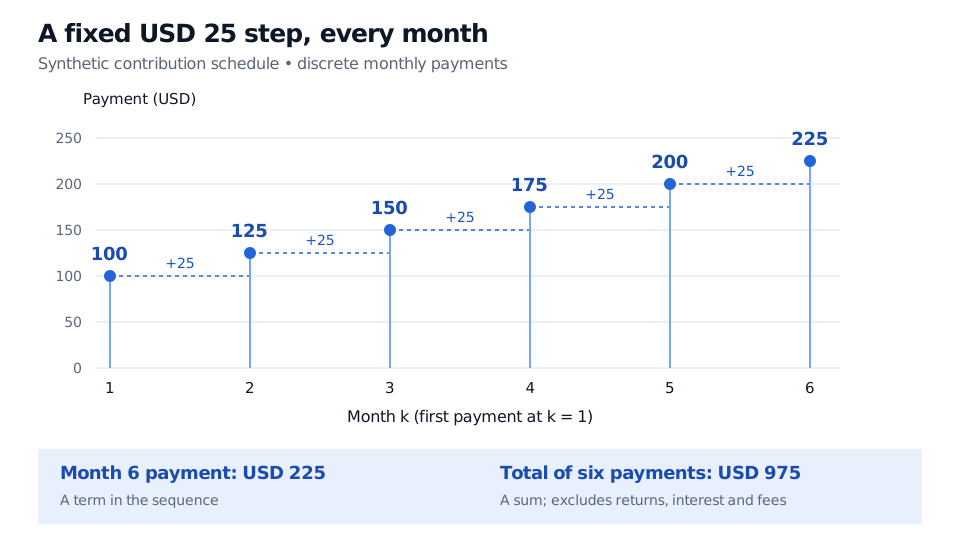
Original synthetic schedule. The dashed steps mark equal differences between discrete payments; they do not represent payments between months.
The first increase is ; the second is . The dollar difference is constant, while the percentage increase changes. A rule that increases every payment by 25% instead would produce USD 100, 125, 156.25, and so on: a geometric sequence with constant ratio 1.25.
Decide what the index means
Some models start counting at zero. If labels the same six payments with , then
Here is the first payment, not a zero initial account balance. Index origin and payment timing are separate choices: neither formula says whether the payment arrives at the beginning or end of a calendar month. State that timing when calculating an account balance or future value.
A payment, a sum and a balance
The sequence lists the individual payments. Adding its first six terms gives the finite arithmetic series, USD 975. That total is contributed capital. An account holding invested payments may have a different balance because of returns, fees or withdrawals; the arithmetic contribution rule alone cannot determine it.
For help substituting into formulas and keeping amounts separate from percentages, see Arithmetic, Algebra, Equations and Functions (public preview; full lesson requires membership).
Sources
- OpenStax, Precalculus 2e, §11.2, Arithmetic Sequences: common differences, recursive and explicit formulas, and zero-based applications.
- Kyle Burke, Instructor’s Solutions Manual for Otto Bretscher’s Linear Algebra with Applications, 4th edition, Pearson, 2009, solutions 1.2.48 and 4.1.12: constant-difference sequences and the equivalent zero-based representation.