An arithmetic series is a sum of terms whose successive differences are constant. The ordered list is an arithmetic sequence; adding its terms produces the series. In finance, the distinction is useful when a cash-flow schedule increases or decreases by the same currency amount each period: its total can be calculated from just the first payment, last payment and number of payments.
The shortcut: count × average of the endpoints
Let the first term be , the common difference be , and the number of terms be a positive integer . The final term is : there are steps after the first term. Then
Why does this work? Write the sum once forwards and once backwards. Each column adds to , and there are columns. This gives . Dividing by two gives the formula, whether is odd or even. The University of Waterloo's CEMC lesson develops this pairing argument.
The formula also handles falling terms () and constant terms (). But the endpoint average represents the average of all terms only because the differences are constant. It is not a shortcut for an arbitrary payment schedule.
A loan whose interest falls by USD 100 each month
Consider a hypothetical loan with these stipulated terms:
- Initial principal: USD 120,000.
- Repay USD 10,000 of principal at the end of each month, for 12 months.
- Pay interest separately at each month-end, equal to 1% of that month's opening principal balance.
- The 1% is the effective rate for each monthly period, given directly. It is not an annual quote. There are no fees, missed payments, prepayments or day-count adjustments.
Interest is paid as it falls due, so it is not added to the outstanding principal. For month , the opening balance and interest charge are
The fixed principal reduction makes the interest reduction fixed too: 1% of USD 10,000 is USD 100.
| Month | Opening principal (USD) | Principal repaid (USD) | Interest paid (USD) | Total payment (USD) |
|---|---|---|---|---|
| 1 | 120,000 | 10,000 | 1,200 | 11,200 |
| 2 | 110,000 | 10,000 | 1,100 | 11,100 |
| 6 | 70,000 | 10,000 | 700 | 10,700 |
| 12 | 10,000 | 10,000 | 100 | 10,100 |
Month 12 still incurs interest: its last principal repayment happens after that month's interest has accrued. The zero balance is the balance after the final payment, not the opening balance for month 12.
The twelve interest charges form an arithmetic sequence with first term USD 1,200 and last term USD 100. Their sum is
Alternatively, pair the first interest charge with the last, the second with the second-last, and so on. Six pairs of USD 1,300 give USD 7,800. The interest cost is USD 7,800; the principal repaid is USD 120,000; the total cash paid is USD 127,800.
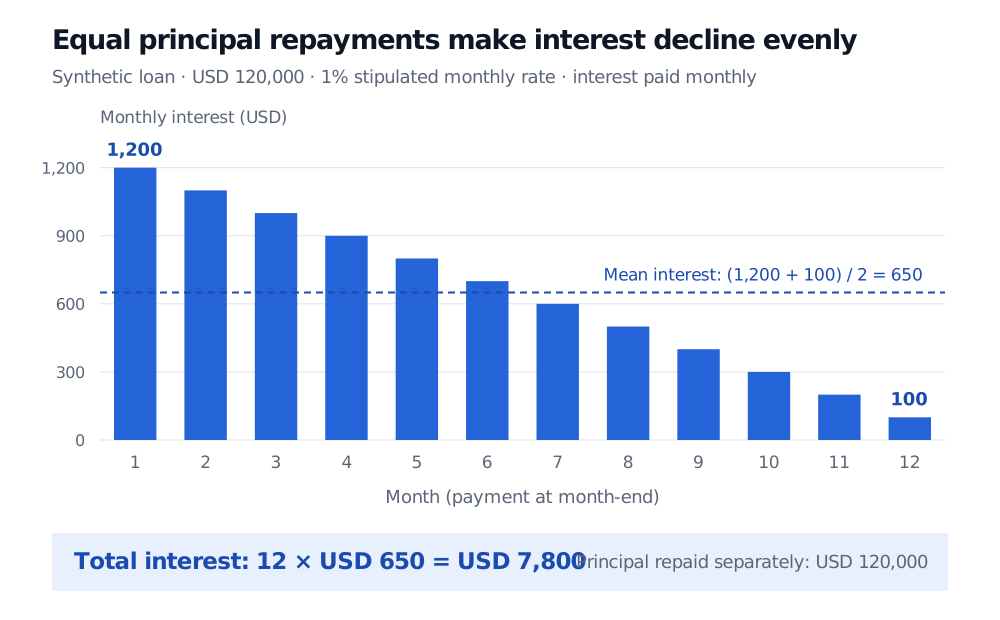
Original hypothetical equal-principal loan. Each month's interest is 1% of its opening balance and is paid at month-end; the dashed line marks mean interest, not a constant actual charge.
When the arithmetic pattern disappears
This is an equal-principal schedule. A level-payment annuity loan instead fixes the combined principal-and-interest payment. As interest falls, the principal component rises, so its interest charges generally do not decline by a constant currency amount. The CFPB explains that changing split within fixed monthly payments.
Likewise, a constant percentage increase produces a geometric series, rather than an arithmetic one. Variable interest rates or irregular repayments can break the loan example's constant-difference property.
Finally, USD 7,800 is the undiscounted sum of interest paid on different dates. It is not their present value. Discounting requires a separately specified valuation rate and timing convention; multiplying by date-dependent discount factors generally destroys the arithmetic pattern.
For the next step, Series and the Geometric Series: Partial Sums and Convergence develops partial sums and explains why discounted level cash flows lead to geometric-series formulas. The public page is a preview; the full lesson requires membership.
Sources
- University of Waterloo, Centre for Education in Mathematics and Computing, Lesson 5: Arithmetic Series: arithmetic sums and the reversed-sum derivation.
- Chris Brooks, Introductory Econometrics for Finance, 4th ed., Cambridge University Press, 2019, §§2.5–2.6: constant differences versus constant ratios, and the timing of cash flows.
- Consumer Financial Protection Bureau, What is amortization and how could it affect my auto loan?, reviewed 24 September 2024: principal and interest components of fixed monthly payments.