The effective interest method calculates the amortised cost of a financial asset or liability and spreads interest income or expense over time using the instrument’s effective interest rate (EIR). For a bond bought at a discount, it explains how the holder can earn more interest than it receives in coupon cash. IFRS 9, Appendix A
How a 3 USD coupon produces 5 USD of interest income
Suppose a holder buys a fictional fixed-rate bond for 98 USD and measures it at amortised cost. The bond has 100 USD of face value, a 3% annual coupon rate, and exactly one year remaining. The final coupon and principal arrive together. Assume no transaction costs, early redemption, or loss allowance.
The EIR is the internal rate of return that makes the present value of the payment equal the opening carrying amount. With annual compounding, solve
Apply that rate to the 98 USD opening balance. The holder recognises 5 USD of interest income. The 3 USD coupon is paid in cash, and the other 2 USD increases the carrying amount. At the same settlement, the 100 USD principal payment clears the resulting 100 USD balance. Splitting the payment into two ledger steps makes it easy to see how the discount was earned.
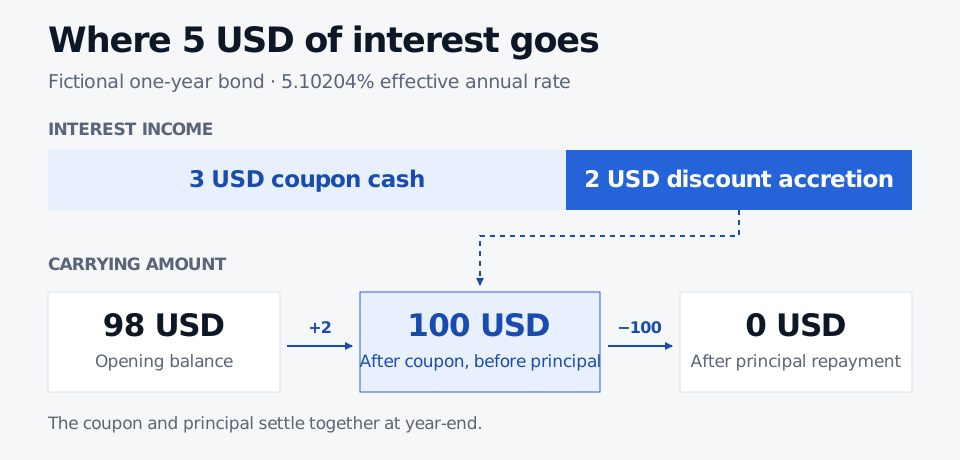
The coupon and principal arrive together. The two ledger steps show where the coupon cash and the discount accretion enter the calculation.
For an unmodified fixed-rate asset with no loss allowance, the same steps work period by period. Add interest at the effective rate on the opening carrying amount, then subtract cash received, including any principal. For a plain fixed-coupon bond bought at a premium with no fees, the coupon exceeds effective interest, so the carrying amount falls as the premium is amortised.
Which rate and which balance?
A market yield to maturity solves for the rate implied by the full market price and promised payments. It matches the EIR at purchase when the price, cash flows and compounding convention match. Later market yields can move while the original EIR still governs this fixed-rate bond’s accounting schedule. FINRA, Understanding Bond Yield and Return
Under IFRS 9, directly attributable transaction costs enter the initial measurement of an amortised-cost bond. The EIR also incorporates fees that are integral to the financing, such as qualifying loan origination fees. A separate fee for servicing a loan follows the service-revenue rules in IFRS 15. If the holder paid 1 USD of qualifying acquisition costs on the same 98 USD purchase, the opening carrying amount would be 99 USD and the EIR would fall to , even though the promised 103 USD payment is unchanged. IFRS 9, paragraph 5.1.1, Appendix A and B5.4.1–B5.4.4
IFRS 9 generally applies the EIR to the gross carrying amount, before deducting the loss allowance. The ordinary EIR calculation excludes expected credit losses. If the asset later becomes credit-impaired, apply the EIR to amortised cost after the allowance in subsequent reporting periods. The gross basis resumes if the asset ceases to be credit-impaired and the improvement can be objectively linked to a later event. If the asset was already credit-impaired when purchased or originated, start with a credit-adjusted EIR that incorporates expected credit losses and apply it to amortised cost from initial recognition. IFRS 9, paragraphs 5.4.1–5.4.2 and Appendix A
Sources
- IFRS Foundation, IFRS 9 Financial Instruments, paragraphs 5.1.1, 5.4.1–5.4.2, Appendix A and B5.4.1–B5.4.4.
- FINRA, Understanding Bond Yield and Return, “Yield to maturity” under “Key Terms.”