Defined benefit pension accounting measures the retirement benefits employees have earned, compares that obligation with the assets held to pay it, and records how the difference changes in the employer’s financial statements. Under IAS 19 Employee Benefits, a company can contribute cash to its pension plan and still report a larger pension liability at year-end. Changes in bond yields, plan investments or assumptions about how long retirees will live can outweigh the contribution. IAS 19, paragraphs 56–64 and 120–130
Valuing the promise
A defined benefit plan specifies the benefit, often through a formula based on salary and years of service. The employer generally bears the risk that the benefits cost more than projected or the investments fall short. IAS 19 uses the projected unit credit method to attribute benefits to periods of service. The present value of projected benefits attributed to current and prior service is the defined benefit obligation (DBO). Estimates such as future pay where relevant, mortality and employee turnover help determine the projected payments. IAS 19, paragraphs 27–30 and 66–98
The IAS 19 discount rate reflects reporting-date market yields on high-quality corporate bonds. If the benefit currency lacks a deep market in those bonds, IAS 19 uses government bond yields in that currency. The reference bonds must be consistent with the currency and estimated term of the benefits. Lower discount rates increase the DBO for the same projected payments. The effect on the net position also depends on how the assets respond. IAS 19, paragraphs 83–86 and 145–147
Why the deficit grew after a contribution
A fictional single-employer plan ends the year with plan assets at fair value of 850 and a DBO of 1,000, measured on the same date. All amounts are in currency units. On an assets-minus-obligation basis, its funded status is . The employer shows a positive net defined benefit liability of 150 on its balance sheet, assuming no adjustment for minimum funding requirements under IFRIC 14. IAS 19, paragraphs 56–64
At the start of the year, the DBO was 900 and plan assets were 775, leaving an opening liability of 125. The opening discount rate was 4%. Assume the plan pays 20 in ordinary benefits and the employer contributes 50, both at year-end, with no other movements beyond those shown.
| Where it appears | What happened during the year | Effect on net liability |
|---|---|---|
| Profit or loss | Current service cost of 25 plus net interest of 5. Interest on the obligation was 36 and interest on plan assets was 31, both calculated at 4%. | +30 |
| Other comprehensive income (OCI) | An actuarial loss of 59 increased the DBO. The actual plan-asset return of 45 exceeded the 31 already in net interest, giving a remeasurement gain of 14 that offset part of the loss. | +45 |
| Employer cash flow | The employer’s contribution increased plan assets by 50. | −50 |
| Payments from the plan | Ordinary benefits paid by the plan reduced the obligation and plan assets by 20 each. | 0 |
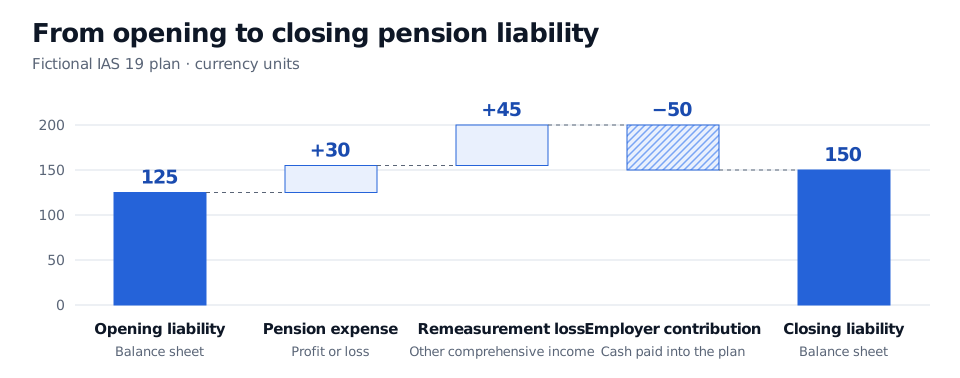
Service and interest expense plus remeasurement losses outweighed the employer’s contribution.
IAS 19 generally puts service cost and net interest in profit or loss, subject to any inclusion in an asset’s cost under another IFRS. It puts remeasurements in OCI and leaves them out of later profit or loss. To estimate the sponsor’s near-term cash payments, read the funding arrangements and next year’s expected contribution in the pension note. The accounting deficit and the funding schedule can use different valuation bases. IAS 19, paragraphs 35–37, 120–130 and 139–147
What the employer can recognise when assets exceed the obligation
When a plan has a surplus, IAS 19 caps the net asset at the lower of that surplus and the asset ceiling. The ceiling measures the value today of economic benefits the employer can recover through a refund or lower future contributions. Plan terms and statutory requirements determine what is available. IFRIC 14 also requires an additional liability for minimum contributions due to cover a past-service funding shortfall to the extent that the employer cannot recover those amounts after paying them into the plan. IAS 19, paragraphs 8 and 64, IFRIC 14, paragraphs 7–12 and 23–24
For a closer look at the rate exposure on both sides of the balance sheet, the SelfMadeQuant lesson Key Rate Exposures, Bucket Shifts, and Immunization shows how to compare the rate sensitivity of a bond portfolio and an annuity liability at different maturities. The preview is public and the full lesson requires membership.
Sources
- IFRS Foundation. IAS 19 Employee Benefits, 2026 issued standards.
- IFRS Foundation. IFRIC 14 The Limit on a Defined Benefit Asset, Minimum Funding Requirements and their Interaction.