A cliquet option resets its reference level over successive periods. Follow a coupon ledger to distinguish local caps and floors, summed returns and global protection.
Cliquet option
A cliquet option, also called a ratchet option, is an exotic option built from a sequence of reset periods: each period's return is measured against a newly reset reference level, and the contract combines the resulting payoffs. This lets a structured payoff retain contributions from earlier gains even if the underlying subsequently falls. The reset schedule, local limits, aggregation rule and payment dates determine exactly what is retained.
“Cliquet” names a family of contracts. A strip of forward-starting calls, a sum of locally bounded returns and a sum with an additional global guarantee have different payoffs. Read the formula before interpreting a quoted return.
Reset, clip, add
For positive reference levels St0,…,Stn, define the simple return over reset period i as
Ri=Sti−1Sti−1.
The denominator changes at every reset. For a locally floored and capped coupon, set
ci=min(max(Ri,f),c),
where f≤c are the local floor and cap, expressed as decimal returns. A synthetic sum-style cliquet paid entirely at maturity has terminal cash payoff
HT=Ni=1∑nci.
Here N is the currency notional, not the price paid for the option. This formula includes no global floor or cap, no interim payments, no principal repayment and no compounding. Those features require additional terms.
Consider three consecutive reset periods, with observations on 26 October 2026, 26 January 2027, 26 April 2027 and 26 July 2027. Use USD 1,000 notional, local floor 0% and local cap 6%. The synthetic reference prices below are USD per underlying unit; they exclude dividends. All coupons are paid together on the final observation date T.
Reset period
Start level
End level
Simple return
Credited coupon
1
100
112
+12%
6%
2
112
103.04
−8%
0%
3
103.04
107.1616
+4%
4%
The first gain reaches the cap. The second period contributes zero because of its local floor; it does not subtract from the first coupon. The third return is calculated from 103.04, rather than from the initial 100.
HT=1,000(0.06+0+0.04)=100 USD.
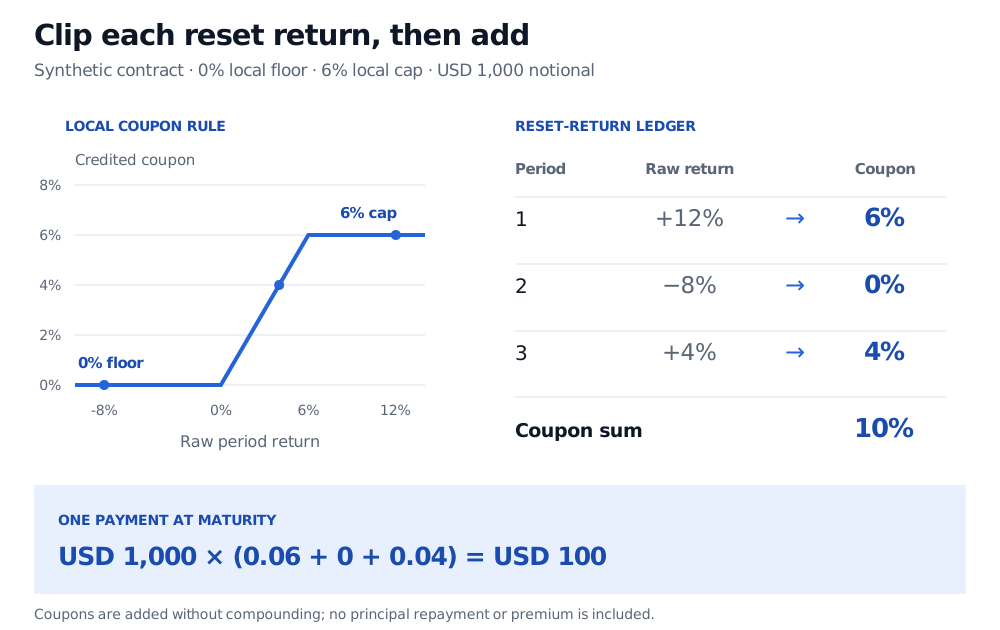
Three raw reset returns of +12%, −8% and +4% become coupons of 6%, 0% and 4% under a 0% floor and 6% cap. Their 10% sum pays USD 100 on USD 1,000 notional at maturity.
Original synthetic coupon ledger. Apply the local rule separately to each reset return, then add the coupons. All cash is paid at maturity; there are no interim distributions.
This USD 100 is a contractual payoff, not the option's present value or net trading profit. The premium and financing costs have not been deducted.
Three tempting calculations that answer different questions
The underlying's total return is 107.1616/100−1=7.1616%. Applied to USD 1,000 of initial underlying exposure, it gives a price gain of USD 71.616. That is different from the cliquet's USD 100 payout: the cliquet has clipped each period separately.
Compounding the credited coupons gives (1.06)(1)(1.04)−1=10.24%, or USD 102.40 on the notional. That calculation reinvests coupon growth into later periods. It is not the stipulated sum-style payoff.
Looking only at the final level discards the reset history. A different path, 100,100,100,107.1616, has exactly the same endpoints but earns coupons of 0%, 0% and 6%, paying only USD 60. This is path dependence in cash terms.
For the stated three-period contract, every coupon lies between 0% and 6%, so the terminal option payoff lies between USD 0 and USD 180. This bound says nothing about whether buying it is profitable.
Local protection and global protection are separate
A local floor acts before aggregation. In this example it prevents a negative period return from reducing the accumulated coupons. Other cliquets allow negative local contributions, so earlier gains may be offset.
A global floor acts after aggregation. If A=∑ici and the total-return floor is F, the coupon leg becomes
Nmax(F,A).
It is generally different from flooring each period. A globally capped cliquet can also limit the total after adding the local contributions. A note that repays principal adds a separate redemption leg; a floor on an option's coupon sum does not, by itself, promise repayment of the invested amount.
For an example with different terms, Hess's cliquet pricing paper uses locally capped returns, a global floor and a separate principal amount in its terminal payoff. Its formula should not be substituted for the synthetic contract above.
The payment schedule matters too. A coupon fixed at an intermediate reset may be paid immediately or retained until a later date. Fixing an amount and receiving cash are separate events; their discounting and reinvestment consequences differ.
The variable part is a call spread on the period return. In underlying-price terms, its strikes scale with the unknown future reset level: Sti−1(1+f) and Sti−1(1+c). Its exposure is therefore connected to forward-start options and the forward smile.
A calibrated implied volatility surface describes today's vanilla option prices across strikes and maturities. It generally does not determine the joint behaviour of levels at successive reset dates. Models fitting the same vanilla surface can therefore disagree about cliquet values. For a pure sum without global bounds, valuation is additive across the coupon legs; a global floor or cap additionally couples those legs through their aggregate.
Exercise 3 in Reading the Implied Vol Surface develops the distinction between terminal distributions and the reset-period dependence needed by cliquets. The public page is a preview; the full lesson requires membership.
Sources
Jim Gatheral, The Volatility Surface: A Practitioner's Guide, John Wiley & Sons, 2006, Chapter 10, pp. 122–123: forward-starting cliquettes, local versus global coupon limits, payment dates and forward-skew exposure. The worked example and figure here are original synthetic calculations.