The build-up method estimates the return common shareholders require by adding selected risk premiums to a risk-free rate. Appraisers use it in discounted cash flow valuation, particularly for private companies whose shares lack a reliable trading history for estimating equity beta. The resulting rate discounts cash flows to shareholders. Each premium needs a clear benchmark so the same exposure enters the rate once. Hitchner, Financial Valuation Workbook, Exhibit 1.14
A 12% rate, built from four assumptions
For a fictional private company, suppose the risk-free rate is 4% and the equity risk premium is 5 percentage points. The market premium measures the return investors require above the chosen risk-free benchmark for holding broad equities. Assume the applicable size comparison adds 2 points beyond that market component, and the appraisal supports a further 1 point for a company-specific exposure. The inputs are stipulated on the same annual, nominal USD basis.
Here is the annual effective cost of common equity. The size adjustment depends on how the subject company compares with the portfolio used to estimate the premium. The company-specific adjustment depends on evidence about the business and the valuation premise. Include each adjustment only where the evidence supports a separate contribution. Hitchner, Financial Valuation Workbook, Exhibit 1.14 and accompanying notes
Check what the quoted premium already includes
A data source can provide a combined premium measured over the risk-free rate. It already reflects market exposure as well as the incremental return associated with size. Other tables report a size premium over CAPM, after stripping out the beta-based market component. The same report can contain both types of table. Some build-up variants also use a separately estimated industry adjustment relative to the broad market when the industry exposure is missing from the other inputs. Duff & Phelps, 2011 Risk Premium Report, Size Study and Figure 7
Suppose a combined premium for the fictional company is 7 points and embeds exactly the example's 5 market points and 2 size points. Replacing both separate inputs with that 7 gives the same 12%. Adding the market premium again gives 17%. For a single expected equity payment of USD 112 at the end of year one, the present value is USD 100 at 12% and USD 95.73 at 17%.
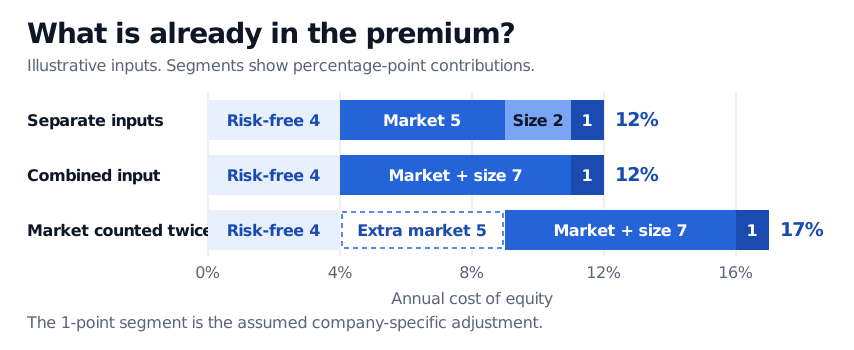
The illustrative 7-point premium replaces both the market and size inputs. Adding the market premium again overstates the rate by 5 percentage points.
Keep the model and forecast consistent
In the capital asset pricing model (CAPM), the excess required return is times the market equity risk premium, where measures the equity's exposure to market returns. The separate-input build-up above takes the market premium at full weight, equivalent to setting beta to one for that term. A private company can still use a CAPM estimate based on listed peers, with the peers' betas adjusted for the subject company's leverage. A model that retains the beta term and adds separate size or company adjustments is a modified CAPM. Damodaran, Estimating Inputs for Valuation · Hitchner, Exhibit 1.14
Match the risk-free benchmark to the valuation date, cash-flow currency, inflation basis and investment horizon. Check that the market premium was estimated against a compatible benchmark and that the equity risk assumptions reflect the financing in the forecast. Use the resulting cost of equity for free cash flow to equity after net debt cash flows. For operating cash flows available to debt and equity investors, the equity rate is one input to the weighted average cost of capital. Damodaran, Estimating Discount Rates, slides 2 and 6
The SelfMadeQuant lesson shows how the equity rate enters the present value of dividends and how valuation changes with the gap between the rate and expected growth. Equity Valuation — Dividend Discount and DCF Models, full lesson for members
For a company dependent on one customer, a forecast can probability-weight the cash lost if that customer leaves. A rate surcharge intended to cover that same expected loss would duplicate the cash-flow adjustment. A separate premium needs its own justification for the risk investors bear under the stated valuation premise. Plain CAPM compensates diversified investors for market exposure, so the existence of company-specific uncertainty alone gives no premium under that model. Damodaran, Estimating Inputs for Valuation
Sources
- James R. Hitchner, Financial Valuation Workbook, 4th edition, Exhibit 1.14 and accompanying notes.
- Duff & Phelps, 2011 Risk Premium Report, Size Study and Figure 7.
- Aswath Damodaran, NYU Stern, Estimating Inputs for Valuation and Estimating Discount Rates, slides 2 and 6.