TRACE, the Trade Reporting and Compliance Engine, is the system FINRA uses to collect reports on eligible fixed-income transactions and disseminate trade information where its rules allow. This is post-trade transparency. In the over-the-counter market, an executed corporate bond price gives other investors a point of comparison for a fresh dealer quote. Its usefulness depends on when the print arrived and what it reveals about the trade. FINRA Rule 6710
From execution to the public tape
When a FINRA member is a party to a reportable trade, it submits a record with details such as the security identifier, execution time, price, side and counterparty identifier or category. For a conventional corporate bond, it reports the full par amount. Under Rule 6730(a)(1)(B), covered trades during standard system hours are due as soon as practicable and within 15 minutes of execution, with separate treatment near the close and outside system hours. The SEC approved a move to one minute for covered fully electronic trades in 2024, then approved rescinding that reduction in 2025 before it took effect. FINRA Rule 6730 · SEC Release 34-103986 · FINRA Notice 25-17, endnote 9
FINRA normally disseminates eligible corporate-bond prints as it receives the reports. That is a different clock from execution. The public corporate-bond feed can show the execution time, price, yield, size field and party types while the regulatory flow also carries counterparty identifiers where applicable. For an ordinary reportable trade between two FINRA dealers, both report, while the Bond Trade Dissemination Service (BTDS) shows only the selling dealer's side. Dissemination also varies by security and transaction type. Individual trades in on-the-run nominal Treasury notes and bonds are disseminated at the end of the day, and certain reportable transactions, such as qualifying transfers of proprietary positions in a merger, stay in the regulatory flow. FINRA Rule 6750 · FINRA Notice 24-06 · BTDS specification, §§ 5.1 and 8.3.9
What “5 million plus” tells you
Suppose two fictional trades in the same bond have par sizes of USD 2 million and USD 8 million. Under a hypothetical USD 5 million display cap, the public prints would show USD 2 million and USD 5 million+. For those two distinct, valid prints, the public lower bound is million dollars and the exact total is million dollars. The plus sign leaves the excess size unknown. Using the cap as an exact weight in a volume-weighted average price can distort the result, and the direction depends on the prices of the capped trades.
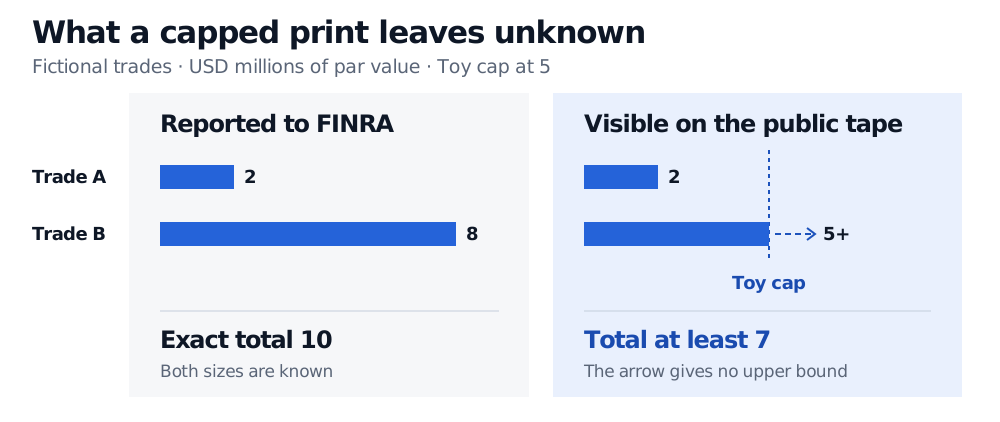
The arrow shows that the second print gives a threshold with no upper bound. The exact regulatory amount stays visible in the left panel.
Actual size caps depend on the security and data product. For example, FINRA describes different real-time size caps for investment-grade and non-investment-grade corporate bonds, and makes uncapped sizes available in its delayed Historic Corporate Bond Data Set. Verify the product and vintage before using volume or comparing samples. FINRA Notice 25-17, endnote 8 · FINRA Rule 7730
Working with the prints
For a price comparison, start with the same security and check the trade's age, side and size. An old small-lot price can be a poor reference for a current block order. A print records a completed trade. Use contemporaneous quotes to measure the current bid–ask spread.
For historical totals, use each feed's rules for cancellations and corrections. A cancellation removes a previously counted print. A correction replaces its affected fields. Counting the correction as another trade can inflate both turnover and trade count. For an intraday backtest, admit each message only when the strategy could have received it, including later corrections. Sorting a revised file by execution time can introduce look-ahead bias. BTDS specification, §§ 4.3 and 8.4
Trades, Quotes and Market State works through what a trading system knows at decision time using separate event and receipt clocks. The preview is public and the full lesson requires membership.