A corporate bond is a debt security issued by a company: the holder has a contractual claim on specified payments from the issuer. Companies use bonds to borrow; investors use them to obtain income and credit exposure. For a quant, the key distinction is between the promised cash-flow schedule, which defines the instrument, and the payments actually received, which determine the investment outcome.
Buying a corporate bond makes you a creditor. Buying common stock gives you an ownership interest. A conventional bond does not automatically share in unlimited company profits, and its legal payment obligation does not make those payments certain. Corporate bonds can have fixed coupons, floating coupons or no interim coupons; “corporate” identifies the issuer, not a single payment structure.
A promise with a price
Consider a synthetic, noncallable two-year bond with USD 1,000 face value and a fixed annual coupon rate of 5%. Buy it on a date with no accrued interest. Ignore fees and taxes. If the issuer pays in full and on time, the holder receives:
| Date | Coupon | Principal | Total promised receipt |
|---|---|---|---|
| End of year 1 | USD 50 | — | USD 50 |
| End of year 2 | USD 50 | USD 1,000 | USD 1,050 |
At a stipulated 6% annual effective yield to maturity, the price is
The price is below face value because the promised 5% coupon is less than the stipulated 6% yield. The coupon remains USD 50; buying at a discount does not increase it. The yield incorporates the payment timing and the gain from buying below the promised principal repayment.
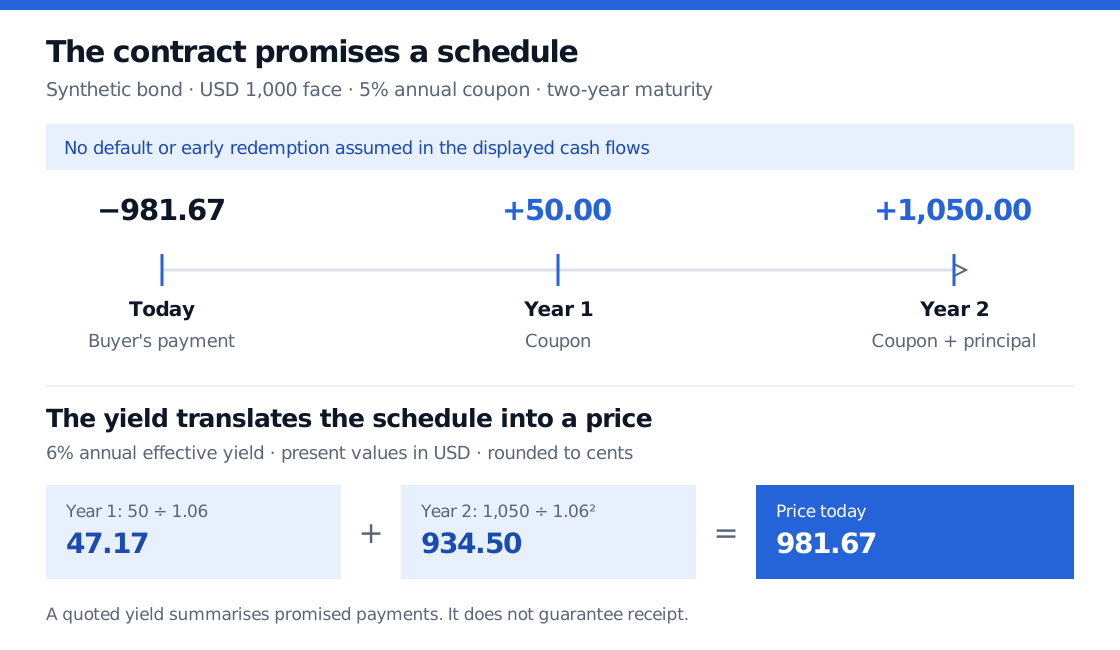
Original synthetic illustration. Annual payments and annual effective yield; USD amounts rounded to cents. The displayed receipts assume no default or early redemption and are not guaranteed.
This calculation is a price–yield conversion for the promised schedule. It does not estimate expected receipts after default. Nor is 6% automatically the realised compound return. If all promised payments arrive and the first USD 50 coupon is reinvested for one year at 6%, terminal wealth is , equal to using the unrounded price. Different coupon reinvestment rates change terminal wealth; an early sale makes the sale price part of the return.
The Bonds and Yields lesson develops the coupon–price–yield distinction and explains clean versus dirty prices. It has a public preview; the full lesson requires membership.
Read the claim before comparing the yield
A company name and a coupon are insufficient to identify the credit exposure. Read the prospectus, the bond's terms and the underlying contract, often called an indenture in US issues. Five questions change what the holder is buying:
| Question | Why the answer matters |
|---|---|
| Which legal entity owes the money? | A parent company and its subsidiaries are separate obligors. A familiar group name alone does not give a claim against every group company. |
| Is there collateral, subordination or a guarantee? | Secured debt has rights over specified collateral; senior unsecured debt has no specific collateral pledge. Subordinated debt ranks behind the claims specified in its terms. A guarantee adds a claim against a named guarantor subject to its scope, enforceability and ability to pay. |
| Which covenants apply? | Covenants may restrict additional borrowing, asset transfers or other actions, or require reporting. Protections, exceptions, cure periods and remedies vary; do not assume every issue limits leverage. |
| What can change the payment schedule? | Floating rates, coupon deferral, conversion rights and principal amortisation can materially change the cash flows. |
| Can the issuer redeem early? | A callable bond permits redemption under stated conditions. Call dates and prices, including any make-whole formula or later par-call period, matter alongside final maturity. |
Seniority concerns priority, not a fixed recovery rate. Under the US framework discussed by Fabozzi and Fabozzi, bond claims generally rank ahead of equity, but the outcome also depends on collateral value, other creditors, the obligor and the bankruptcy process. Even a senior secured bond can lose money. Other jurisdictions and particular structures require their own analysis.
A real filing shows why these distinctions matter. Apple's 1 February 2021 prospectus supplement described its notes as senior unsecured, with claims behind subsidiary creditors against subsidiary assets and behind secured creditors to the extent of collateral value. It also disclosed no financial covenants and permitted optional redemption under specified terms. These are terms of that historical offering, not assumptions to apply to every Apple bond or a statement of its current credit quality. See the filing's Risk Factors and Description of the Notes.
The risks can move separately
Default risk is the possibility of missing promised interest or principal; contractual breaches can also be events of default under the applicable terms. A rating is an assessment of credit quality, not a guarantee. Interest-rate risk can lower the bond's market price even when the issuer's finances are unchanged. Liquidity risk affects how readily and at what cost it can be sold. For callable debt, redemption can also force the holder to reinvest sooner than expected. The SEC's corporate-bond bulletin introduces these contractual and market risks.
A credit spread compares a bond's yield with a specified benchmark. A wider spread can lower its price without a default occurring. It is not a default probability: interpreting it requires a model with assumptions about recovery, payment timing, liquidity and risk compensation, as well as the probability measure. Two bonds with the same yield can therefore offer quite different claims and risks.
Practice: income versus investment return
You buy a different synthetic corporate bond for USD 990. It has USD 1,000 face value and a 4% annual coupon. Exactly one year later, it pays the full coupon and you immediately sell it for USD 960. There is no accrued interest at either transaction; ignore fees and taxes. What is your one-year total return?
- A. 4.00%
- B. −3.03%
- C. 1.01%
- D. 0.00%
Answer. C. The coupon is . The net gain is , so the return is . A confuses coupon rate with investment return. B counts only the price loss and omits income. Receiving the coupon does not prevent a price loss, and a price loss alone does not establish that the issuer defaulted.
Sources
- Frank J. Fabozzi and Francesco A. Fabozzi, Bond Markets, Analysis, and Strategies, 10th edition, MIT Press, 2021. Chapters 2–3 on present-value pricing, yield measures and reinvestment; Chapter 8 on corporate debt, seniority, redemption and covenants (local PDF pages 252–254 and 262–265).
- SEC Office of Investor Education and Advocacy, What Are Corporate Bonds?, 4 June 2013, checked 25 October 2026. US investor overview of corporate debt and its risks.
- Apple Inc., Prospectus Supplement dated 1 February 2021, especially pages S-6–S-7 and S-11–S-12. Historical issuer evidence for ranking, covenant limitations and optional redemption.