The matching adjustment (MA) and volatility adjustment (VA) modify the risk-free discount curve used to value insurance obligations for solvency purposes. The MA draws on the assets an insurer assigns to match a specific portfolio of obligations. The VA starts from bond spreads in a representative reference portfolio for the currency. A positive adjustment lowers the present value of a fixed schedule of net outflows and therefore lowers the best-estimate liability for that schedule. An obligation can receive at most one of the two adjustments. EU Solvency II Directive, Articles 77 and 77b–77d, PRA Technical Provisions, Chapter 8
What earns the matching adjustment?
Consider an insurer that pays monthly annuities. If its assigned assets bring in cash when benefits fall due, it has less need to sell bonds at depressed prices. In both the EU and UK, use of the MA requires supervisory permission and a separately managed portfolio of eligible obligations and backing assets. Expected asset cash flows must replicate expected payments in the same currency, with any mismatch small enough to avoid material risk. Matching the average duration of the two portfolios can still leave a cash shortfall on a particular payment date. EU rules generally require fixed asset cash flows, with exceptions for matching inflation-linked payments and for changes backed by sufficient reinvestment compensation. EU Solvency II Directive, Article 77b, UK Prudential Requirements Regulations, regulation 4
The MA calculation compares two annual effective rates fitted to the same liability cash flows. One rate reproduces the value of the qualifying assigned assets and the other reproduces the liability value under the basic risk-free curve. The difference is the starting point. The calculation excludes the fundamental spread, which reflects retained risks such as default and losses from downgrades. A wide quoted credit spread can therefore come with a substantial risk deduction. EU Solvency II Directive, Article 77c, UK Prudential Requirements Regulations, regulations 5–6
Under Solvency UK, the Prudential Regulation Authority (PRA) also allows certain assets with highly predictable cash flows. The contract must bound the variability of payment timing and amounts, and a failure to meet those terms constitutes default. In aggregate, these assets can contribute at most 10% of the MA benefit, and the insurer adds to the fundamental spread for the extra uncertainty. Since 27 October 2025, a separate Matching Adjustment Investment Accelerator permission has allowed existing MA users to include a limited amount of eligible assets with features outside their current permission before applying to vary it. The firm has 24 months from inclusion to file the variation or take steps to remove the asset. PRA Matching Adjustment, Chapters 5, 8 and 14–16, PRA PS17/25
What does the volatility adjustment absorb?
If market spreads widen while the basic risk-free curve and projected insurance payments stay flat, bond prices can fall with little immediate change in the unadjusted liability value. If the VA rises, the adjusted discount rate also rises, so the fall in the liability value can partly offset the asset decline on the solvency balance sheet. The offset depends on how the reference portfolio and the insurer's actual assets respond to the spread move. A cash shortfall can still force bond sales during stress. PRA SoP13/24, paragraphs 2.3–2.8 and 2.30–2.31
- EU as of November 2026. The currency component is 65% of the spread on a representative portfolio for that currency after a correction for credit and other risks. A country increase can apply under separate conditions. Member States may require prior approval. EU Solvency II Directive, Article 77d
- EU from 30 January 2027. The revised rules use an 85% factor multiplied by the insurer's credit spread sensitivity ratio and the risk-corrected currency spread. A euro macro component replaces the old country increase. The general rule requires prior approval. Firms that were using the VA before 29 January 2026 may continue without prior approval if they satisfy the approval conditions from 30 January 2027. Directive (EU) 2025/2, Articles 1(41) and 4, Delegated Regulation (EU) 2026/269
- UK under Solvency UK. The VA is available with PRA permission. A firm uses the adjustment published by the PRA within the scope of its permission. The published UK measure is currency-based and equals 65% of the risk-corrected currency spread, using reference portfolios representative of UK insurers' holdings. PRA Technical Provisions, Chapter 8, PRA SoP1/20, paragraphs 2.1C and 3.8–3.15
One payment, two valuations
Suppose a fictional liability pays 105 currency units exactly one year from now. Take a basic annual effective rate of 3% and assume an illustrative adjustment of two percentage points. The discount rate rises to 5%.
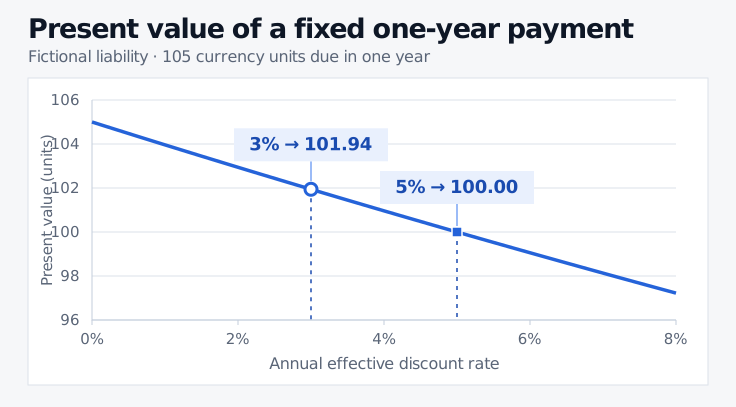
The curve traces the present value of the same payment over a range of illustrative rates. The two markers isolate the effect of a two-percentage-point increase.
The 1.94-unit fall comes entirely from discounting. The 105-unit payment remains due in one year. For a schedule of payments, each payment uses the rate for its own maturity. The SelfMadeQuant lesson Bond Prices, Discount Factors, and the Law of One Price works through that calculation for an annuity. The preview is public and the full lesson requires membership.
Sources
- European Union. Solvency II Directive 2009/138/EC, Articles 44 and 77–77e, consolidated 17 January 2025.
- European Union. Directive (EU) 2025/2, Articles 1(40)–(42) and 4.
- European Commission. Delegated Regulation (EU) 2026/269, rules for the revised credit spread sensitivity ratio and application date.
- UK Treasury. Insurance and Reinsurance Undertakings (Prudential Requirements) Regulations 2023, regulations 3–6.
- Prudential Regulation Authority. Matching Adjustment and Matching Adjustment Investment Accelerator, PS17/25.
- Prudential Regulation Authority. Technical Provisions, Chapter 8, and Volatility adjustment permissions, SoP13/24.
- Prudential Regulation Authority. The PRA’s approach to the publication of Solvency II technical information, SoP1/20, effective 29 July 2026.
- Bank of England. Technical information for Solvency II firms, VA reference portfolios.