A tax rate reconciliation is the tax-note bridge from the tax expense implied by a reference rate on pretax book profit to the expense reported in the income statement. Its individual lines help explain whether a low effective tax rate is likely to carry into an earnings forecast. A recurring credit and a one-time tax benefit can produce the same headline rate. IAS 12, paragraphs 81(c) and 84–86
From 25% to 24%
Suppose a fictional company earns USD 200 before tax and uses a 25% reference rate. Expected tax is USD 50. Book profit already includes a USD 8 penalty that the tax rules never let the company deduct. Adding it back gives USD 208 of taxable profit and USD 52 of tax before a USD 4 credit. Assume the company can use the full credit and has no deferred tax or other adjustments in this example.
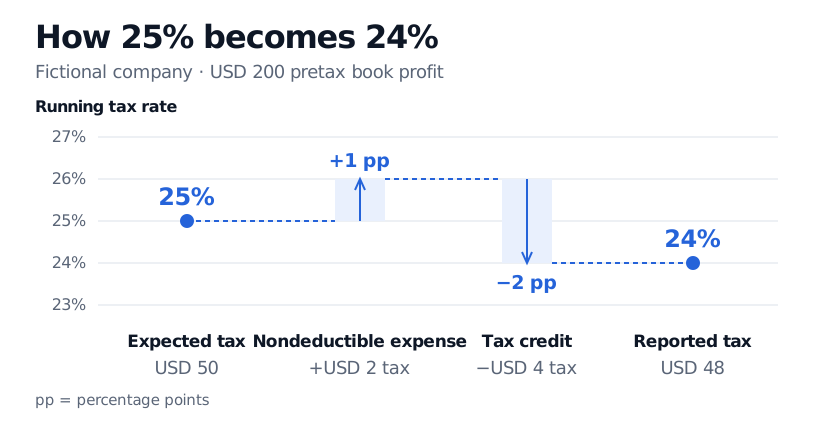
Each step shows the same tax effect in dollars and in percentage points of pretax book profit.
Divide each tax adjustment by the same USD 200 to translate the dollar bridge into rate points. The penalty line is USD 2 because it shows the tax effect of losing the deduction. Dividing reported expense by taxable profit instead would answer a different question.
Check the reporting basis
IFRS. IAS 12 requires a numerical bridge and allows amounts, rates or both. The company explains the basis of its reference rate. A multinational may use its home-country rate or aggregate separate reconciliations at local rates. Under the latter approach, the difference between home and foreign rates can already be reflected in the starting figure. IAS 12, paragraphs 81(c) and 84–86
US GAAP. ASC 740, as amended by ASU 2023-09, requires an annual table in currency amounts and percentages for public business entities subject to income tax. It uses continuing operations on both sides of the bridge and starts from the federal or national statutory rate in the country of domicile. Its eight categories cover state and local tax net of federal effects, foreign effects, newly enacted changes in tax laws or rates, cross-border tax rules, credits, valuation allowances, nontaxable income or nondeductible items, and changes in unrecognised tax benefits. The amendments apply to annual periods starting after 15 December 2024 for public business entities and after 15 December 2025 for other entities, with early adoption allowed. Other entities describe significant categories and jurisdictions qualitatively. FASB ASU 2023-09, ASC 740-10-50-12 through 50-13 and 65-9
For specified items, the US disclosure test compares the size of each tax effect with 5% of the absolute value of expected tax. General materiality guidance still applies. Applied to the fictional bridge, that is USD 2.50. The USD 4 credit meets the threshold for disclosure by nature. The USD 2 penalty can sit within its broader category. For foreign effects, a country that meets the threshold is shown separately, as are individual items that meet it, even in countries below the threshold. The note identifies the state and local jurisdictions that together account for more than half of that category’s effect. FASB ASU 2023-09, ASC 740-10-50-12A, 50-12B, BC22 and BC35
Forecast expense and cash separately
The bridge covers current and deferred tax expense recognised in earnings. Before carrying an item forward, read what generated it. A recurring credit may move with qualifying spending. A change in the recoverability of deferred tax assets can change tax expense today, with any cash benefit arriving when the company uses the deduction. Near break-even, even modest tax adjustments can make the effective rate swing because pretax profit is so small. Compare the dollar effects across periods as well. IAS 12, paragraphs 5, 56 and 79–86
For a cash forecast, start with the cash flow statement and the cash taxes disclosure. Even current tax expense can differ from cash taxes when payments and refunds fall in different periods. The US update requires a federal, state and foreign split of cash taxes. It separately identifies a jurisdiction when the magnitude of its net payment or refund reaches 5% of the magnitude of total income taxes paid net of refunds. IAS 7, paragraphs 35–36, FASB ASU 2023-09, ASC 740-10-50-22, 50-23 and BC70