A synthetic credit rating is a model-implied credit rating estimated from a borrower’s financial characteristics. One common method compares an unrated issuer’s interest coverage with the ranges observed for rated firms. The resulting grade gives a starting point for estimating the issuer’s cost of debt when comparable borrowing terms are hard to observe. Damodaran, Estimating a synthetic rating and cost of debt
Three times coverage, two nearby grades
In the basic lookup, interest coverage is earnings before interest and taxes (EBIT) divided by interest expense for the same period. A fictional large non-financial issuer earns USD 18 million in annual EBIT and records USD 6 million of annual interest expense, measured as a positive cost.
Choose the calibration before looking up the grade. Damodaran’s methodology illustrates different bands for smaller and larger firms, and his January 2026 web table separates large non-financial firms from financial firms, for which it specifies long-term interest coverage. An identical multiple can imply a different grade under a different calibration. Damodaran, methodology and Tables 8.5–8.6 · Damodaran, January 2026 table
In the January 2026 large non-financial table, the BBB row ends at 2.999999× and the A− row starts above 3× under the printed greater-than sign. The printed bounds leave exactly 3.00× unassigned. Keep the USD 6 million interest bill fixed and test two values clearly inside the neighbouring rows. EBIT of USD 16.8 million gives 2.80×, mapping to BBB and 111 basis points. EBIT of USD 19.2 million gives 3.20×, mapping to A− and 89 basis points. Both spreads are January 2026 table estimates. Damodaran, January 2026 table, large non-financial firms
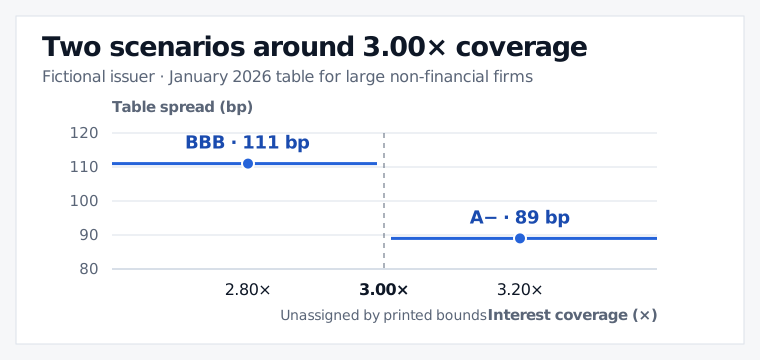
With annual interest fixed, a change in operating earnings can move the issuer to a different row and change the estimated spread in one step.
Adding each table credit spread to a hypothetical 4.00% annual benchmark gives pre-tax borrowing estimates of 5.11% in the lower-coverage case and 4.89% in the higher-coverage case. In a valuation, match the benchmark to the intended debt’s currency and maturity. A market spread uses an observed bond yield or financing quote and can differ from the lookup spread with changes in liquidity, collateral or embedded options. Exercise 1(a) in the SelfMadeQuant lesson works through the market calculation from a corporate bond yield and a matched Treasury yield. Cleveland Fed, Credit Spreads and Subordinated Debt · Credit-Sensitive Bonds, Ratings, and Spreads, full lesson for members
When the inputs tell only part of the story
Use the same earnings and interest definitions as the calibration. A one-off operating gain can inflate EBIT, so check whether it belongs in a measure of recurring earnings. If the model treats leases as financing, reconcile the lease adjustment to both EBIT and interest and check what the accounts already include. A zero denominator leaves coverage undefined. If reported interest is negative, check the expense sign and whether the line nets interest income against borrowing expense. Use a comparable positive expense if one exists. If it does not, leave the ratio unmapped. Damodaran, Estimating Synthetic Ratings, lease adjustments
Interest coverage uses accounting earnings and omits scheduled principal. An issuer at 3.00× can still face a cash shortfall if a large maturity falls before collections arrive. Use the debt service coverage ratio with cash available and the debt payments due for the relevant period, then check the actual payment dates and available liquidity. The lookup grade depends on its inputs and table. An agency rating is a forward-looking opinion that also weighs factors such as business resilience, capital structure and access to funding. S&P Global Ratings, Understanding Credit Ratings, methodology
Sources
- Aswath Damodaran (NYU Stern), Estimating a synthetic rating and cost of debt
- Aswath Damodaran (NYU Stern), Ratings, Interest Coverage Ratios and Default Spread, January 2026
- Aswath Damodaran (NYU Stern), Estimating Synthetic Ratings
- S&P Global Ratings, Understanding Credit Ratings
- Federal Reserve Bank of Cleveland, Credit Spreads and Subordinated Debt