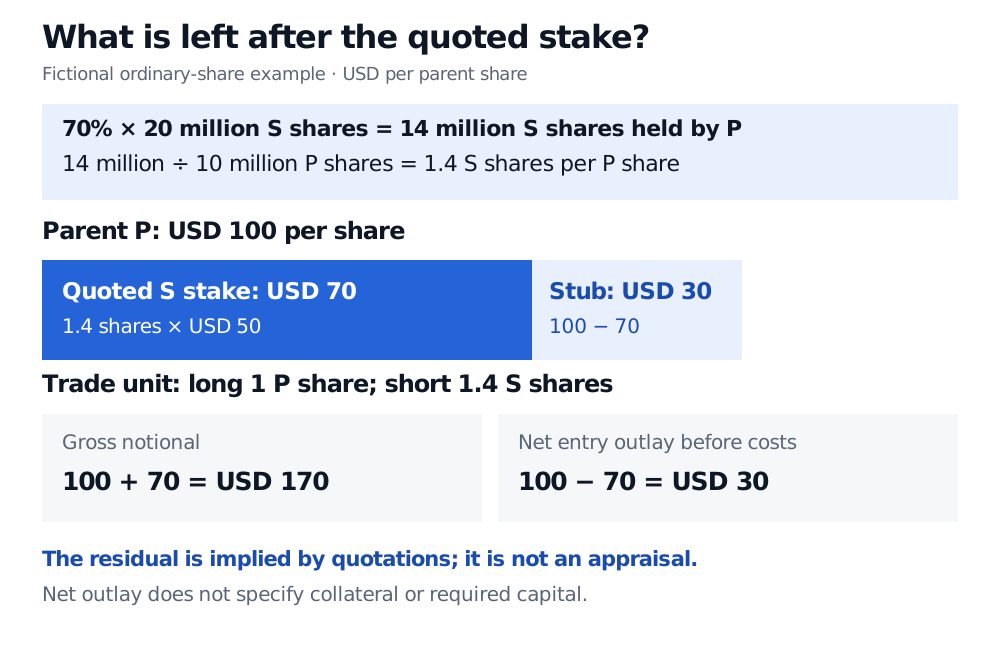
Stub trading offsets a parent shareholding with its listed subsidiary stake. Calculate the ownership hedge, implied residual and P&L, then distinguish a negative stub from executable arbitrage.
Stub trading
Stub trading combines a position in a parent company with an offsetting position in its separately listed subsidiary to isolate the parent's implied residual equity value. A common construction buys the parent and sells short the number of subsidiary shares represented by each parent share. The quant task is to measure the ownership correctly and attribute the package's gains and losses to the residual, costs and corporate events.
Here, stub means the remainder after subtracting the quoted subsidiary stake. It is unrelated to a short or long first coupon period on a bond.
Subtract a stake, not the entire subsidiary
An equity carve-out can leave a parent owning a large block of a subsidiary whose other shares trade publicly. That provides a market quotation for one component of the parent. It does not make the parent and subsidiary interchangeable securities.
Consider fictional companies Parent P and Subsidiary S. All prices are USD, both have one ordinary share class, and the ownership and share counts below remain fixed during the example.
Input
Parent P
Subsidiary S
Share price
100
50
Shares outstanding
10 million
20 million
P's ownership of S
—
70%, or 14 million shares
One P share represents an indirect holding of
h=10 million0.70×20 million=1.4
S shares. The subsidiary stake is therefore worth USD 70 per P share. Define the implied stub per parent share as
V=P−hS=100−1.4(50)=30,
where P and S denote the two share prices. At company level, the same subtraction is USD 1 billion of parent equity less USD 700 million of subsidiary stake: USD 300 million, divided among 10 million parent shares.
The ownership percentage, 70%, is not the share hedge ratio. Shorting 0.7 S shares for each P share would remove only half the look-through shareholding in this example. Subtracting S's entire USD 1 billion market capitalisation would make a different error: P does not own the outside shareholders' 30% stake.
Fictional parent equity of USD 100 per share consists arithmetically of a USD 70 quoted subsidiary stake and a USD 30 implied stub; buying one parent share and shorting 1.4 subsidiary shares gives USD 170 gross notional and USD 30 net entry outlay before collateral and costs.
Original fictional ownership bridge. The USD 30 remainder is an implied equity residual, not an independently appraised operating-business value.
This subtraction is a starting point for sum-of-the-parts valuation. The remainder bundles other operations, parent-level net debt, possible taxes, holding costs and any discount or premium embedded in the quoted parent price. Subsidiary equity already sits behind the subsidiary's own liabilities; adding consolidated debt mechanically can count some obligations twice. Identify which liabilities belong to the residual before comparing it with an operating-business valuation.
What the two legs actually isolate
For each long P share, short 1.4 S shares. Entry notionals are USD 100 long and USD 70 short: gross exposure of USD 170 and an arithmetic net purchase outlay of USD 30. Short proceeds can be restricted, and both legs can require collateral. USD 30 is neither a stated margin requirement nor a return denominator.
Suppose S rises from USD 50 to USD 55 while the implied stub stays at USD 30. Then P must be USD 107 under this decomposition:
P1=30+1.4(55)=107.
The long earns USD 7 and the short loses USD 7, so the package's price P&L is zero. With fixed h, no distributions and no costs,
ΔΠ=ΔP−hΔS=ΔV.
This is a price-accounting identity. It does not establish that P will actually move by USD 7 when S rises by USD 5. If P instead ends at USD 103, the package loses USD 4 and its implied stub falls to USD 26. The residual can move with the subsidiary, the broad market or parent-specific news. An ownership hedge is not automatically market neutral.
Dividends, financing, borrow fees and trading costs require separate cash-flow entries. Changes in shares outstanding or in P's stake require a new ownership calculation; the fixed-ratio identity cannot silently span a sale, dilution or distribution.
A negative number is a question to investigate
If P were quoted at USD 60 while S stayed at USD 50, the same calculation would give an implied stub of minus USD 10. That describes the relative quotations; it does not prove that the remaining businesses have negative enterprise value or that a free arbitrage is executable.
Lamont and Thaler's research on technology carve-outs documents the importance of expensive or unavailable subsidiary shorts. A displayed negative stub need not survive implementation costs. Their historical cases are evidence about those episodes, not a current return forecast. Original working-paper abstract.
Mitchell, Pulvino and Stafford's broader parent–subsidiary study explains why convergence itself is uncertain: corporate events can break the ownership link, and an adverse price path can force an early unwind. An intended distribution may be delayed or cancelled. Their study also distinguishes the simple equity-minus-stake measure used here from residual estimates adjusted for other net assets and liabilities. Original paper, §§I–IV.
Before treating a negative residual as cheap, the substantive questions include:
Can the short remain open? Availability, fee changes and recalls affect both cost and the ability to wait.
What would shareholders receive? A possible spin-off needs an actual distribution ratio and terms. Corporate ownership of 1.4 shares per parent share does not itself promise that shareholders will receive 1.4 shares.
What claims absorb the remainder? Parent debt, guarantees, holding costs and potential taxes can prevent the quoted stake value from passing intact to common shareholders.
What ends the trade, and when? A sale, takeover, financing transaction or changed distribution plan can alter the payoff. A widening residual discount can create funding needs before any hoped-for convergence.
These questions connect the arithmetic to a feasible holding period. A cheap-looking remainder and the ability to hold a hedged position are separate inputs.
Follow the corporate action through
Equities, Indices and Corporate Actions explains share-count adjustments and spin-off mechanics, which help keep the ownership calculation consistent across events. The public page is a preview; the full lesson requires membership.
Sources
Lamont, O. A. and Thaler, R. H., Can the Market Add and Subtract? Mispricing in Tech Stock Carve-Outs, working-paper abstract and bibliographic record. Historical carve-out evidence and short-sale constraints.
Mitchell, M., Pulvino, T. and Stafford, E. (2002), Limited Arbitrage in Equity Markets, Journal of Finance 57(2), 551–584. §§I–IV distinguish residual measurement, capital requirements and convergence risks.